Audio Version Of The Blog – 11/20/24
Posted on November 20th, 2024
Listen to an Audio Version of the Blog
Download:MP3Audio

Listen to an Audio Version of the Blog
Download:MP3Audio

Talks about the Steps of the Ladder, Part 2
What in Prayer Is Under a Person’s Control?
It is written: “I have labored and found.” The effort is under a person’s control, but the outcome is not. Why? It is because we are working on our soul without knowing its structure or its paths of development. We only need to try, to apply effort, both in quantity and quality; we do not need to worry about the results, the path, or the events that we might encounter. We should not worry about the pace of our progress or our ultimate form. This is because we not only do not know our final form, but in every new state, we have no idea where we will arrive. Even a great Kabbalist like Rabbi Shimon Bar-Yochai knew that he was ascending to the level of the final correction (Gmar Tikkun) only because he recognized its posterior side. If he had not seen its posterior, he would not have known what level he was about to reach. A new state awakens at every moment. It is born out of an internal memory called a “Reshimo” (record).
People think that a Kabbalist knows and sees everything from the beginning until the end of the world. A Kabbalist, however, only knows what they have traversed on their spiritual path. They know what they have attained up to their current level, and not what they have not yet experienced. Therefore, spiritual levels are referred to as “ascents” and “discoveries,” discoveries of what was previously unknown.
In a spiritual ascent, the effort should thus be aimed above our current understanding, against the understanding and thoughts in our present state. This is always the relationship of the lower level to the higher level because the posterior side of a higher level is darker and less corrected than the lower level.
Effort itself holds no indication of the result. It has no direct correlation to the greatness of the goal. A person labors on a certain matter and receives a result that they never expected because each time a new part of their soul becomes revealed that was previously hidden from them.
Related Material:
Talks about the Steps of the Ladder, Part 1
 Love is when you go out to eat and give somebody most of your French fries without making them give you any of theirs (Chrissy, age 6).
Question: Is this love?
Answer: Yes, it is love.
Question: Why, can you explain as if you were to explain this to the child?
Answer: Because he is giving away something he himself likes. It feels good for him to have it, but he gives it away.
Question: Is that a simple answer? I really want to eat it, but I give it to my friend. And this is called love?
Answer: Yes, that is love.
Comment: Another answer from the group of children who were asked what love is:
Love is what makes you smile when you are tired (Terri, age 4).
My Response: That is also love. Because by doing that, you uplift another person, elevate them, make them feel good against their will.
Question: So you are associating this with smiling for another person?
Answer: Yes.
Love is when you tell a guy you like his shirt, then he wears it every day (Noelle, age 7).
My Response: This speaks more about the love of the boy who wears the shirt toward the one who complimented it.
Question: Why is that love?
Answer: Because the boy who wears the shirt wants to please the one who likes it.
You shouldn’t say ‘I love you’ unless you mean it. But if you mean it, you should say it a lot. People forget (Jessica, age 8).
My Response: I don’t think such behavior should be taught to a child.
Question: But this is the child’s answer, an eight-year-old child. So if you do not love, should you say that you do?
Answer: No, you should not lie.
Question: And if you love, should you say that you do?
Answer: Probably, yes, but I think even in that case, not entirely.
Comment: The winner of the contest to find the most caring child judged by Leo Buscaglia was a four-year-old boy whose next door neighbor was an elderly gentleman who had recently lost his wife. Upon seeing the man cry, the little boy went into the neighbor’s yard, climbed onto his lap, and just sat there. When his mother asked the boy what he said to the neighbor, the boy replied: “Nothing. I just helped him cry.”
My Response: These are somewhat unbelievable stories for a four-year-old child.
Question: But helping someone cry, what do you think about this moment of compassion?
Answer: It is good.
Question: Does it really help?
Answer: Of course!
Question: So the child sits down, looks at you, and cries with you?
Answer: Yes, but that is too much. It is somewhat unreal.
Question: I see. So here is a question: where does all this go afterward? Even all these answers—they contain such childlike purity. Where does it go? How do we become haters, warriors, killers, criminals? Where does the child inside us go? This child who grew up like this?
Answer: Egoism grows and consumes everything there is.
Question: And that is it?
Answer: That is it.
Question: Does this child remain in us or does it also…?
Answer: There is a possibility to start developing anti-egoistically, to suppress this ego within us.
Question: Can we return to this child even a little?
Answer: Yes, but it will not be a child anymore.
Question: Is it an adult child then?
Answer: Yes.
Question: When you say that an old man is like a child. A wise person is like a child. What do you mean when you say that? That the child does not die in us, that it remains?
Answer: Yes, the child does not die in us and remains because we desire to experience nature and life directly, like children.
Question: Is there this spontaneity in these answers?
Answer: Yes.
[327739]
From KabTV’s “News with Dr. Michael Laitman” 3/25/24
Related Material:
Bestowal For The Sake Of Bestowal: A Clean-Up State
Love Is A Two Way Street
Awe and Love
 Question: A fish asks God, “Lord, can you make the ocean smaller?” “Why?” God is surprised. “Because I don’t know how to swim.” God replies, “Learn to swim, and the ocean will seem smaller to you.”
We live in this world and often complain about life. Essentially, we do not know how to swim in this ocean of life. How can we learn to swim?
Answer: We do not have any natural abilities for it. We were created in egoism. We can criticize each other, but we rarely think well of one another. Achieving a state where each person is a friend, companion, and brother to others is, in essence, a fantasy.
Question: Then, why did the Creator fill this “aquarium” and place us in it like fish without teaching us how to swim?
Answer: He gave us the opportunity to learn on our own.
Question: What does this give me?
Answer: It gives us the chance to be the creators of our own lives.
Question: So, I am essentially a human with “fins” and “gills,” equipped for this water, but I do not know how to swim?
Answer: Yes.
Question: Do I need to develop these “fins and gills”?
Answer: Yes.
Question: How and when do we come to understand this?
Answer: We understand it when we have no other choice. Either we line up and march toward the cliff or learn to swim.
Question: So do we need to be brought to this dead-end?
Answer: Yes.
Question: How should we correctly perceive this ocean of life?
Answer: It is open before us. It all depends on how we relate to each other. That is still a problem. We always think that if others do well, it will somehow be worse for us.
How can one convince a person that this is not the case? On the contrary, let us work on ourselves so that everyone feels good and you feel good with everyone, and everyone feels good with you. But people resist this idea.
Question: So even here, the fish asks God, “Make the ocean smaller.” It does not say, “Give me the ability; teach me to swim.” So, we are not asking, “Teach us to swim in this ocean.” We are not asking this of the Creator, or are we?
Answer: No.
Question: Are we asking for the ocean to be different?
Answer: Yes.
Question: Is this also inherent in us?
Answer: Of course it is inherent in us! We cannot change ourselves. Our egoism is truly the opposite of nature.
Question: What does it mean spiritually to learn to swim?
Answer: Spiritually “learning to swim” means feeling the sea of the Creator’s love around you and knowing how to remain in it.
Question: In this love?
Answer: Yes, and when we finally learn to move our arms and legs a little, we will start to understand that we know how to swim.
But we can truly learn to “swim” only when we turn solely to the Creator. Because the sea, the ocean, the waves, the sky, the earth, everything, is Him. We need to learn to be within Him. And to be within Him means to exist in the qualities of bestowal, love, and connection with everyone. That is what it means to learn to “swim.”
[336483]
From KabTV’s “News with Dr. Michael Laitman” 10/14/24
Related Material:
Where Will the River of Life Take Us?
Live and Rejoice!
Like Fish In A Sea Of Light
 Comment: The nightingale sang to a rose every night. One day, the rose asked: “Why are you singing to me?” The nightingale replied: “Because you are beautiful.” The rose thought about it and said: “But I am poking you with my thorns, with my spikes.” “Such is your beauty,” said the nightingale, “Without thorns you would not be so lovely.”
My Response: Clearly, the nightingale…
Question: Is in love?
Answer: Yes, he can sing and whistle.
Question: Please tell me, why do thorns add beauty? Why do they enhance beauty for the nightingale?
Answer: Because he loves.
Question: Does he love being pricked?
Answer: He loves and therefore loves even the thorns.
Question: So love is blind?
Answer: It is not blind, it evens everything out.
Question: Do you think marriage without thorns, in constant love and friendship, is possible?
Answer: If two idiots come together and somehow decide between themselves how to live, then, of course, they can fantasize.
Question: But will life proceed with thorns?
Answer: Yes, absolutely.
Comment: So you think it is impossible to live like…
My Response: No, of course not. What do we live for? We live to learn how to live with thorns. If everyone is an egoist, then what can there be? They should have a special wisdom to understand that it is better to force themselves to live peacefully and wisely.
Question: Above the thorns?
Answer: Above the thorns.
Question: But must there be thorns?
Answer: Yes.
Question: Please tell me how to love a wife with thorns? She has spikes, she humiliates you. That is how it is for you. She brings you down, and makes fun of you. How can this work? But you say it is still possible.
Answer: You must understand her. She had a certain childhood, a certain upbringing and qualities of character. I think you should not concentrate on being pricked like that.
Question: What will this understanding of the reasons give me? I am in pain.
Answer: No, you will begin to understand these are all her natural reactions that she has no control over.
Question: Can I cover it all with love? Is this what they call “covering with love?”
Answer: Yes, love covers all flaws.
Question: Tell us please, can we artificially create “spikes?” Take a couple, that is, as you say, “thornless.” Can I act out “spikes”?
Answer: Yes.
Question: In order to increase love?
Answer: For this you have to be wise.
Question: Do you call this wisdom?
Answer: If one uses the weakness of another in order for these weaknesses to lead to even greater contact between them, then this is wisdom.
Question: So if I want to introduce some kind of “thorns” in order for us to have more contact, so love would somehow increase between us—is all this necessary?
Answer: Sure.
Question: I will ask a general question. We usually reveal everything up to the global level. I wonder if a person lives in some country. This country is pricking people all the time with taxes, wars, poverty, all kinds of humiliation. But one continues to live there and says it is beautiful, and he loves it, and this is his homeland. What is it?
Answer: So he loves it. That is, even if it is all seemingly so, he feels this way.
Question: Does he feel it?
Answer: Yes, he feels it is all bad, disgusting, cruel, and so on; all the same, deep down he is attached to it and loves it.
Question: Then can you reveal the concept of love again? Now you said “he loves.” What does it mean?
Answer: Love is when, despite everything, in all the relationships between one and the other—it does not matter if it is a man, a country, a woman, a family, no matter what—love is when you value another person’s modulus. It is like in mathematics when you do not take into account whether it is a plus or a minus.
Question: Is it possible to live like this?
Answer: I see it is possible sometimes. And this is called love.
[334206]
From KabTV’s “News with Dr. Michael Laitman” 8/12/24
Related Material:
Create Your Love
A Person Who Is Loved Is Always Beautiful!
“As The Lily Among Thorns”
 Question: Is there any way to measure development in the ten? For example, such and such a relationship in the ten is the first grade of education. The manifestation of other relationships is the second grade of study, etc. Do I know that for the first ten years of working in the ten, I spent in the first grade, the second ten years in the second grade?
Answer: You have to feel it for yourself. I cannot tell you anything because it cannot be expressed in words. That is, when you start to see, not just feel, but compare your possible states, then you can talk more specifically about your feelings.
And so there is nothing to talk about, like with a baby with whom they are cooing and that is it. So let us hope that soon you will start babbling.
Question: Is there any sensory parameter that you can rely on? Let us say I cannot get up for class, which means I am in second grade; I cannot talk to my friends, which is a plus for me, third grade.
Answer: There is no such thing. At each stage, in each state, negative and positive forces manifest themselves, and in this way you adapt them to yourself, and learn from your own experience. And to tell you in advance which classes you are taking will not help anyway. I can, for example, name all 125 steps that we should climb, but they will not tell you anything.
AB, SAG, Ibur, Yenika, Mochin, ascents, and descents—you study all this, but you still do not have adequate sensations, and therefore you do not know where you are. When the appropriate sensations come, you will immediately begin to give them names from what you have studied.
[336320]
From the Daily Kabbalah Lesson 8/28/19, “Questions and Answers”
Related Material:
What to Demand from the Ten?
Verify the Connection with the Creator
The Path Will Be Revealed Gradually
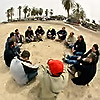 To reach the goal of creation, we need to unite among ourselves, become like one person with one desire, meaning with one heart, and think only about how to attain the goal.
This means revealing the Creator so that He manifests as the center of the spiritual system, and we realize what the purpose of creation is, what we live for, and what we exist for. This is the goal of our lessons.
Attainment of the Creator depends on our efforts, on the fact that we try not to miss lessons, that we are united with each other, that we write down the main points of the study, and that we ask questions on the topic. Thus, within a few months we will start feeling our connection, and the upper world at the center of this connection.
[336613]
From the Daily Kabbalah Lesson 11/3/24, “We have gathered here”
Related Material:
How to Achieve the Goal Faster?
Toward a Single Goal
A Quick Way To Feel Spirituality
 To become a partner with the Creator in the desire to bestow to others means that a person wishes to reach a state where they do everything to help people attain the quality of bestowal, that is, to transform their inherent egoistic desires into altruistic ones.
Therefore, the correct daily implementation of the connection between the ten and the Creator involves our striving to help everyone in the world draw closer to the quality of bestowal, to connection with others, and to collective correction.
Question: What should the ten hear from the Creator once they are connected?
Answer: They should hear how exalted the Creator is in His thoughts, how all-powerful He is in His actions, and how His actions influence everyone.
[336661]
From the Daily Kabbalah Lesson 11/4/24, Writings of Rabash, “Go Forth”
Related Material:
Bring Everyone Closer to the Creator
Helping Humanity Ascend
Doing Еverything For The Benefit Of Your Neighbor
Question: When we reach out through love of friends toward love of the Creator and it does not work, it is perceived as a failure, as a blow. How can this be justified and turned into a springboard for a new degree?
Answer: The entire ten should embrace and try to squeeze out all sorts of thoughts and feelings that prevent you from merging with each other.
Squeeze out all the bad, all negative emotions, like pus from a wound. It is purification when you fill the freed-up emptiness with a positive feeling.
[336629]
From the Daily Kabbalah Lesson 11/1/24, “Parashat Noah”
Related Material:
Springboard to the Final Correction
The Only Place To Meet The Creator
Network of Love
Preparation to the Lesson
 Video: Play Now | Download Video: Play Now | Download |
 Audio: Play Now | Download Audio: Play Now | Download |
1st part of the Lesson — Writings of Baal HaSulam, “Introduction to The Study of the Ten Sefirot,” Item 141/b>
| Video: Play Now | Download |
Audio: Play Now | Download |
2nd part of the Lesson — Lesson on the Topic “On the Verge of Lishma“
| Video: Play Now | Download |
Audio: Play Now | Download |
Selected Highlights
| Video: Play Now | Download |
Audio: Play Now | Download |
 Daily Audio Version-MP3
 Get the Weekly eNewsletter
 Follow on Twitter
