Audio Version Of The Blog – 7/31/25
Posted on July 31st, 2025
Listen to an Audio Version of the Blog
Download:MP3Audio

Listen to an Audio Version of the Blog
Download:MP3Audio
 Question: If Baal HaSulam says that the shattering essentially did not exist, does this mean that the desire to receive for oneself also does not truly exist?
Answer: It exists, but not in a revealed form.
We need to understand that our advancement is based on the fact that we reveal our states relative to uncorrected Kelim, and we therefore feel increasingly shattered. In this way, our state depends solely on what we are searching for within our current state, what we desire to attain.
In principle, it turns out that we draw closer to the shattered Kli and then start to analyze it in parts.
From there, based on the shattering between the parts of the Kli, we raise a prayer to the Creator so that He would help us come together, recognize the separation between us, and clearly see our entire path .
[346309]
From the 4th part of the Daily Kabbalah Lesson 7/15/2025, “The Ruin as an Opportunity for Correction”
Related Material:
Reconnect Every Day
Artificial Respiration
The Point Where The Creator Is
 Question: It is said that correction is only possible over the shattering. What kind of shattering should this be? What must we reveal in order to unite more?
Answer: We must reveal the very shattering in which we currently find ourselves. Only then will we be precisely aligned for its correction.
We need to understand what a corrected Kli is and what a corrupted Kli is, and compare the positive connection between the parts of a whole Kli and a shattered one.
Only then will we be able to feel within our own Kelim (our desires), what a shattered Kli and a corrected Kli truly are.
Then we will have a clear idea of what we need to ask of the Creator.
[346289]
From the 4th part of the Daily Kabbalah Lesson 7/15/2025, “The Ruin as an Opportunity for Correction”
Related Material:
The Shattering As An Opportunity For Correction
Ascending To The Breaking
Justify The Creator
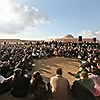 Gatherings of friends were implemented among Kabbalists throughout all centuries and were highly effective and popular. Kabbalists gathered together to discuss their spiritual work.
When I brought new students who had no connection to Kabbalah to my teacher, he began organizing them into groups of 10 to 15 people. He wrote articles for us, which we read at weekly meetings.
We would meet at one person’s house or another’s and study these articles together. That was what the gatherings of friends were about back then.
Today, after many years of studying Kabbalah, our gatherings of friends have taken on a different form. Our global group includes several thousand people around the world. That is why we hold large, unified gatherings for all our friends, with video broadcasts, translations into many languages, and so on.
Does this still count as a gathering of friends? I believe it is exactly what it should be because we place special emphasis on the connections between us.
It does not matter whether we study a specific article at these gatherings or not, since in principle, we do that during our regular lessons. What matters is that we try to draw even closer to one another because to the extent that we achieve sensory and conscious closeness, we come closer to the feeling of the Creator. That is the principle and goal of the gathering of friends.
[258275]
From KabTV’s “Fundamentals of Kabbalah. The Order of Gathering of Friends,” 3/11/19
Related Material:
Following Sound Logic
A Successful Gathering Of Friends
Contemporary Gathering Of Friends
 Question: A person does not always feel. Sometimes one does, and other times one does not. What difference does it make if one’s work is accompanied by feelings, or if a person works out of confidence, without sensations?
Answer: Where does a person’s confidence come from in that case?
Question: From faith in the sages, from what they describe in their books, or from faith in the teacher.
Answer: What is written in the books says nothing. If I feel that I am in it, it means I have mastered this degree.
[346475]
From the 3rd part of the Daily Kabbalah Lesson 7/21/2025, “The Ruin as an Opportunity for Correction”
Related Material:
Attain the Spiritual Degree
From Degree to Degree
Spiritual Attainment Is the Truth
 Question: You were always seeking the purpose of life. You were unsatisfied with this world. When you arrived in Israel, you found RABASH. What did you see?
Answer: It took me a while to get to RABASH. At first, I was introduced to people that I was told I could get answers to my questions from. I was asking about the meaning of life and searching for it.
I was sent to all kinds of religious figures who only told me to do this or that, to pray, and everything would be fine. But it did not suit me at all! I had a university education, and in general none of this was for me.
I got to RABASH by accident when, simply out of desperation, I decided to go with my friend to look for a teacher. We had been looking in different places before. But here I was struck by the fact that he began to explain what I was interested in, in simple words without relying on any dogmas or anything.
You can be a man or a woman, religious or not; you can be from any planet, no matter where. He would explain it the same way for everyone, because the truth is simple and the same for everyone! I was instantly bought.
Very clear, simple answers were given to any questions, which raised new questions and new answers. But it was all built, one might say, scientifically, although in front of me sat a man who did not have even a high school degree. But since he studied Kabbalah, he was well-versed in all my questions, and he always had the answers ready.
Question: What was going on in this small group of six people? How was it built?
Answer: At that time RABASH actually had six students who had studied under Baal HaSulam.
They had a very short conversation: “Let us sit down and study. No answers to your questions. There will be no end to them. You have to learn so that you can answer your own questions later.” There is no other way. Just like now with people who come to us, we can explain anything, answer however we want, but until they learn to answer themselves, nothing will happen.
All six elderly people had a very interesting attitude to life. They were not really interested in anything except Kabbalah. Otherwise, everything was very simple: plain food during meals, ordinary songs, etc. But the most important thing was that they had answers to questions that I, with all my education, could not have heard either from myself or others.
Question: You studied together, held meals and gathering of friends. How was it?
Answer: The lessons were held for us every day from three to six in the morning. In the evenings, there were one-and-a-half-hour lessons intended for all. They were attended by different people, not only those who studied in the morning.
We had meals for the new moon. The new moon is a special holiday for Kabbalists.
Question: Were there people responsible for the meals?
Answer: Yes, there were those responsible for everything.
Each month, a different person was appointed for the meals. After two months of studying, I said I was ready to organize a meal, i.e., to order, pay for, and set it up. Not six, but up to 60 people gathered for these meals.
Question: At what point did you feel you would teach?
Answer: I actually taught before that because sometimes I was invited to give talks at the Jewish Agency Sokhnut. I cannot say I was particularly attracted to it, but I did not mind; it inspired me. After all, if I teach, it means I have to prepare, study, and develop. It helped me study such things in Kabbalah that I would not have approached myself because I was not personally interested in them.
Question: Did you understand, purely selfishly, that you had to take everything from RABASH in order to pass it on? Did you have such a feeling?
Answer: Yes, absolutely. If you are sitting among six 70-year-old elders who say this science is about correcting the world and the world cannot exist without it, the question arises: who will continue to lead this science? It turned out that at that time, there was no one.
Therefore I immediately began to record everything I heard in a notebook and on a tape recorder. I could not stop thinking that I had to save all this and pass it on.
Before that, I had never heard the wisdom that I learned from them: the foundations of the world, the foundations of nature, and the interaction of its parts. It is nowhere to be found. That is why I immediately started writing everything down and organizing it.
Question: How did RABASH treat his students and outsiders?
Answer: RABASH liked to feel free, without revealing to anyone he was a great Kabbalist, an expert on nature and on the governance of the whole world. There was no indication of that. Outwardly he did not want to display anything.
He was surrounded by people who had worked all their lives at very simple jobs. RABASH himself worked laying roads, reinforcing concrete, and at construction sites; he carried stones, bricks, and laid walls. His students also worked hard, but in their old age they switched to easier work. In general, they did not want to stand out in the world; they did not need it.
Question: How did RABASH physically prepare for lessons?
Answer: I saw how, in his spare time, he went through the same material we studied in class. Lessons ended at six o’clock in the morning, and he would not even go to bed.
When I went to see him at nine in the morning to take him to the park or somewhere else, I often found him dozing on a book stand, with Talmud Eser Sefirot open in the place we studied. That is, he continued to study by himself.
Comment: RABASH’s group practically started with that revolutionary move when you brought 40 students to him. Despite the resistance of the religious town and religious relatives, he made this revolution; he accepted them.
And then he did something you did not expect from him. He started writing articles about the group.
My Response: The fact is that he started doing it at my request. When I brought the students, he asked me to talk to them. I did not know what to talk to them about. What can I tell them? Then he started writing, literally pieces, half a page, a page, etc.
Question: He wrote 20 articles that we are studying and will always study as we find more and more depth in them. Did he have any hope that the guys you brought would form a group?
Answer: Yes.
Question: But this hope did not really materialize?
Answer: He did not have much time. I brought people to him in 1983, and he died in 1991. Six years is a very short time for people to start interacting with each other properly. Of course, a living, true Kabbalistic group began to form, but it did not have time to fully form. It takes years.
Question: What happened after RABASH left?
Answer: Since I was always attached to him, not to the group, his death was a big blow to me. The source from which I grew and drank as from a spring was as if torn off.
The guys I brought to him were more or less connected to each other in different subgroups, as usually happens in groups of people united by circumstances or internal similarity.
But I had practically nothing to do with them.
Question: So your group was RABASH. Where did you, practically an individualist, later get the powerful desire to create a group? Where did you get the feeling this was the only advancement?
Answer: Because that is how it is. RABASH writes about it everywhere. He and I were also a group, two friends who constantly helped each other. This was a group. I cannot put it any other way. At least that is how he felt about it.
As for the other students, I think RABASH did not let me get close to them. It was probably enough for him that I was attached to him.
[256022]
From the 8th Lesson of the Congress in Moldova, 9/8/2019
Related Material:
In Him Is the Root of My Soul
Contact With Rabash
The Light of Rabash
Preparation to the Lesson
 Video: Play Now | Download Video: Play Now | Download |
 Audio: Play Now | Download Audio: Play Now | Download |
1st part of the Lesson — Writings of Baal HaSulam, Shamati #38 “The Fear of God Is His Treasure” (10.28.2021)
| Video: Play Now | Download |
Audio: Play Now | Download |
2nd part of the Lesson — Writings of Baal HaSulam, “Preface to the Wisdom of Kabbalah,” Item 72, 66 (7.12.2006)
| Video: Play Now | Download |
Audio: Play Now | Download |
3rd part of the Lesson — Lesson on the Topic “The Ruin as an Opportunity for Correction”
| Video: Play Now | Download |
Audio: Play Now | Download |
4th part of the Lesson — Writings of Baal HaSulam, “Introduction of The Book of Zohar,” “The Donkey Driver”
| Video: Play Now | Download |
Audio: Play Now | Download |
Listen to an Audio Version of the Blog
Download:MP3Audio
 Question: Why is the authority of the Creator experienced as some heavy burden that must be accepted with effort, as a yoke?
Answer: Because the authority of bestowal is directed against our will, against our ego. That is why we perceive it as a heavy load, as a burden.
First and foremost, I need to organize a routine for myself, one that becomes a framework, a burden so that I work “like an ox to the burden and a donkey to the load.” I must understand that this work is unpleasant to my “donkey” (desire—Homer, donkey—Hamor). I treat my nature like a donkey, over which I, as the master, want to place a burden, a yoke that restrains it and forces this force—the “ox” or “donkey” to work.
I cover its eyes with blinders, give it food, I create both restrictions and fulfillments in order to compel it to perform the actions I need. In this way, I am not killing or punishing it, but working with my natural inclination in a deliberate, goal-oriented manner.
I am not the one who makes the corrections, the light does. I only carry out all the preparations so that my “donkey” will do its job exactly as needed, so that the light can influence it. That is why I bring in my control: reins, a yoke, a bridle. Most importantly, I blind its eyes so that it will not be distracted by anything irrelevant to the straight path, and so it sees only the road ahead.
This is what it means to place a load on the donkey. But I do all this for its own benefit! Because afterward, as it is said: “The ox knows its owner, and the donkey its master’s trough.” It is in these desires, corrected with the right intention, that we eventually receive fulfillment.
[60300]
From the Daily Kabbalah Lesson 11/10/11, Writings of Baal HaSulam “Matan Torah [The Giving of the Torah]”
Related Material:
Only A Fool Gnaws At Himself
We Need New Fuel
A Covenant Of Mutual Assistance
 Question: What is Kabbalah’s position regarding non-believers and religious people? I see that you seem to constantly navigate between them!
Answer: You are right.
Religion views the Creator similar to a human being, i.e. changing and depending on the person’s actions. Each religion presents both the Creator and His messengers as it likes. They are forced either to coexist or to try to destroy each other because their view is based on faith, meaning it is unprovable. Whoever is stronger is “right.” Or they act as if the others do not exist, each in its own flock.
But they all share one thing: they see God as treating a person based on how the person treats God and others. That is, God changes, is sometimes angry, sometimes compassionate. This is how a person interprets it from their life and fate.
So God can be bribed, you can “pay” for paradise, or appease Him so that He will treat you well. You can atone for sins or buy off punishment. You can give charity to ward off a blow of fate. It is all built on the idea that a person’s external behavior changes God’s attitude toward them.
Atheists treat God like nature, unchangeable and mechanical, and it does not have its own mind and plan, it does not depend on our attitude toward it, but only on our “mechanical” actions.
Kabbalah sees nature and the Creator as one and the same. But He has intelligence, a plan, a purpose. He has feelings. So in the process of development (evolution), He created the human being exactly as we are: with feeling and mind, with two opposing systems, like an egoist who wants to enjoy every moment of existence. He created us this way so that by using the method of Kabbalah and the forces of nature (the surrounding light), a person would change themselves and become similar to the Creator.
Through this a person gains true independence (otherwise they are completely driven by nature and egoism, and are not free), perfection, eternity, and adhesion with the Creator (the status of the Creator).
The Creator in Kabbalah is unchanging because He is absolute, absolutely good, and therefore cannot change; only something less-than-perfect can become better or worse, but not the absolute.
Therefore turning to the Creator is really turning to yourself and convincing yourself of the need to correct yourself to become like the Creator, the model of goodness.
So atheists try to remake the world, and the religious beg the Creator, while Kabbalists correct themselves and thereby correct the world.
[46915]
Related Material:
“He Hangs The Earth Upon Nothing”
A Black Point In An Ocean Of Goodness
My Beloved Is Hiding From Me
 Daily Audio Version-MP3
 Get the Weekly eNewsletter
 Follow on Twitter
