Roots And Branches

laitman_608_01There is a law of roots and branches.
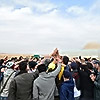
Historically we came out of Egypt once, crossed the desert, came to the land of Israel, built the First Temple, then the Second Temple, and so on, and all of this has already happened.

But we are not talking about things that happened in history; after all, they had to happen this way. We are talking about the law when a spiritual root necessarily has to touch its earthy “response,” or earthy branch. Roots and branches must connect with each other, but only once!

It is enough for the root to touch the branch lightly, and it already performs the work in it, creates connection. Therefore, we don’t need to return to Egypt again to buy a plane ticket to meet our Pharaoh there that rules over us. It’s just no longer necessary.

It remains for us to do what we have to do, i.e., to correct ourselves. All this already exists in the root and now we need to implement it in the branches. Therefore, we are in the land of Israel, in egoism, and now we need to undergo all this ourselves, to go through and to correct it.

Question: What does it mean then that a person should feel as if he exits Egypt every day?

Answer: The exodus from Egypt is a rise above our egoism. There are 613 egoistic desires (Taryag) in the egoism that need to be corrected to altruistic ones, i.e., desire of hatred, competition, and hostility to connection and love. This is called observing the commandments of correcting desires.

And this must be done daily because every time a person rises to a new level, each of them has the same 613 desires but in a different, stronger form. Therefore, every day a person must imagine that he exited Egypt and has the right to correct these desires.
[192728]
From KabTV’s “Secrets of the Eternal Book” 5/11/16

Related Material:
Unity Determines Everything
Exiting Egypt Without Leaving Your Place
The Great Assembly At The Foot Of The Mountain

Donating And Spirituality

Laitman_049_01Question: From the point of view of the wisdom of Kabbalah, is a donation a type of spirituality, or is there a difference between “giving the surplus” and “giving the last?”

Answer: There are no kinds of donations that belong to spiritual impulses.

For everyone, there are strict rules that depend on which stage a person is in.

When a person begins to study, according to his degree of advancement, he begins to understand what he can really spend money on if he has surplus cash; it could be for buying books, coming to a convention, and the like. However, not every donation leads to something good!

For an uncorrected person, this donation is revealed as more egoistic, according to which he supposedly will gain the world to come.
[192285]
From the Kabbalah Lesson in Russian 4/3/16

Related Material:
Where Is It Profitable To Invest Money?
Why Am I Unsuccessful In Making More Money?
Why Do We Need Money?

Correction Of The World: A Pyramid Of Desires

laitman_254_03Question: For three years we have been engaged in the general dissemination of the wisdom of Kabbalah, but then we began spreading it among the Jews, we separated the friends from the general dissemination. How is it possible to cover the shortage of forces?

Answer: According to the “Introduction to The Book of Zohar,” dissemination of the method of correction, the wisdom of Kabbalah in the world, must be carried out according to a pyramid of desires:
1) to those who yearn for the goal of creation,
2) to Jews who carry Reshimot (Remembrances) from previous spiritual states, and
3) to the rest of humanity.
[192239]

Related Material:
A Key Stage In Dissemination
Israel Is Not A Nationality But An Aspiration
Putting Together The Mosaic Of Humanity

History Of Humanity – A Look Inside, Part 1

Laitman_417Question: You claim that the solution for all problems is in our unity. I am an historian and have studied the history of the destruction of the First and the Second Temples. The First Temple was built by King Solomon, and I am not sure that there was any unity between the people of Israel at that time.

It also doesn’t look like people knew what unity was during the construction of the Second Temple and afterward during the time of Herod. Anyway, if by “Temple” we mean internal connection and not a material concept, then why do we mourn the destruction of the Temple on the ninth of Av?

Answer: There is a difference between the way historians and Kabbalists study history. Historians study events in the form in which they are seen by us based on the visible facts. The cause for all of the events also derive from the analysis of what they have seen. Therefore, they concluded that there were quarrels and feuds between the people of Israel and that clans were fighting with each other.

Humanity works with the means that are available to it and tries to understand the processes we undergo with their help. Therefore, historians ascribe what has happened to different reasons: economic, personal, and random events.

But the study of the wisdom of Kabbalah begins from a completely different root. Kabbalah says that the root cause of everything in our world is the force of nature, which has a program. Under this program, the force of nature, which can be called the upper force or the Creator, our reality unfolds.

Kabbalists study the actions of this upper force, try to understand it and ascertain the event which has occurred from its actions, instead of studying events relative to the subjective perception of a person, which depends on his development and his ability to comprehend events and their causes, the way historians do.

A person sees a spectacle unfolding in our world: Herod, Pharaoh, Moses, Solomon, and Nebuchadnezzar. But they all are just puppets on a stage. Can we see the hand of nature that is acting inside the dolls and moving these puppets on the stage?

This is what the wisdom of Kabbalah deals with. It explains that creation has a beginning and a final goal. The upper force of nature leads all of the creatures from the beginning of creation to its end so that eventually they will achieve the same level of development and the same abilities as the force of nature itself.

Our desire to enjoy, which is opposite to the force of nature, to the desire to bestow, must develop and reach its worst form, opposite to the Creator and standing against Him. Then, a special creature should appear, which will have a desire to enjoy and a desire to bestow in itself simultaneously. It will be called Adam, a man, because it will be able to become like (Edome) the Creator.

A person is given conditions in which he can grow. He must include within himself qualities that are 100% opposite to the Creator and qualities that are 100% similar to the Creator at the same time. In this way, a person can become a perfect creature, independent due to his opposition to the Creator and equivalent to Him at the same time. This is the development that the Creator planned for creation.
[191959]
From the 1st part of the Daily Kabbalah Lesson 8/12/16, Writings of Rabash

Related Material:
The Walls Of The Temple
The Destruction Of The Temple – The 17th Of Tammuz
The 17th Of Tammuz

Between Humanity And The Creator

Unity, The Way To A Good FutureTorah, Deuteronomy 7:1: When the Lord, your God, brings you into the land to which you are coming to possess it, He will cast away many nations from before you: the Hittites, the Girgashites, the Amorites, the Canaanites, the Perizzites, the Hivvites, and the Jebusites, seven nations more numerous and powerful than you.

Our desire (spiritual structure) consists of seven parts: Hesed, Gevurah, Tifferet, Netzach, Hod, Yesod, and Malchut. In the Torah, they are represented by seven nations—seven very strong egoistic desires.

And the desire to reach love and bestowal is very weak in a person. It is like a small Moses against the great Pharaoh. Egoism rules between us and we don’t have any strength to cope with it because we lack the qualities of bestowal, love, and connection.

We have no other option except to ask the Creator to help us conquer these nations. And He fights for us. Our strength is manifested only by the fact that we are connected with Him.

We are the link between all of humanity and the Creator. Therefore, we receive negative inclinations from both sides that are obliged to put us on the correct level of relations with both the Creator and all the nations of the world (our egoistic desires).

Our strength is that we can connect with the Creator, to enlist His support and thus overcome our egoism.
[190511]
From KabTV’s “Secrets of the Eternal Book” 4/6/16

Related Material:
Entering The Land Of Israel
The Third Temple And A Solution To The Global Problem
Leaving Egypt…

New Life 758 – Loving Children Properly

New Life 758 – Loving Children Properly
Dr. Michael Laitman in conversation with Oren Levi and Tal Mandelbaum ben Moshe

There are two opposing forces at the foundation of nature, the force of attraction and the force of repulsion, love and hatred. So hatred and love are the two main forces upon which all of our lives are built. Only in humans, has nature not left clear boundaries when it comes to attraction and repulsion, love and hate.

For these two forces to be in balance and for our children, we need to to us to relate to the “middle line.” Absolute love awakens repulsion and hatred in a child because he doesn’t know how to respond to it. So incessant pressure is useless and places children in an unclear situation. As people, we are not prepared to feel something that is unlimited; if love is unlimited, it is impossible to feel it.

To know how to behave correctly, one must study human nature. The wisdom of Kabbalah teaches this. The right connection includes 3 kinds of attitudes: I am greater than the other, smaller than the other, and equal to the other. Parents and children need to sit in a circle together and speak as equals.

Through such conversations, children will acquire importance and responsibility. If parents radiate a spirit of reciprocity, equality, and respect, this spirit will pass to the children and they will understand that even when parents restrict them, it comes from love. In addition to feelings and intellect, we must develop the middle line in children.
[191682]
From KabTV’s “New Life 758 – Loving Children Properly,” 8/11/16

icon for podpress Video: Play Now | Download
icon for podpress Audio: Play Now | Download

Daily Kabbalah Lesson – 09.09.16

Preparation for the Lesson

[media 1] [media 2]

Writings of Rabash, “Dargot HaSulam,” Article 587

[media 3] [media 4]

Writings of Baal HaSulam, “Preface to the Wisdom of Kabbalah,” Item 81

[media 5] [media 6]

Writings of Baal HaSulam, “Peace in the World” 

[media 7] [media 8]

Audio Version Of The Blog – 09.08.16

Listen to an Audio Version of the Blog
Download: MP3 Audio

Why Do We Need To Correct A Man If He Was Created In The Image Of The Creator?

Dr. Michael LaitmanThe Creator created a spiritual prototype of a man called Adam. He was on the level of the quality of complete bestowal and love, i.e., was in equivalence of form with the Creator.

We are called “sons of Adam” and there is a part of him in each of us. Today, we are completely opposite to the Creator and our task is to rediscover the quality of bestowal and love in the connection between us and to rise to the level of an upper force.
[192733]

Related Material:
Fire And Water
A Live Replica Of The Upper World
How Can We Delight The Creator?

Ynet: “What Is Important For Our Children At School?”


From my column on Ynet: “What Is Important For Our Children at School?”

If we don’t want to wake up one morning and discover that we have lost a whole generation, we have to change the education system that prepares our children for life as soon as possible. But while all the surveys indicate the need for urgent change the Ministry of Education is focused on conveying knowledge and on grades only. What is the solution?

If you were one of the decision makers in the country, which public service would you improve first? The medical care services, the National Security institute, the courts, or the education system? Hundreds of Israelis answered this question in a poll conducted by the Central Bureau of Statistics and the results were published this week.

If you are the excited parents of children who are starting a new school year this week, you probably know the answer to this question. More than 30% of the public believe that the Israeli education system needs improvement: 48% of the parents in Israel are disappointed with the way it operates; 60% look for alternatives, and 81% of the parents complain that the education system doesn’t prepare the children for adult life in the 21st century.

The customer is always right, and in this case it is the parents. What tools to manage in society will our children have after 12 years of school? What values will they learn in school? Racism is growing, the division in the nation is widening, and the discourse in social networks is becoming more violent. Who is preparing our children to cope with these real problems and many more?

Parents, do you care?

This week school will once again become the central institution that influences your child’s life and future. The public education system was established as the 19th century industrial revolution accelerated with the intention of training many workers for the assembly lines. It has not changed much since then… It thus turns out that the main focus is on teaching professional skills that will serve the economic system better and will help it develop. As long as schools continue to be a factory for producing good and competitive citizens and the achievement test is the only criterion for measuring success, there is no point sending our children to school.

The school system should first focus on teaching values and not information. Improving the core subjects and increasing the number of students who take five point English and math final exams (the highest level) and rewriting phrases in social studies is important, but this is the role of the Ministry of Information and not of the Ministry of Education.

Profound Re-education

In the meantime, there is a sharp decline in the number of youth that want to serve in the army. Many young people think about leaving the country and we are becoming increasingly more indifferent to one another every day. In a state that is coping with a national problem called unfounded hatred, the seeds of which were planted with the destruction of the Temple, we have to take action and teach the national idea of “love thy friend as thyself.”

“The one concerned with days, plants wheat; with years, plants trees; with generations, educates people” (Janusz Korczak). Every parent worries about the future of his children and does his best so that they will learn to keep the family relations between them. This is how we together should also worry about the future of the next generation. We should encourage the improvement of interpersonal relations so that we can discover the power of unity and the wellness and security it offers, not as a result of the false spirit of mutual guarantee which emerges at times of trouble. “Our only hope is to profoundly rearrange the education of our children, to discover and to reignite the natural love that is flickering in us and to revive the national muscles in us which have been inactive for two thousand years” (The Writings of Baal HaSulam).

A Lesson in Connection

If we don’t want to wake up one morning and discover that we have lost a whole generation, I suggest that we start the school day as Baal HaSulam says in his article, with at least one hour of consolidating unity activity. We mustn’t miss the moment; we have to sit on the school bench again. “We, the nation should lead to an interaction that will create a micro society among the students in which everyone cares about everyone else like a small family. This will prepare the children to establish a warm friendly connection on top of all the tension and the natural conflicts among them, and bring out all the creativity and potential in them. (“Education doesn’t create anything new but brings out what is already in a person” Rav Kook).

During the “connection hour,” the teachers will provide the basic tools for building a strong and healthy connection between the students, bring examples of positive mutual dependence and consideration, and will guide the students in how to better cope with the global world, which affects every aspect of our life. The children will sit in a circle in which everyone is equal and can see and hear each other, not behind desks arranged in a row. Everyone will learn to listen to each other without imposing their opinion until they reach a general understanding. Gradually they will learn to overcome their egoistic nature, and finally they will feel a partnership, connection, and love as it is written: “love will cover all our transgressions.”

A Teacher forLife

The teacher will also be part of the circle and will sit with the children and talk with them on the same level. He will replace his authority and superiority with the art of asking leading questions that help the children discover the information by themselves by communicating and speaking among them. This is how information is assimilated in a much more meaningful, qualitative manner.

A child who grows up in an environment that measures his success according to his consideration of others and according to his contribution to the whole society is guaranteed to flourish and to be educated. As an adult he will undoubtedly face life with a much wider perspective of the world and with a feeling of responsibility and care regarding the building of a considerate egalitarian society, just like the environment he grew up in.

“It is a shame to admit” says Baal HaSulam in the same article that “one of the most precious and important qualities which we have lost during our time in exile, is our national awareness, which means the natural feeling that connects and sustains every nation. It is because the strings of love that tie the Israeli nation together have deteriorated and have been cut from our hearts and are lost and gone.” Our nation has a great wisdom of connection, an ideology that has been established for generations. All we have to do is to implement the method of connection that is rooted in the love of mercy of Abraham among our dear children. It isn’t a dream, in is right here in the relations between us.
[192703]
From Ynet article 8/31/16