Audio Version Of The Blog – 12/15/24
Posted on December 15th, 2024
Listen to an Audio Version of the Blog
Download:MP3Audio

Listen to an Audio Version of the Blog
Download:MP3Audio

Talks about the Steps of the Ladder, Part 27
What Causes a Person to Escape the Struggle?
There are many reasons, but ultimately, they all come down to one: a lack of sufficient support from the environment. Baal HaSulam states that such a person has not exercised their free choice to surround themselves with supportive people, books, or study. Regardless of the physical environment they are in, even near a great teacher, they might still escape, depending on how much they connect with those who support them.
The “environment” is not the place that we are in, nor is it merely the company of a group of good and strong people who influence us. It is whether we want and allow ourselves to be influenced. The rule is that there is no coercion in spirituality. No one can change under compulsion from the outside. We change and are influenced according to our desire, and not by coercion. “No coercion” is not merely a prohibition that we need to observe. It is impossible to force anything even if no prohibition were in place. That is, even if we want to be forced and ask our friends to force us, and even if we receive blows to force us, even then, we cannot be forced. The person himself is the only one who can compel his own change.
All change can take place only with the person’s consent, willingness, and free choice. We will change when we open a way for the light to enter. Outside, there is the light of Ein Sof (infinity); it can be a large group, a great teacher, a society, even the “holy society” of Rabbi Shimon Bar-Yochai, but the degree to which we open ourselves up to it determines the extent of influence that the society can have on us. If we fail to make such an opening, then we can be sitting among friends, and they can be talking and making actions with a fire burning between them, but it will have absolutely no effect on us. We will remain cool and indifferent, can drink another cup of coffee, sit with them a little longer, and that will be it. Despite all good intentions, the friends will be unable to influence us.
Therefore, Baal HaSulam writes in his “Speech for the Conclusion of The Zohar” that everything depends on how much a student serves his teacher. It refers to the extent in which we serve the group, as this degree of dedication opens the door for the teacher or the group to influence us in return. This is called “free choice.” Free choice is the extent to which we let a positive environment influence us. We should engage in self-reflection and examine how genuinely we relate to our environment in order to receive strength from it. The extent of our progress depends on the strength we are willing to receive from the group.
Related Material:
Talks about the Steps of the Ladder, Part 26
Talks about the Steps of the Ladder, Part 25
Talks about the Steps of the Ladder, Part 24
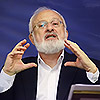 Question: We try to work in one desire, to bestow. How can we keep the feeling of the group in the right intention when there are constant changes of sensations and reactions that come from the difference in our friends’ properties?
Answer: Try to keep them in your common heart all the time so that it feels where it can lead, and you stabilize it.
You need this stabilizer that will keep you in the right state between you and with the Creator. I am sure you will succeed.
[337755]
From the Daily Kabbalah Lesson 11/29/24, Writings of Rabash “Discernments in States”
Related Material:
Break Out of the Shell of Egoism
In One Heart, In One Desire
The Common Heart
 Question: What is the repentance of the ten that leads us out of exile and brings us to deliverance from egoistic desire?
Answer: If the friends in the ten feel that they have fallen into their egoism and do not have the strength to rise from it on their own, then they have no choice but to turn to the Creator, to cry, and to pull themselves out of this state with all their might.
Question: How important is it to expect salvation every day, and what does this add to the ten?
Answer: This adds urgency that with each question, with each appeal, you increasingly desire that the Creator stays in your sensations.
[337745]
From the Daily Kabbalah Lesson 11/28/24, Writings of Rabash “And Isaac Was Forty Years Old”
Related Material:
Do Not Be Afraid to Ask and to Receive
Questions about Overcoming Obstacles
Become Aware of your State
 Question: Our ten experienced a very strong descent, and now we have risen. We decided to meet physically. What advice would you give us?
Answer: By all means, it is good. Physical actions give something, but, in principle, they do not symbolize anything.
Just pick a couple of good articles that talk about unity between you, and discuss them when you meet; you will feel how much you are already internally connected.
[337742]
From the Daily Kabbalah Lesson 11/29/24, Writings of Rabash “Discernments in States”
Related Material:
The Importance of Participation in the Ten
Intention Does Not Replace Action
Help Your Soul Grow
 By uniting among us, we enable the upper force to positively influence us. Previously, its light caused negative disturbances within us because it was opposite to our nature.
And since now we strive to resemble the upper force, these states of connection and bestowal become similar to it, and to the extent of this similarity, we begin to feel it, not only the effects of its influence on us, but the upper force itself. This we call the revelation of the Creator.
Although in essence little is required to achieve this, attaining the spiritual world is not easy. It demands many efforts and stages. This is how we progress.
Later as we unite more deeply with the help of the upper light, we begin to build conscious connections that we initially call a spiritual embryo, followed by small spiritual states, greater spiritual states, and transitions from one degree to another.
We constantly work with our egoism and strive to connect with it correctly. The Creator forms increasingly egoistic ties between us—oppositions, contradictions, and rejections of one another—and we continuously build positive connections above them. In doing so, we reveal the upper force.
[337946]
From Preparation to the Daily Kabbalah Lesson 9/3/19
Related Material:
How To Envision The Connection Between Us
A Conscious Movement Towards The Creator
From The Tree Of Knowledge To Our Days
 Question: What does it mean to subordinate the force of receiving to the force of bestowal since there is no coercion in spirituality?
Answer: Yes, but you want the force of bestowal in you to be above the force of receiving.
Question: What makes it submit? Love?
Answer: The Creator does. A person can cause the beginning of the Zivug (combining the force of receiving with the force of bestowal), but it happens only under the force of the Creator.
[337720]
From the Daily Kabbalah Lesson 11/29/24, Writings of Rabash “Discernments in States”
Related Material:
Why Is There No Coercion In Spirituality?
There Is No Coercion In Spirituality
Coercion Or Spiritual Elevation?
 Question: Often we follow the instinctive impulses of our nature and only later realize that something is wrong. If I am unable to change anything, I ask the Creator to correct me. How do you learn not to blindly follow your nature?
Answer: To do this, we need to understand what the Creator requires of us and with the help of what actions we can satisfy Him. And then everything will be fine.
Question: There is a material world and the upper world. The upper world is felt nearby, among friends. How do we learn to feel the upper world in a multidimensional, sensory, and conscious way within yourself, and not somewhere nearby?
Answer: Try to feel it, and you will see that you are gradually approaching it.
[337970]
From the Daily Kabbalah Lesson 12/5/24, Writings of Rabash “The Meal of a Wicked One”
Related Material:
How Do We Get Out of Egoistic Properties?
How Can We Feel The Upper World?
The Spiritual World Is Love of Everyone for Everyone
 Question: What needs to be done to be given a soul?
Answer: Unite the desires of the people in the ten into one great desire to bestow so that it resembles the Creator in some way.
It is the common soul of the ten. It may be that some feel it and can already use it, and others still cannot.
Question: What does it mean to do good in the ten?
Answer: To do my best to help each friend with whatever he needs to advance.
Question: But this is not enough. We do not have many needs for the ten to grow.
Answer: Try to do what your friend wants so your forces join his forces, and he would achieve what he wants.
[337739]
From the Daily Kabbalah Lesson 11/29/24, Writings of Rabash “Discernments in States”
Related Material:
The Need of the Soul
The Ten Is Your Soul
Revelation of the Soul
 This is the meaning of “‘Folly of follies,’ said Kohelet,” meaning that he assembled all those follies into Kedusha, and from them come great unifications (Rabash, Assorted Notes, 560, “Generations“).
Question: How can we transform “folly of follies” into holiness?
Answer: This is something we accomplish gradually.
Even if we do not clearly understand what we are doing, the Creator continually distances us from one another and from spirituality each day. Yet we persist in striving to draw closer to Him. Thus no matter what, we are engaged in this work.
Question: How exactly can this be brought into holiness? For instance, if we are working in the ten and the Creator disconnects us, do we then reunite?
Answer: This process naturally shifts to another degree. As soon as you complete what you were required to do on your current degree, you transition to a different degree, even if you do not feel it and do not think about it.
[337596]
From the Daily Kabbalah Lesson 11/25/24, Writings of Rabash “Generations”
Related Material:
Rewarded with Holiness
Transfer Life to Holiness
Connect Every Moment to Holiness
 Daily Audio Version-MP3
 Get the Weekly eNewsletter
 Follow on Twitter
