Entries in the 'Spiritual Work' Category

The Camp Is A Laboratory For The Unification Of Souls

laitman_934Torah, “Numbers,” “Chukat” 19:9: A ritually clean person shall gather the cow’s ashes and place them outside the camp in a clean place, and it shall be as a keepsake for the congregation of the children of Israel for sprinkling water, [used] for cleansing.

The ashes of a red cow can be used for purification. If you have the proper connection between Malchut and Bina, it is possible to take the power for correction from there.

A clean person who gathers the ashes means someone who creates the right intention within himself. This speaks only about spiritual and not physical cleanliness.

The camp is a collection of people who practice all the possibilities of connection between each other. There cannot be any absolutely pure space there. Therefore, it is said that he must place the ashes of the red cow “outside the camp in a clean place.” “Outside the camp” means in a place where the power of the Creator is found, where people don’t enter. In the camp can be only an Ark.

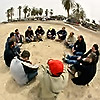
The camp in itself embodies a laboratory in which the souls of people try to connect to create a Kli for themselves, a constant common desire to discover the Creator.

Question: Is it possible to call the discussion circles, the workshops of ten people, in which all of us discuss and go through all kinds of situations, a camp?

Answer: No, a camp is not bodies, but desires.

There is a completely different picture here, in which there are desires, a vector (intention and fulfillment), and a degree of connection with the Creator. We are talking only about these three parameters: the desire, coupled with other desires for a shared influence on each other, and to the extent that there is a shared influence towards the Creator, in turn He fulfills the general common desire.

And a camp that is working with an intention for the sake of bestowal is therefore called a “sacred camp.”
[169717]
From KabTV’s “Secrets of the Eternal Book” 6/10/15

Related Material:
The Secrets Of The Red Heifer
Spiritual Purity
Ashes Of Our Desires

How Can We Delight The Creator?

laitman_940Question: How can we delight the Creator if He is an emotionless law of nature? What does it mean to delight the Creator, and how can I determine whether it is achieved?

Answer: We attribute our qualities to the Creator, and this is how we imagine Him. We have another opportunity. This description is called the language of the Torah.

Kabbalists describe Him as forces that they feel, and this description is called the language of Kabbalah.

The Creator is perceived by us as the sum of all of the best relationships between people, as absolute love. I begin to feel what it means to delight the Creator by delighting the people around me in the group. I emphasize the point of the group because only there does the feeling of the upper state appear.
[169993]

Related Material:
Is the Creator Alive?
The Switch For The Higher Light
The Creator’s Name Is Four Letters

Climbing The Steps Of Spiritual Development

laitman_243_05Question: How can I know if I have transcended to another spiritual level?

Answer: When a person ascends to the next spiritual level, he feels absolutely everything that happens to him. It is a very accurate feeling, without any visions or illusions.

Question: Will everyone be able to ascend to the spiritual world?

Answer: Absolutely everyone! The only thing necessary is a desire for it. Anyone can attain the upper world. Anyone who agrees to dedicate a certain amount of time and effort will have no problem attaining it. Moreover, while in our world, anyone can choose a certain profession and more or less succeed in it. There is no doubt that each of us will have to master the wisdom of Kabbalah, either in this lifetime or in the next life, and to fulfill himself totally in his spiritual ascent, rising to the world of Ein Sof (Infinity).
[169803]
From the Kabbalah Lesson in Russian 10/11/15

Related Material:
Connecting To A Higher Level
Measuring Our Progress
Can Anyone Study Kabbalah?

Answers To Your Questions, Part 114

laitman_628_2Question: You often say that we shouldn’t go back to the past, but what can I do if the past is part of my present life and is expressed in different complexes, pressuring me and ruining my life and the lives of those around me?

Answer: You must yearn for unity in the group. You should know and feel that this is how you are spurred to move toward the goal and consequently will begin to be grateful for your feelings and your memories.

Question: What does the feeling of shame mean according to the wisdom of Kabbalah?

Answer: The past is realized on me by the Creator, so the feeling of shame is never regarding the past, but the present, as to whether I can fill it with mutual guarantee.
[169801]

Related Material:
Gratitude For The Past Prepares For The Future
Corporeal Shame And Spiritual Shame
It All Starts With Gratitude

The Kabbalists’ Time Machine

laitman_526Question: If a Kabbalist today could go back to the past in a time machine and speak with Kabbalists who lived during the time of the Bible, would they be able to understand one another?

Answer: Of course, without a doubt! When I ascend the spiritual levels from the bottom up, I meet all the Kabbalists who have climbed these levels. I become part of these levels and attain what other Kabbalists attained in the past.

I go up the elevator to the first floor and see what happens on that floor. All of the Kabbalists also saw the same thing, starting from Adam HaRishon (First Man) all the way to me. Perhaps each described it according to his own style because he perceived a picture that is a bit different, according to the root of his soul, but everyone attained the same thing.

I rise to the second floor, and there I feel what they felt and so on. I must understand them according to the level of the floor I am on, and there is no problem on that level.

I may not understand everything they wrote because they are on a height that I have not yet attained, but when I rise to a certain floor, I attain all the Kabbalists who were on that floor and discover whatever they discovered.
[169731]
From KabTV’s “The Wisdom of Kabbalah and Science” 9/7/15

Related Material:
The Secret Of Kabbalah Books
Equal And Different
What Does A Kabbalist See?

Egoism In The Service Of Altruism

laitman_276_01There is a close scrutiny of the connections between Malchut and Bina in the weekly section of the Torah Behukot: how and according to which laws and which dosage can the egoistic attribute of receiving be incorporated in the attributes of bestowal. This is the reason that this section of the Torah is very deep and powerful.

It is about the red heifer that symbolizes the connection between Malchut and Bina (to receive in order to bestow). On the one hand, this connection can sanctify a person and turn him from an egoist into an altruist.

On the other hand, an altruist can turn into an egoist according to what is important to him: whether Malchut is above Bina or Bina is above Malchut. If you are pure to a certain extent and suddenly open your Malchut more than the attribute of Bina, you become impure.

It is a very complex system of interdependence between purity and impurity, specific to the spiritual world. Therefore, the main point is that the connection between Malchut and Bina be in the right dosage.

All of the other laws described in this section of the Torah also emphasize the right cooperation between the ego and the Light that corrects the ego according to the amount of Light that it draws.

The two attributes must be connected carefully in the spiritual world, but how can they be properly connected in advance? This is impossible to determine because a person himself is a totally new object each time.

He doesn’t know who he is and what he is, how he should behave now in order to resemble the Creator because he isn’t familiar with his internal attributes that have been renewed. How can he become one in order not to go wrong? You must be your own psychologist here who works with the unknown each time. This is what the attainment of your nature comes down to.

A person has constant doubts. He is afraid of himself so as not to violate the balance, not to fall, and to be in the right motion forward. This motion can be only in faith above reason, when he constantly controls that the attribute of bestowal in him always is above the attribute of receiving so that he will be able to advance with his eyes closed toward bestowal.

If we are on the level of our world, how can I be sure that I will not steal if I suddenly have such an opportunity? How can I avoid temptations that can turn my head around? I am shaken suddenly, and everything that I have attained disappears. There is another conflict here, a new state. What do I do in this situation? How can I be sure that I will not fall, but will hold on to the attribute of bestowal in all of my actions?

Where does a person find the strength when he begins to explore himself and understand that he cannot count on himself in any way and that he is simply hanging by a thread?

It is only if he has a constant feeling that he cannot count on himself, that he can devote himself to the attribute of love and bestowal, which means to depend on everyone else and act only in them.

Question: How can this be done if a person has no basis under his feet?

Answer: This is actually the best feeling because I don’t do, change, or create anything by myself.

Question: Does that mean that neither knowledge nor wisdom will help me here?

Answer: Nothing! The wise are in the same position. You actually acquire knowledge when you are connected to the upper and not by yourself.

It is then when you don’t feel anything under your feet that you begin the movement from Malchut to Bina. This connection is very carefully calculated.

On the one hand, it is a very accurate, internal, mathematical, and psychological problem where you must calculate how much of a certain Light and a certain Masach (screen) and a certain Aviut (depth of desire) that you need. On the other hand, it means that you are already under the upper.

This is the reason that the weekly section “Chukat” begins with the story of the red heifer that sanctifies the egoists and turns the holy into sinners, which means that it works in both directions, back and forth. When it is burned, it is actually its ashes that turn into the general attribute since then you burn everything, both the attributes of bestowal and the attributes of receiving, and have nothing left. However, then one special attribute is formed.

Question: It says that King David could explain everything except the commandment of the red heifer.

Answer: Yes, it is because this attribute is in Keter, the highest spiritual phase from which the idea of the creation of man that is equal to the Creator descends. It is this that works on a man and how he can ascend to resemble the Creator.

Question: Do the laws repeat on every level?

Answer: The laws are totally the same on every level. They include the first restriction (Tzimtzum Aleph), a Masach, resistance to egoism, and the calculation above the Masach, to what extent can I resemble the attribute that I discover.

When I restrict myself and place a Masach, I discover the attribute of bestowal, the attribute of love, the attribute of connection, that is opposite from me. I discover a new world, and now I see what it is in itself, how I can resemble it, and to what extent I can participate in its actions.

This is the calculation that is made with the sum of the attributes of Bina and Malchut in order to use my previous egoistic attributes to perform altruistic actions.
[169763]
From KabTV’s “Secrets of the Eternal Book” 6/24/15

Related Material:
Spiritual Purity
The Secrets Of The Red Heifer
Doubts Are A Place For Advancement

Hatred Is The Beginning Of Love

laitman_286Question: I realize that I hate the Creator. First, I thought that I loved Him, but this turned out to be a bluff. I didn’t feel my love, but I certainly feel hatred toward Him.

I am burning inside; I just don’t want to feel it. I am choked by His greatness. I know that He is the one and only, and that He is good and beneficent. However, hatred is within me. I don’t know how to love, and I don’t know what love is.

Answer: It is just miraculous that this was revealed to you, for this is love for the Creator, and you feel how you hate Him within your ego. The correction begins from this moment. What a joy!

Good luck!
[169723]

Related Material:
Roadmap To The Creator
Loving The Tough Father
Love Always Rises Above Hate

Is It Possible For The Body To Have Eternal Life?

Laitman_709Question: The physical body of a person is part of creation. If a person learns to live according to the Mitzvot (Commandments), will his physical body become immortal?

Answer: The physical body has no connection to Mitzvot. Observance of the Mitzvot is a correction of the ego to the characteristics of bestowal and love of others. It is specifically this characteristic that is called the corrected Adam (Man).

We are commanded to change gradually, time after time, each one of our 613 desires from egoistic to altruistic usage, and in this way, feel the upper world more and more with greater clarity through these corrected characteristics.

Question: What in Kabbalah is the body?

Answer: A body is a collection of desires. We now have 613 egoistic desires, meaning an egoistic body, and when we correct the ego, we acquire another, sacred body, meaning the desire for bestowal and love.
[169727]
From the Kabbalah Lesson in Russian 10/11/15

Related Material:
Compliance With The 613 Mitzvot (Commandments)
Eternal Life Is Possible!
The Most Difficult Thing Is To Ask For Help

Spiritual Purity

laitman_602_02The Torah, “Numbers,” 19:6 – 19:7: The kohen shall take a piece of cedar wood, hyssop, and crimson wool, and cast them into the burning of the cow. The kohen shall wash his garments and bathe his flesh in water, and then he may enter the camp, and the kohen shall be unclean until evening.

Spiritual purity means that your intentions are absolutely pure and that in your spiritual work you want to use only the desires that are aimed at connection with others, and through them, with them, with the Creator.

When you work with these desires, you must detach yourself from other egoistic desires, so you need to reveal them.

These desires may not have been revealed in you yet, and you may not even be aware of them or understand how to detach yourself from them. Thus, the Torah instructs us as to how to act. You have to plunge into water (in a Mikve, a pool filled by water from nature), which means to place yourself under the attribute of Bina.

Then, you must be in this state until the evening because only when night falls do the new desires (vessels) appear since every new day begins in the evening.

Since your action was done in these clothes during that day, you don’t have to leave it at the end of the day. You will receive new vessels during the night, and you will be a new person the next day.

Question: Why does a person receive new vessels at night?

Answer: It is because the new desires that rise in a person are not corrected yet, which means that they are in the dark. In the meantime, one cannot work with them with the intention of in order to bestow. This is the reason they are dark.

New vessels are born until midnight, and from midnight onward, they are corrected and the Light is revealed in them gradually, which is called the sunrise.

In fact, there is no sunrise or sunset, but we simply feel dawn, sun, or daylight in the corrected desires.

During the day, we fulfill them correctly, and then they gradually transcend to the next level. When the new, uncorrected desires approach us from a distance, the sun is forced to set by the force of Gevura, the force of rigidity, of Din (Judgment). Then, a new phase begins. The next chain of desires appears in a person, which he must correct. Everything happens inside of us.

Question: What does it mean that the priest must wash his clothes?

Answer: Clothes symbolize the intention. The correction of the ego takes place by helpful intentions.

The five clothes of the priest are a hat, a shirt, a belt, sandals, and trousers. These are the five levels of the egoistic desires, each of which needs a new intention.
[169631]
From KabTV’s “Secrets of the Eternal Book” 6/10/15

Related Material:
What Is A High Priest?
Where Is The Door?
The Clothing Of The High Priest

Laws That Stem From The Torah

Laitman_137Torah, “Numbers,” 19:4 – 19:5: Eleazar the Cohen shall take from its blood with his finger and sprinkle it toward the front of the Tent of Meeting seven times. The cow shall then be burned in his presence; its hide, its flesh, its blood, with its dung he shall burn it.

Everything the Torah tells us about seems like a barbarian spectacle taking place on the steps of the spiritual world, not in the material world. The Torah tells us in corporeal terms what happens in our attributes, inside us and between us.

It is very hard to express feelings using the language of our world because there are many interpretations of the Torah. After all, they don’t give us the right picture. These interpretations also need interpretations since the great Kabbalists who attained the spiritual worlds described the spiritual actions as if they take place in our world.

On the whole, it is about the fact that every person has to find the point of the priest (Cohen) inside him and determine how it can help correct the combination of Bina (the attribute of bestowal) and Malchut (the attribute of receiving).

The Torah is written for each of us. The priest, the Levites, and Israel are in one person and he has to perform these actions on different levels of the spiritual ascent.

It turns out that I find the priest, the attribute that is directly connected to the force of love and bestowal. I extract the “red cow” from my inner desires, and I need to slaughter it and skin it, which means to take the uncorrected desires called blood from it, and sprinkle it on the tabernacle, which is the vessel in which I receive the revelation of the Creator.

The cow symbolizes the connection between Bina and Malchut.

Question: Why should I sprinkle the blood on the tabernacle seven times?

Answer: Because these are seven Sefirot: Hesed, Gevura, Tifferet, Netzach, Hod, Yesod, and Malchut. Hence, everything in the physical world is divided into seven, like the seven days of the week, for example.

There is also a division into sixty, like 60 minutes or seconds, which also stems from the Torah, since Zeir Anpin includes six Sefirot (Hesed, Gevura, Tifferet, Netzhach, Hod, Yesod), and each of them is made of 10 levels. Six times 10 is 60 and so 60 actions in Zeir Anpin equal one bestowal unto Malchut.

Besides, there is also the division into 12 in the corporeal world, which stems from the concept of the 12 tribes. These are four levels (Hochma, Bina, Zeir Anpin, and Malchut) in each of which there are three lines. Thus all the major divisions in our world stem from the Torah.
[169543]
From KabTV’s “Secrets of the Eternal Book” 6/24/15

Related Material:
Spiritual Actions In The Allegories Of The Torah
The Origins Of Time
Special Language Of The Torah