New Life 486 – The Degree Of Righteous

New Life 486 – The Degree Of Righteous
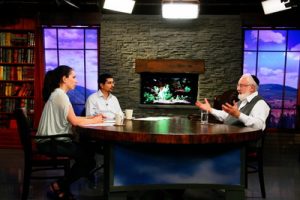
Dr. Michael Laitman in conversation with Oren Levi and Nitzah Mazoz

What is the degree of righteous in spirituality? Why do we experience awakening during a pilgrimage to the tombs of the righteous? How can we relate to their Torah and their spiritual level?

There is nothing of holiness in the objects left behind by a righteous—not in his relatives nor in anything material. A righteous is a person who has developed forces of love and bestowal and has revealed the Creator in his inner vessels. A righteous person is one who repeatedly transcends the desire to receive in order to awaken in himself the desire to bestow. Any person who develops spiritually can reach the level of each one of the righteous.

We can make contact with the righteous through the study of the wisdom of Kabbalah in a correct group that connects with love above the ego. The power attained in the right connection can be called righteous, and within this power we attain the Creator. It takes at least a minyan, ten people who want to transcend spiritually with the help of wisdom of Kabbalah, which is the Torah of the truth.

We must distinguish between spiritual things and religious-psychological things. Religions teach heritage and customs, and increase one’s ego. The wisdom of Kabbalah, on the other hand, speaks of correcting the ego with the help of the light that reforms.

From KabTV’s “New Life 486 – The Degree Of Righteous,” 12/30/14
This summary was written and edited by students of Kabbalist Dr. Michael Laitman

icon for podpress Video: Play Now | Download
icon for podpress Audio: Play Now | Download

“Can you tell me some questions which will help me introspect?” (Quora)

Dr. Michael LaitmanMichael Laitman, On Quora: Can you tell me some questions which will help me introspect?

Do I have love for humanity?

If it seems too far-fetched to have love for humanity from the beginning, then you could start with love for people in your own country.

How do you check if you have love for people in your country?

Are you willing to share everything you have with them?

If you feel love for them, then you would certainly share everything you have with them, just like you do in the family.

Today, we might be willing to be decent citizens who find a place of work and who pay their taxes, but nature requires more from us.

Nature wants us all to feel a much deeper connection to each other, “as one man with one heart.” Achieving a love-fueled connection is a condition set in nature, and it runs against our egoistic nature, where we wish to enjoy for self-benefit at the expense of each other.

While we do not want to prioritize the benefit of others according to our egoistic nature, we can, however, counter our egoistic desire in order to start taking others into consideration. It depends solely on the way we influence each other. If we set up our communications in our societies, cultures and the media to influence each other with values and examples of mutual consideration, then we will strengthen each other to positively connect above our egoistic drives.

We need to evolve in our mutual awareness to understand that our positive connection to each other above our egoistic drives is no matter of ethics or morals. It is rather a condition set in nature. The more we let our egos develop without any motions to positively connect above them, the more we will fall into a bigger and bigger pit of troubles. We thus need to bring ourselves to a state where we will tell ourselves that we have to achieve a positive connection because it is the highest law of nature.

We neither understand nor feel it. On the contrary, we constantly think in an opposite direction, about how we can make ourselves more comfortable.

Our every desire, thought and action is for our personal benefit, from how we sit, eat and drink to how we aim ourselves at various goals in our lives.

Nature, however, demands of us to elevate ourselves above our inborn nature and instead of thinking about ourselves, to think about others. Such awareness should gradually bring us to a state of realizing that we simply cannot desire, think and act for the benefit of others, and in order to do so, we need to ask—to ask for the force of love to enter our connections.

Nature created our world in such a way so that we eventually reach a genuine request for help, called a “prayer.” We will then connect with the upper force in nature, and it will pass on the force of love to everyone. We will then all become as one unit, sharing a harmonious and peaceful existence in a single connection among each other and with the positive force of love that dwells in nature.
[317061]

Based on the video “The Key Question to Help You Introspect” with Kabbalist Dr. Michael Laitman.
Written/edited by students of Kabbalist Dr. Michael Laitman.

Daily Kabbalah Lesson – 8/29/23

Preparation to the Lesson

icon for podpress Video: Play Now | Download icon for podpress Audio: Play Now | Download

1st part of the Lesson — Writings of Rabash, “What Is ‘According to the Sorrow, So Is the Reward?’”

icon for podpress Video: Play Now | Download icon for podpress Audio: Play Now | Download

2nd part of the Lesson — Writings of Baal HaSulam, “Introduction to the Preface to the Wisdom of Kabbalah,” Item 52

icon for podpress Video: Play Now | Download
icon for podpress Audio: Play Now | Download

Selected Highlights

icon for podpress Video: Play Now | Download icon for podpress Audio: Play Now | Download

Audio Version Of The Blog – 8/28/23

Listen to an Audio Version of the Blog
Download:MP3 Audio

Love and Mercy

509Reception for the sake of bestowal is love. Bestowal for the sake of bestowal is mercy. The difference between them is that love is when you are ready to give everything, and mercy is when you as if do a favor to another.

Question: Let’s say I have received pleasure from bestowal and I must transfer this pleasure to the Creator, humanity, and the group. How can I do it practically?

Answer: You connect yourself with a group, you wish to unite your friends and direct them to the Creator in order to receive from the Creator forces that would bring you closer to each other and to all the people in the world.

In connection with the friends, you should try to reach a state where you will have a common desire to bestow, and you will be able to work with it.
[316794]
From the Daily Kabbalah lesson 8/9/23, “Habit becomes A Second Nature”

Related Material:
The Greatness Of Hafetz Hesed
Bestowal For The Sake Of Bestowal: A Clean-Up State
Three Pillars Upon Which The World Stands

Forced Labor

571.03Question: How can work for the Creator be by coercion, without pleasure?

Answer: It may not be the best, but if we can force ourselves to do something for the sake of the Creator even when we do not experience any pleasure, it is still considered bestowal—work to correct our desires.

I cannot force myself to have fun and be happy because I am doing some work. But if I still do it, then I am interested to know what I achieve as a result of doing it.
[316839]
From the Daily Kabbalah Lesson 8/10/23, “Habit becomes A Second Nature”

Related Material:
Your Efforts Do Not Vanish Into Thin Air
The Simplest Efforts
Preparation For The Work Of The Creator

Change under the Influence of the Light

544Question: In our work, we acquire habits. Every day we come to the lesson, meet with the ten, and perform many other actions according to the usual program. How does they all become Kelim (Vessels) for the quality of bestowal, for spiritual attainment?

Answer: A person does not know how this happens. The light influences a person and gradually leads to an increasing understanding that the benefits of bestowal far exceed the benefits of reception.

Then one weighs: it is better for me to give, say, five dollars than to receive it. This is how it works.
[316827]
From the Daily Kabbalah Lesson 8/9/23, “Habit becomes A Second Nature”

Related Material:
Due to the Influence of the Light
The Influence of Light on a Person
How Does The Upper Light Work?

How Can We Pass the Pleasure to the Creator

530Question: How do we rely on the Creator in our sensations? How can I understand that my actions really bring contentment to Him and not to my egoism?

Answer: You must pass your actions through the group. If you bring contentment to the group, and your friends want to bring contentment to the Creator together with you, then you are acting correctly.

An indicator of receiving pleasure for the sake of the Creator is that as soon as you forget about Him, the pleasure stops.

Question: How do we correctly pass pleasure to the Creator?

Answer: It depends on the intention. You must gather as a group that is united by a common intention and common efforts to bring contentment to the Creator. And you should want to see and to feel that you all are connected with each other and with the Creator; that is how you pass the pleasure to Him.
[316841]
From the Daily Kabbalah Lesson 8/10/23, “Habit Becomes a Second Nature”

Related Material:
What Brings Contentment To The Creator?
Giving Contentment To Others Gives Contentment To The Creator
The Creator In Every Object In Our World

The Advantages of Mutual Preparation for a Meal

506.3Question: When preparing a meal for a group event, is there a difference between everyone building an intention at home alone, or is it better to get together and cook a meal with a common intention?

Answer: There is a big difference. If you prepare a meal together with a common intention, with common actions, if you help each other and set a common table your friends gather at, it means a lot. Cooking and eating together bring you closer together than a lot of lessons.

When preparing a meal, you need to think about the fact that you want to be together, in one heart, in one stomach, in one body. It brings people very close together. While eating, take your time, start to feel the taste in every part, in every spoon, in every piece of bread, in everything you do. You will see how much it connects you spiritually.

It is written both in the Torah and in The Book of Zohar about how nice and pleasant it is to sit at the table with your friends. You can be sure that such a meal brings you closer to each other and to the Creator.

Question: And what if the friends have decided that it is better for everyone to cook at home and bring the food to a common meal? Is it right?

Answer: This is also possible, but then it’s not a common task. Perhaps you don’t have the space and opportunities. We have special conditions for this in the Bnei Baruch center—a large, good kitchen. All meals are prepared only by our own people; we do not hire anyone from the outside.

So come and participate in the mutual preparation. We invite everyone.
[316797]
From the Daily Kabbalah Lesson 8/9/23, “Habit Becomes a Second Nature”

Related Material:
A Meal Is A Time Of Contemplation
Meals In The Temple
Silence at Kabbalistic Meals

To Dream or Not to Dream?

229In the News (Inc.com): “‘64 Years of Data Proves That the Bigger Kids Dream, the More Successful They’ll Be, A new study shows that how big kids dream matters as much for future success as IQ or family background’
“A recently published study analyzes surveys of 17,000 children conducted 10 times from 1958 up to the present day and finds that when it comes to how much kids achieve in life, big dreams matter as much if not more than IQ or the family’s socioeconomic situation. …

“The scale of kids’ dreams helps determine their future circumstances–and adults have a big role in shaping those dreams. …

The study found that when kids harbored unrealistic goals in their teenage years, they did end up unhappier in early adulthood when reality set in. …

The data shows that when parents and teachers push kids to dream big whatever their current circumstances, kids elevate their expectations. And the result is greater career success and happiness in adulthood, no matter where kids start out in life.” 

Question: The question is very simple: to dream or not to dream?

Answer: If a person does not dream, then one will be an animal.

Question: And if these are completely unrealistic dreams? The dreams of a child are somewhat…

Answer: Even if they are unrealistic, it is still necessary to dream. You don’t have to live in dreams and by dreams, but, in principle, it is necessary to dream.

Question: What is it? What does this dreaminess develop in a child?

Answer: This develops a lot of qualities in a child. Firstly, he begins to imagine his life as he would like to see it, what he needs to change in himself and change in general, what he would like to change in life and in the world. And all this puts him face-to-face with the world. That is, he is no longer just some weak-willed and accepting individual, but he really is what he would like to create in the world.

Question: So this reality that the child sees, he wants to improve and live in it all the time?

Answer: Yes, of course, at least make it for yourself, maybe it’s not better, but it is for yourself.

Question: Why is it that when children dream unrealistically, many become unhappy at the age of 18?

Answer: It depends on how much he understands, how much he is in criticism of his dreams. Here it is necessary to take it reasonably after all.

Question: So at some point the thought comes that this is just a dream?

Answer: Yes. It is necessary to train him, it is necessary to tell him, explain. And he must understand that there is a long way from a dream to its realization. But, in principle, he can implement part of it.

Question: At some point, do dreams begin to leave a person, or does a person have to dream all the time?

Answer: No, the fact is that a person goes through many different stages during his life, mainly in his youth, in adulthood. The main stage is hormonal development when he is already drawn to creating a family or connection, and so on. And then there are a lot of questions that contradict his earlier dreams, ground him. But this is not a stroke of fate for him, on the contrary. All this is a form of development.

Question: Does a person need to continue dreaming like this until old age?

Answer: Absolutely!

Question: Do you have a dream?

Answer: Yes, there is a dream.

Question: You have kept it that long? Were you going through life with this dream?

Answer: No, it has changed over the course of a lifetime. It is getting more and more sober, realistic to implement in life. It remains, but it is far from the dream that I had in the beginning.

Question: If a person is cut off, stops dreaming, and everything is gone what is this?

Answer: I feel sorry for him. What is left for him in life then? Just a pension.

It is necessary to dream, to realize your dream, at least in a partial form. Choose from it what is real and implement it.
[315807]
From KabTV’s “News with Dr. Michael Laitman” 7/17/23

Related Material:
Mutual Guarantee: Not Rosy Dreams But Real Life
Medium: “The Pursuit Of Happiness And The Fading American Dream”
“Imagine A Better World, It Can Become A Reality” (Linkedin)