It Is Impossible To Get To Spirituality Without A Guide

749.04Without faith in the sages, it is impossible to reach faith above reason and connect with the Creator. After all, there is no direct connection between our egoistic desire and the desire to bestow.

Since we are inside egoism, we are not able to jump into the desire to bestow, and we do not even understand what it is or how to approach it. Therefore, we need a guide who can take us from the sensation of this world to sensing the upper world.

We are in this world, that is, in the desire to receive, and we feel the world only through it. Egoism determines all our qualities, controls our heart and mind. At the same time, we want to feel reality in the desire to bestow.

However, we do not know what the desire to bestow is and how to develop it in order to feel another reality, as it is said: “I shall see an opposite world.” We need to undergo a special transition, which can take a long time and include many intermediate states between this world and the next one, the dominion of the desire to receive and the desire to bestow.

Such a transition cannot happen at once but according to what has been said: “Only goodness and mercy shall follow me all the days of my life.”

Therefore, we need a sage who lives in both worlds at once and can teach us how to make such a transition. Not everyone who is in attainment of the spiritual world is able to be such a guide. This requires consistency in feelings and understanding, in understanding both worlds, and knowledge of how to make the transition from one world to the other step by step.

The property of this conductor is called Moses. On one hand, he is in the qualities of the Creator, and on the other hand, as a “loyal shepherd,” he can take on this mission to guide people, disciples, from this world to the spiritual world and fulfill the Creator’s instructions.

Faith in the sages, meaning the teacher on the spiritual path, is the same as believing in the path itself, believing in the Creator and in all the actions we perform. Success depends on how much I adhere to the teacher and follow him. As if on a serious hike when you go through an unknown area fraught with danger, on untrodden paths, you need to have suitable clothes and shoes, a proper staff in your hand, follow the one who is going in front of you, and follow the trail of the one in front of you. Then you can move forward with confidence.

This is the first rule that a beginner must learn when entering the spiritual path, an untrodden road, unknown and perplexing to him. Therefore, the first to walk is a person who has a lot of experience and has already walked this path himself. But those who follow him do not know the way.

It is customary to do so in a corporeal hike and even more so in a spiritual one because there we do not know at all what we should do in order to make a single right step forward. Moreover, egoism always confuses us and leads us astray. Therefore, we need to have as many clear indicators as possible to help us move forward without stumbling and falling.
[278341]
From the Daily Kabbalah Lesson 2/14/21, “Faith In The Sages as The Means for Faith Above Reason”

Related Material:
The Duty To Follow A Guide
A Guide On The Spiritual Path
A Guide Through The Desert To The Promised Land
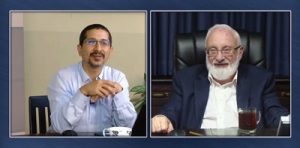
New Life 1294 – Decision Making Process

New Life 1294 – Decision Making Process
Dr. Michael Laitman in conversation with Oren Levi and Nitzah Mazoz

We are living in special times in which the world develops toward connection to one mechanism. This realization should impact our decision making. The main factor in making sound decisions is whether or not the decision will be in sync with the development of society toward mutual interdependence and integrality.

We can make a list of pros and cons, consult experts as well as family and friends, or use intuition; however, we need to ask ourselves what our family and society needs from the decision. Incorporating contradictory opinions from others helps in the process of choosing the right direction.

The final decision should be made after we weigh it carefully and make sure that it is compatible with the integral development.
[277204]
From KabTV’s “New Life 1294 – Decision Making Process,” 1/17/21

icon for podpress Video: Play Now | Download
icon for podpress Audio: Play Now | Download

Different Prayers

562.02What is the characteristic of a Kabbalistic prayer that distinguishes it from the prayers of ordinary people? A prayer of an ordinary person emanates from his egoism without any intention to unite with others and ascend to the Creator.

Therefore, this prayer has a purely psychological effect, calming the person but not changing anything in reality. It has no effect on spiritual forces.

It is possible to influence the forces governing creation only by uniting. If the ten unites, then the whole ten acts as one in relation to the upper force.

And if we do not unite in the ten above our egoism, then we do not have any impact on the upper force. It can be influenced only to the extent of the equivalence of properties, and for a minimum equivalence we need to unite our attitudes in the ten.

Therefore, all the prayers of mankind to the Creator have no effect on Him. They are a natural reaction of the desire to receive pleasure, which the Creator Himself provided to each person. Therefore, it makes no sense for Him to listen to the requests of this desire to receive pleasure, which He Himself created.

But if we combine our desires in the ten and, despite our egoism, want to achieve something higher, that is, the power of bestowal instead of the power of reception awakened in us by the Creator, then we really turn to the Creator as the very source of bestowal. And then He gives us the power of bestowal with which we become like Him.

Our prayer is aimed at becoming like the Creator and gaining the power of bestowal, like Him. And this is possible only if we unite in corporeality.

All other prayers, no matter what religion they belong to, are requests for egoistic fulfillment. Therefore, they are of no use except to gradually lead a person to the need to ask for connection between all and adhesion with the Creator on the basis of the power of bestowal and not the power of reception.

Here lies the huge, cardinal difference from the prayer of a Kabbalist in which we ask to gain the power of bestowal, which is above us, outside of everyone’s personal interests, for the sake of other people, for the sake of humanity, and for the sake of the Creator. Everyone asks to have the power to give to everyone except himself because in this he resembles the Creator, who bestows to everyone except Himself. Therefore, such a prayer is significantly different from all other prayers.
[278249]
From the Daily Kabbalah Lesson 2/12/21, “My Sons Defeated Me” (Preparation for the Convention 2021)

Related Material:
New Life 530 – Which Prayers Are Answered?
When Prayers Become A Song
The World Is Built By Our Prayers

Prophets Will Walk On The Earth Again

750.01The Book of Zohar, VaYechi [Jacob Lived], Item 593: Initially, there was prophecy among men. They knew and beheld to know the glory of the upper one. When prophecy had ceased in them, they used an echo. Now prophecy, as well as the echo, has stopped and people use only dreams.

For many years after leaving Babylon and before the destruction of the Second Temple, there was a group of people who were in a state of personal and group spiritual communication with the upper force or nature, meaning with the Creator.

Beside the fact that they were all at this level, there were also prophets among them. Imagine the level of those prophets who are written about in the holy books!

Then they fell from the spiritual level of “love your neighbor as yourself” into unfounded hatred and lost the feeling of the Creator in their egoistic qualities, that is, they ceased to be prophets. The prophecy disappeared. This is precisely what The Book of Zohar is talking about because it was written at the time when the destruction of the Temple took place.

The destruction of the Temple is the destruction of communication with the Creator.

The Book of Zohar was written to be revealed in two thousand years. And now, after receiving this book from them, we can return to the same degrees of prophecy.

During these 2,000 years, we have completely disconnected from spiritual perception, and now we can return to a state where the prophets will walk the Earth.
[278026]
From KabTV’s “The Power of The Book of Zohar” #3

Related Material:
A Prophet, Work And Designation
Prophets – Spiritual Futurists
What Baal HaSulam Contributed To The Spiritual System

“What Is The Main Ideology Of Kabbalah?” (Quora)

Dr. Michael LaitmanMichael Laitman, On Quora: “What is the main ideology of Kabbalah?“

The wisdom of Kabbalah is a method that enables us to reach the perception and sensation of the highest dimension of reality, above corporeal life and death, while we are alive in this world.

By doing so, we can sense our future states, and we gain the ability to directly influence reality from its “control room.” We need only attain the connection to our life’s source, and by doing so, we assume control of our destiny.

Kabbalah was revealed for the first time 5,781 years ago by Adam, who wrote the book, Raziel HaMalach (Heb. “The Secret Angel”). It describes the concealed force (i.e., “angel” is a certain kind of spiritual force) that operates our reality, and which can be revealed by applying a certain method. After 20 generations of Kabbalists, Abraham made the next major development in the wisdom of Kabbalah by founding the first Kabbalistic group, which became known as “the people of Israel.” This was a group who gathered based on the principle of “love your neighbor as yourself.” Love of one’s fellow man became the Kabbalists’ principle ideology and constitution. They united as a single nation, which later became known as “the Jews,” from the word for unity (“Yichud”).

At a certain stage of its development, the group ended up having to show the Babylonians of the time, who did not want to follow Abraham, the need for self-transformation and correction: rising above the egoistic intention for personal benefit at other’s expense. By doing so, they formed bridges of unification and love upon the rampant hatred and division of the time.

Kabbalah’s main ideology is thus “love your neighbor as yourself,” and the method of Kabbalah is one of attaining such unification above the divisive human ego. At the peak of developing increasing ties of love and bonding above our innate divisive drives, the universe’s two ends—egoism and altruism, division and unification, receiving and giving—become combined into a single creation, namely “receiving in order to give.” By attaining such a principle in practice, we implement the formula for us all to live harmoniously, happily and in balance with nature. Moreover, we also discover the eternal and perfect reality of our soul that exists above corporeal life and death.

We currently have a single quality: reception. Even if we give, we do so with the calculation that we want to receive something in return. By adding the quality of giving over our inborn quality of receiving—i.e., pure giving with no shred of egoistic intention laced within—then we achieve a perfect connection with each other, balancing our egoism with nature’s altruistic quality, or in other words, balancing the negative pole of reality with the positive one.

Kabbalah explains how nature divides into four levels: still, vegetative, animate and human. On the still, vegetative and animate levels, nature itself balances between giving and receiving, positive and negative. At the human level, however, i.e., at the level of our relationships and attitudes to each other, we have no connection to the altruistic side of reality. As such, the more our egoistic desires evolve over time, the more we encounter problems and crises on all scales of life.

In other words, the ultimate cause of our life’s problems is the disharmony between altruism and egoism. The wisdom of Kabbalah is a method for establishing the correct balance between these two qualities, and by doing so, bringing about balance personally, socially and globally.

It is also important to note that Kabbalah is not a religion, but a science. Where religion is based on believing in one or several higher powers, Kabbalah is instead a method by which we reach a revelation of the higher powers through research, experimentation, gathering feedback, and by doing so, “rinsing and repeating” until we can scientifically confirm our attainment of the altruistic quality above our inborn egoistic one. It does not involve performing rituals, wearing any specific clothing or ascribing any special importance to any physical objects. It rather involves study and participation in an environment that supports progress to the attainment of the higher reality. By doing so, anybody can advance to such a lofty attainment.

Written/edited by students of Kabbalist Dr. Michael Laitman.

“What Is The Secret To A Balanced Life?” (Quora)

Dr. Michael LaitmanMichael Laitman, On Quora: “What is the secret to a balanced life?“

We reach a balanced life when we discover the balance between forces of reception and forces of bestowal, which takes place when we disclose the general force of balance that exists in the system we are parts of. At that point, we start feeling the entire system and not only ourselves, the individual parts of the system. We then come closer together in mutual connection, bestowal and support such that we all lose our sense of our individual selves and instead sense the life in the whole system.

We then feel the whole system, which includes humanity as well as nature on all of its levels, as our own. On our current level, the closest example to this sensation, even though it is still far from the actual feeling, is a mother toward her family: She feels that she loses her sense of self in her commitment to her family, feeling her family as her own. In other words, her devotion to her family expands her sense of self to include all of her family members, and she somewhat exits her own individual self in such a sensation.

Therefore, when we realize ourselves in the direction of bestowal upon others, i.e., when we think about benefiting others over self-benefit, we exit the limited and narrow boundaries of our individual selves and open up to those whom we wish to benefit similarly to a mother toward her family. The wider the circle of society we do this for, the more of the system of nature and reality we feel.

Ultimate balance in life emerges when we care about the whole of humanity and nature. Our sensation of existence then expands to include the life of the whole of humanity and nature and not only the transient and short life of our individual selves. Moreover, by doing so, we discover our ultimate destiny in reality, that of living for the sake of the whole system we are parts of and feeling the life of that system, and we also find how nobody stands in anybody’s way, as it currently seems to us.

If we start directing ourselves in such a holistic manner, then we will also see how this system, call it “nature” or the “universe,” starts giving us positive feedback in that direction, helping us on our way.

Practically, in giving and bestowal upon others, by wanting to benefit and positively connect with everyone, we will then feel a special kind of support and vitality, that nature and life works in our favor by doing so.

In order to discover these signs, we need to surround ourselves with a supportive environment of like-minded individuals who wish to support each other toward this ultimate state of balance. By learning and seeking how to benefit others over self-benefit with these people, and finding our place in such an environment, we then progress correctly toward that final state of ultimate balance in life.

The state of balance through positive connections among each other and with nature is the discovery of the human degree in the world (the Hebrew word for “human” [“Adam”] stems from the phrase “similar to the most high” [“Adameh le Elyon”]). We need a supportive environment of like-minded individuals specifically because care for one another needs to be mutual, where we each exercise positive connections and giving to others mutually above our innate self-interests. Over time, by integrating in such a society, we eventually reach the realization of the ultimate balance in life. Moreover, the efforts of a critical mass of people who direct themselves in such a way positively influences others in the world who do not awaken to such a direction, thus also making it easier for others and future generations to reach such balance.

Ultimately, we will all develop to the realization of humanity as an interconnected and interdependent system, similar to nature in and of itself. When we reach that level of consciousness, we will all “click” into nature, integrating into and identifying with it, and adhering to it such that we all realize the destiny of every person individually and of all people in the world together.

Written/edited by students of Kabbalist Dr. Michael Laitman.

Everyone—In Their Own Time

281.01Question: You say that all people have a point in the heart, but it awakens in some and not in others. What is light and darkness for a person in whom the point in the heart has not awakened? What is the meaning of his life?

Answer: We live the same way as other people until the point in the heart awakens in us. Don’t think that everyone else’s life is wasted. They must also go through these states because certain Reshimot (informational records) without which they will not be able to attain any spiritual states and enter the spiritual world do accumulate in them.
[258716]
From KabTV’s “Fundamentals of Kabbalah” 12/15/19

Related Material:
When Does The Point In The Heart Open?
Does Every Person Have A Point In The Heart?
Two Ways Of Revealing The Point In The Heart

Three Kinds Of Desires Within A Person

632.4Question: There are many characters in the stories of the Torah, each of which personifies the inner desires of a person. The basic state in Kabbalah is the exodus from Egypt, meaning from your egoism. Who are the “Egyptians” within us?

Answer: “Egyptians” are all kinds of our egoistic properties. They can be small or large, depending on these characters.

In Rabash’s articles it is written that “Egyptians” are desires within me that say: “Do actions, intention does not matter. This is not for you, you are not yet mature enough.” That is, my egoistic properties calm me down and drag me away from intentions; intentions are not the main thing, the main thing is actions.

Comment: Even in primary sources, you can find some kind of support for actions without intention.

My Response: It depends on how we see the primary sources. Indeed, the Torah speaks of intentions.

Comment: But you also often say: if you do not have the strength, the main thing is to do something, and the intention will come later.

My Response: Yes, but you do it and the intention will come later.

Comment: We also have desires within us that are called “secular.” They are practically neutral. They lack not only the intention, but even the strength to do actions to unite.

My Response: Such states also occur in a person who is already moving toward a goal. And the rest of the people have no action or intention. They are simply in their elementary egoism.

Let’s say you have to go to class. But there is no strength to go to do something in a group, let alone an intention. This is called secular desire. A person acts like a small animal, guided only by his natural movements, motives.

And the desires of the “Egyptians” are already an ideology: the main thing is to clearly fulfill what is prescribed while the intention is not at all important. This is called “Mitzvot anashim melumadam” meaning, I was taught that way and I do it. That is, by my actions, it seems that I can reveal the Creator without changing my nature, without changing my intention.

I am like a machine that must perform mechanical actions. And with them, I still have to say all sorts of phrases that supposedly replace the intention: blessings and so on.

In addition, there is a kind of desire in man, which is called “Erev rav” meaning “mixed multitude.” These are people organized into groups who perform actions with the intention “for their own sake.”

Question: Unlike the Egyptians, do they have an intention?

Answer: No, the Egyptians are the next level of egoism: “I do everything in order to achieve reward both in this world and in the next world.”

And about “Erev rav” it is said that they are afraid of the Creator, but work for Pharaoh, because all their actions are for themselves.
[277654]
From KabTV’s “Spiritual States” 4/22/19

Related Material:
“To Kill The Egyptian” In You
“God-Fearing” Egyptians
“The Mixed Multitude” In A Person, Nation, And The World

Daily Kabbalah Lesson – 2/17/21

Preparation to the Lesson

[media 1] [media 2]

Lesson on the Topic of “Prayer” 

[media 3] [media 4]

Selected Highlights

[media 5] [media 6]

Audio Version Of The Blog – 2/16/21

Listen to an Audio Version of the Blog
Download:MP3 Audio