Self-Deception

600.02Question: How can we explain the advantage of sensory transmission of information from person to person?

Answer: There is no way to explain it because people will not be able to work with this anyway.

Now everyone remembers how in 1997 scientists received a Nobel Prize for developing a theory about the absence of the probability of an economic crisis, as a result of which a society of unlimited consumption can develop endlessly.

How can this be if natural resources are being exhausted, if pollution reaches such magnitudes that it buries us under garbage in this huge earth dump? How can one write that a society of unlimited consumption can develop endlessly and all people on earth, absolutely everyone, will be able to reach unlimited opportunities, and unlimited success? From where?

I was surprised by this view of the world when I visited Disney World’s Epcot Center for the first time 30 years ago. Epcot Center is a round building, which you enter by a little train and you are shown the entire history of humanity from the past, present, up to the future. The future is represented by the fact that everyone has a helicopter, walls of houses are covered with televisions, etc. That is, everything is so fancy. They placed a person in a state from which he cannot get out. What a future!

Egoism blinds us so much that we invent such theories and give Nobel Prizes for them, believing that there will be no end to our development, although long before that the Club of Rome and other scientists said that everything ends.

Why do we award such economists the Nobel Prize? Because we want it to be so. Can you imagine what a self-deception this is?! What can we come to? How can we explain to a person that there are other technologies if people cannot change themselves?

Comment: But you say that in the end, they have to come to it anyway.

My Response: I think that nowadays it is just getting to the point of personal and common internal correction in order to reveal inside ourselves the next level of the universe, the spiritual state. Then this world will involuntarily disappear from our perception. As soon as we begin to feel spiritual qualities, forces, and systems inside ourselves, we will stop seeing this world.
[314358]
From KabTV’s “I Got a Call. Consumer Society” 6/27/11

Related Material:
Where Did The Rosy Prospects Go?
Life Is Not A Random Set Of Events
Rise Above The Body
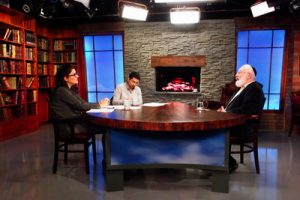
New Life 255 – Relationships With Neighbors

New Life 255 – Relationships With Neighbors
Dr. Michael Laitman in conversation with Oren Levi and Nitzah Mazoz

Why are there many conflicts between neighbors? Can we learn to live together by changing our attitude to one of goodwill?

My neighbor is basically “inside my house” with his noise, his smells, his music, etc.

When one makes good connections with neighbors, everyone benefits. It’s hard to tolerate neighbors because there is no buffer between us. They are as if “under my skin.” If my daughter makes noise, I may be fine with that. But next door ?! If we can break the walls of our heart and feel closer, there will be fewer problems with the neighbors.

In neighborly relations, there is no point in trying to determine who is right and who is not, but only to build good relationships. You can create a sense of paradise inside the building—a cloud of calm, confidence, and warmth.

A series of events to foster good relations between neighbors could be scheduled. Neighbors might start with a connection workshop to talk about the good things and the good people in our building. A shared sense of “home” can bring a person security and warmth that he will never achieve in his private apartment.

This could be followed with a good neighbors workshop: In a circle, each one expresses good things about the other, even if they don’t know each other. When I have a good thought about them, it already makes me feel better in the building. This workshop could include an exercise: During the week, write in a few sentences what you went through with the neighbors in the building. At the end of the week, everyone briefly describes what living in our shared home this week felt like.
[123672]
From KabTV’s “New Life 255 – Relationships With Neighbors,” 11/17/13
This summary was written and edited by students of Kabbalist Dr. Michael Laitman

icon for podpress Video: Play Now | Download
icon for podpress Audio: Play Now | Download

“What is the difference between learn and read Torah?” (Quora)

Dr. Michael LaitmanMichael Laitman, On Quora: “What is the difference between learn and read Torah?“

“When a person learns Torah, he must intend that the Torah and Mitzvot he is doing will help him emerge from the control of the evil.” – Kabbalist Baruch Ashlag (Rabash), “What Is ‘The Earth Feared and Was Still,’ in the Work.”

Learning Torah requires applying an intention to change our egoistic nature, which makes us want to enjoy ourselves at the expense of others, to its opposite.

By intending to turn ourselves into altruists who connect positively to each other, it means that we use what is called “the light”—the upper light, the upper energy, the light of the Torah, or the Torah itself—in order to correct ourselves, i.e., to change ourselves from egoists to altruists.

Learning Torah thus means constantly feeling what is happening to us at the level of our desires, thoughts and actions. It is learning not with the mind, but with the heart.

By learning Torah, we conduct inner work on the path to life’s goal, and we use the Torah as the force that corrects us, i.e., which inverts our nature from egoistic to altruistic. Thanks to such a force, we can then identify the evil within us—our egoistic nature—to the extent that it eventually ceases to exist.

After such a diagnosis, the Torah turns the evil in us into goodness and we then resemble the Creator, the absolute good force of love, bestowal and connection. We then become filled with love and bestowal toward others and through them to the Creator, the force of love and bestowal itself. We then discover what is called “the whole world is filled with His glory.” In other words, we reveal the Creator—the force of love, bestowal and connection—as existing in everyone and everything.

Based on the Daily Kabbalah Lesson with Kabbalist Dr. Michael Laitman on August 6, 2023. Written/edited by students of Kabbalist Dr. Michael Laitman.
Photo by Taylor Flowe on Unsplash.

Daily Kabbalah Lesson – 9/1/23

Preparation to the Lesson

icon for podpress Video: Play Now | Download icon for podpress Audio: Play Now | Download

1st part of the Lesson — Writings of Rabash, “What Are Commandments that a Person Tramples with His Feet”

icon for podpress Video: Play Now | Download icon for podpress Audio: Play Now | Download

2nd part of the Lesson — Lesson on the Topic, “Purifying the Heart”

icon for podpress Video: Play Now | Download
icon for podpress Audio: Play Now | Download

3rd part of the Lesson — Writings of Baal HaSulam, “General Preface” Item 1

icon for podpress Video: Play Now | Download
icon for podpress Audio: Play Now | Download

Selected Highlights

icon for podpress Video: Play Now | Download icon for podpress Audio: Play Now | Download

Audio Version Of The Blog – 8/31/23

Listen to an Audio Version of the Blog
Download:MP3 Audio

The Creator Wants Us to Be Corrected

559Question: It hurts me that the Creator does not love me the way I am. It seems to me that He wants to change me, break me. How can I feel love for Him from this state?

Answer: But why should the Creator love you? Why do you demand that He love you the way you are? On the contrary, we must ask the Creator to correct us.

This is why I do not like myself the way I am now. Each time I love myself more in the form in which I want to see myself in a day, in two, and so on. So, do not get confused.

The fact that the Creator does not love us in today’s state is very good. He wants us to be corrected and thus gives us such feelings.
[316892]
From the Daily Kabbalah lesson 8/10/23, “Habit becomes A Second Nature”

Related Material:
What Should You Ask For When You Are Suffering?
A Kabbalist’s Prayer
A Request Is An Expression Of Inner Aspirations

How to Use Pleasures

276.02All pleasures have a specific image from which we receive pleasure. A person must understand precisely whether he is following them for the sake of connection with his friends and with the Creator or whether he is against these pleasures.

In order to properly receive them and thank the Creator for them without the shame of receiving them, we must try to clarify our relationship with the Creator so that all our desires, intentions, thoughts, and aspirations are directed to Him.

Question: At the moment of enjoyment, do you need to think that it gives pleasure to the Creator or should we rejoice and enjoy what He gives?

Answer: It depends on who the pleasures come from: from you to the Creator or from the Creator to you.

The task of enjoyment is that we correctly orient ourselves to the Creator; it is when you want to accept this pleasure only if you bring contentment to the Creator.

Question: And if I don’t need special pleasures, but the Creator gives them to me, what should I do?

Answer: You should receive them and be grateful; enjoy them with the Creator and with the ten. And if they distract you from connection with your friends, then you don’t use them. But in the end, absolutely all pleasures can be used for the sake of integration with the Creator.
[316903]
From the Daily Kabbalah Lesson 8/11/23, “Habit Becomes a Second Nature”

Related Material:
What Can Bring Contentment to the Creator?
Don’t Be Afraid To Receive Pleasure
Love The Lord Your God With All Your Heart

Questions about Spiritual Work—11

963.5Question: How should I relate to the pleasure from meetings of the ten?

Answer: Enjoy; just make sure you understand that you receive pleasure from the connection with the friends.

Question: What should one choose: a meeting with the ten or watching a lesson alone?

Answer: Undoubtedly, a meeting with the ten. You can listen to the recorded lesson later.

Question: Is it true that suffering and pleasure are the carrot and the stick from the Creator?

Answer: Let it be so for now. Later, you will see that both are carrots.

Question: Is efficiency in spirituality the ability to quickly rise above states?

Answer: Yes, from a descent to an ascent.
[316931]
From the Daily Kabbalah lesson 8/11/23, “Habit becomes A Second Nature”

Related Material:
Questions about Spiritual Work—10
Questions about Spiritual Work—9
Questions about Spiritual Work—8

Complement, Don’t Contradict

282.01

This is why the forces of separation are called “locks,” since they block the gates of approaching and drive us away from the Creator (“Two Points,” Introduction to The Book of Zohar).

Question: What are these properties that distance us from the Creator?

Answer: Everything that we do not yet attain as the sum of all our efforts and everything that we do not yet attain as unity is manifested within us in the form of all kinds of contradictory properties and mutual rejection from each other only in order for us to understand the law of manifestation of properties and come to a state when all these properties will complement each other and not contradict each other.

Then we will reveal unity, that is, the property of the Creator, which is manifested literally in the entire creation.
[316805]
From KabTV’s “Introduction to The Book of Zohar” 8/6/23

Related Material:
Merging Of Opposites
Unity Is A New Reality
When The Gates Open…

Problem of Goal Setting

963.4Question: There is something called a goal setting problem. It applies both to humans and artificial intelligence. When a person sets a goal for himself he needs to evaluate whether it is good or bad in a global sense and  whether it brings him closer to something or moves him away from it.

This evaluation is done on both a genetic level and on the basis of moral principles acquired from society and the laws of the state.

When artificial intelligence is being trained, a problem arises in how to evaluate its actions, because if even a single factor is not taken into account, the artificial intelligence might ignore it. Let us assume the task is to plant a field of strawberries without harming any humans. If the factor of not harming humans is ignored and not included in the overall algorithm, it will lead to significant harm. This is an intricate and complex system that is impossible to design perfectly from the start.

How can we determine what is good and what is bad? I understand that this is a higher-order problem. But still, on the basis of what can be done or at least to come closer to the conclusion that it is good and what is not?

Answer: First, if something is done for the benefit of people—not just for one individual or a single group, but for the benefit of all people—then it is considered good. Second, it is considered good if it does not cause irreparable harm to nature in the process. That is all, really.

These two rules are essentially complex, but they encompass a lot within them.

Question: Is this similar to Kabbalistic definitions where seemingly simple definitions contain the entirety of the universe or the whole path of humanity from the beginning to the ultimate goal? How do you operate with such things in practice?

Answer: Only under the condition of proper education for all the inhabitants of the planet. That is, to load the right information into a person in the course of life and work it out with him until it becomes a practical necessity and reality.
[316528]
From KabTV’s “Kabbalah Express” 7/31/23

Related Material:
Artificial Intelligence
Man And Artificial Intelligence
Artificial Intelligence And Problem Solving