Audio Version Of The Blog – 4/22/25
Posted on April 22nd, 2025
Listen to an Audio Version of the Blog
Download:MP3Audio

Listen to an Audio Version of the Blog
Download:MP3Audio
 In the beginning, the spiritual path seems pleasant, attractive, and inviting; it promises extraordinary attainments, revelations, and spiritual elevation. But then we begin to understand the price we must pay for all this and what is required of us to bring ourselves in line with the spiritual level. Thus, the path becomes increasingly difficult, no longer so appealing, but rather repelling, confusing, and even humiliating.
This is the period symbolized by Maror (bitter herbs). And in truth, it is not easy to go through it because it is like searching for a goal in complete darkness, struggling through dangerous paths and narrow bridges, and climbing a mountain toward the King’s palace. Reaching it seems as likely as shooting a tiny coin from a great distance.
That is why we must sharpen our perception and get used to a new state by rising through faith above reason to a new sense. The only thing that can help here is strengthening the greatness of the goal and the greatness of the Creator.
Otherwise, the spiritual goal loses its significance for our egoistic desire. We see how many who are unable to cultivate and develop the sense of the importance of the spiritual goal above all the darkness and hardship leave this path.
“Only heroes,” as Baal HaSulam writes, attain the goal by seeing no other choice before them and thanks to Arvut (mutual guarantee). This is the time of bitter Maror. Only those who establish themselves correctly will develop a new system called “faith” inside them and will begin to work in bestowal, detached from their egoism. They will escape from exile and step into the land flowing with milk and honey.
[223944]
From Daily Kabbalah Lesson on 3/22/18, Writings of Rabash “What Is, If He Swallows the Bitter Herb, He Will Not Come Out, in the Work?”
Related Material:
“Don’t Swallow Maror Without Chewing It”
The Contrast Between Black And White
Pesach, Matzah, And Bitter Herb
 Before the Exodus from Egypt a person passes through “49 gates of impurity.” That is, he no longer believes in anything; he doesn’t expect anything; he sees that he just about doesn’t have any connection with the upper force and that it is impossible to change anything in his life. Where is this upper force found, which is “There is none else beside Him”? Everything is under the control of Pharaoh and it is impossible to do anything against the ego that controls him.
A person doesn’t understand and doesn’t believe in the “good that does good.” Only a thin thread connecting him to spirituality remains; it is so fragile that he no longer believes that something will come from it. The despair is so great, and the thread that holds him is the patience that is beyond the intellect and logic.
This situation gradually accumulates, and if the person truly reaches the 49 gates of impurity, then the upper power acts against them, acquiring redemption for him.
Here it should be mentioned that “every action leaves an impression,” time after time, a bit further and further, and so we count the 400 years during the period a person accumulates clarifications, efforts, even weaknesses, and over comings, which he succeeds in doing by himself or with the help of the Creator.
Our entire struggle to leave Egypt is under the control of the Creator, There is none else beside Him and He is the good that does good. And the Klipa (the egoistic force) denies the higher providence of There is none else beside Him in every possible way.
The servitude, the exile (in Hebrew, Galut) differs from the redemption (Geula) basically because of the letter “Aleph,” which is the Lord of the World. One must concentrate on this point constantly and not on anything else. Specifically it is necessary to constantly sharpen our clarification, fight against our nature, against Pharaoh, because there is none else beside Him, the good and that does good.
We don’t ask for someone to change anything; we don’t appeal our fate. Instead we only turn to the Creator with our requests. This is what there is none else beside Him, means, because everything that happens we connect only to Him. Only He performing every action, preparing them so that from within the struggle against all the disturbances in which He has wrapped Himself, we discover Him and turn to Him.
Exile means that we are still not ready, but we very much yearn to discover the source of everything that is happening, as it is said, “I and not a messenger.” This is a very important moment. This is our only work, and it is up to us to be ready for it.
It is very important to remain at this point like a ship or an airplane that we must constantly navigate to remain on the right track despite the wind and various disturbances. This is possible only with a good crew.
Everything is constructed so that a person is not prepared to maintain his position by himself. Problems fall on him, and then pity is taken upon him and he is given another opportunity. But this chance is specifically to build the right team for himself so that together with them he will maintain his direction.
It must always be remembered that all of the disturbances come from the Creator and not from Pharaoh or his army and that there are no accidents and no messengers. Instead everything comes directly from the Creator. Our task is to discover the Creator instead of all the sources of power and other actions. Through this, our servitude, the blows, and all of the events of the story of the exodus from Egypt are revealed. All of this is a struggle to locate the Creator through all of the disturbances that are found between the Creator and us.
In the beginning there is no connection between the Creator and us because we are opposites. And the disturbances come precisely so that we will use them to build a connection with the Creator. So we see that Pharaoh brings us closer to the Creator; the evil inclination is help against us (Genesis 2:18) and we transform that into a connection with the Creator.
If we consistently work this way and try to build connection, then gradually we rise to a stronger and stronger connection, like the rungs of a ladder, and we fall into even greater disturbances, into a greater lack of connection. And again we try to build Pithom and Ramses and again fall, losing the connection, tearing, and becoming confused, denying any control by the Creator.
As a result of our efforts we pass through 49 gates of impurity. If we reach the 49th gate, it means that we have made a multitude of corrections on our connection with the Creator. But this is hidden from us. For a fraction of a moment we discover something and fall immediately. In this way we must discover all of the disturbances that are contrary to the fact that there is none else beside Him.
And the discovery is made according to the principle of “I and not a messenger” if we are ready to depict the upper force in spite of all the disturbances. The exile is given to us so that we can feel the Creator, locate Him within “out of nothing.” That is how we reach redemption.
So it is impossible to forget that all of the work towards redemption is to determine the fact that there is none else beside Him when faced with all of the disturbances that of course come from the Creator.
[R131431]
From the 1st part of the Daily Kabbalah Lesson 4/01/14, Shamati #190
Related Material:
The Ability To Manage My Future
Make The Last Step Towards The Redemption
Today’s Environment Is Tomorrow’s Me
 There isn’t a more important state than our current state, since this is where our spiritual evolution begins. It is in our situation, in our condition, that the exit to the first spiritual level is possible. It cannot be any other way. Everyone starts off this way. We are given a special opportunity and we have to use all the means that we are given in order to bring ourselves to the feeling of exile, to feeling that we are in chains and in the worst possible state under the domination of Pharaoh.
Pharaoh controls even our smallest thought, our smallest desire, wherever we turn and whatever we do. Every impulse and every move we make stem from him; every thought and every stream of consciousness, every desire and all the desires that stem from it, are all determined by the ego. No matter which way we go and how far we try to move away from evil, we remain in the ego.
A person determines that he cannot leave exile, although he really wants to exit it and makes many attempts, many great efforts, and exerts himself, but it leads to nothing. When he cries out desperately with the last powers he has left for only this last cry, a miracle takes place and he comes out of Egypt.
Now he begins to understand and to feel what it means to be under the influence of the light. He comes out of his enslavement to his desire and voluntarily becomes enslaved to the light, by choosing to be under the domination of the attribute of bestowal, above reason.
He knows that he is becoming a slave, that he is enslaving himself, and that he isn’t free anymore, but he is free of the desire to receive and from his beloved self, about whom he constantly worries. He is under another kind of domination and actually wants to be under this domination.
There is no neutral state on the way between egoistic Egypt and complete bestowal. A person immediately moves from one kind of domination to another, but he wants it and yearns for it even when he is still in Egypt. Besides the repulsion, the hatred, and the rejection he feels towards the state in Egypt, he also yearns for the total domination of the light so that it will totally rule him, guide him, and manage him.
This is how we should prepare ourselves internally. Let’s hope that we are somehow ready for that and as for all the rest—the Lord will complete the work for us.
[R132569]
From the 1st part of the Daily Kabbalah Lesson 4/13/14, Writings of Rabash
Related Material:
Pharaoh’s Slave Or The Creator’s Servant
Preparation For A Prayer
Poof!
 The Midrash “BeShalach”: Although the sea has not yet parted, the sons of Israel continued to move deeper towards the mighty waves. Water has already reached them up to the neck.
Moses stretched out his hand toward rolling waves and commanded the sea, “In the name of the Creator, make way!” But the sea did not obey.
The sea did not want to change its borders, which were established during the six days of the Creation. The Creator commanded Moses to raise his staff and to threaten the sea, in the same way as the host raises his stick at the rebellious servant. However, the waves did not retreat, and continued to heave.
Then the Shechina (the phenomenon of the Creator) appeared before the sea and it parted. “Why now, the sea, are you gone?” Moshe asked the sea. The reply came, “I retreat just for the King of the World Himself!”
Even in distant countries the roar of the sea being ruptured was heard. At this point, not only the Yam Suf (the Final Sea) parted, but the water of lakes and wells in all countries have parted, even the water in jugs has parted!
Thus a miracle appeared in the whole world! Water around the world returned to its natural state only after the Yam Suf water (the Final Sea water) took its usual position.
The movement of people takes place in the general property of Bina, and all parts of Bina, no matter where they may be, have imbedded Bina’s properties in the properties of Malchut. And if the people reach bestowal, then Bina starts to work at all levels just like in a chain reaction. Therefore, it is said, “the waters of lakes and wells were parted in all countries, and even the water in a pitcher has parted.”
Question: Why didn’t the sea obey the command of Moses?
Answer: In order to exit from egoism, it can be accomplished only by the help of the upper light under the influence of GAR de Bina and the huge Light Hochma, i.e., properties that are called “the Creator.”
Every effort must be taken in order to do this, but it turned out that no one but Nachshon possessed such an opportunity: neither Moses nor Aaron knew, even the priests did not know anything about the property of “Nachshon.”
Usually, a person has no properties that would ever come forward, like a group of athletes that run to the finish, where a leader breaks out ahead. But this group has to come together to the finish line, and if they do not run together, then neither the first nor the last person reaches the finish line.
The main thing is for the whole group to come together to the sacred goal. The leading person of the group has to set the tone since one runs in front, but each time the leader changes. With this, none of the characteristic properties of any person get lost, but rather they must occur at least for a moment while a person is being led and while leading the whole humanity.
Let us say all of humanity is a circle. I am in this circle with my inherent property. While I am in this property I should be once in front of everyone and once behind everyone. Every person does the same. The real property of each person is necessarily manifested twice as leading the whole of humanity and as being led by all mankind.
Question: A concept of “leading mankind” is clear, but why should it be guided by all of mankind?
Answer: There cannot be one without the other, because only in this way the true property of a person manifests itself. All other properties are mixed together. And one’s private quality should manifest only as Keter and Malchut.
[R152616]
From KabTV’s “Secrets of the Eternal Book” 4/30/14
Related Material:
For Waters Of The Sea To Part…
Israelis In Egypt
Nachshon’s Leap
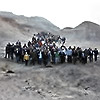 Question: Was there ever a miracle that the Red Sea parted and the Israeli people went through it when they fled from Pharaoh?
Answer: The Torah doesn’t talk about events of our material world. It talks only about what happens between our souls. In this sense, we pass through an inner spiritual state called “Crossing the Red Sea.”
The exodus from Egypt and the freedom from the slavery of Egypt is freedom from the control of our ego, from the “Angel of Death.” In principle, on the way to this freedom, we move through some kind of passage called crossing the Red Sea. It symbolizes the end of Egypt, the end of our ego, after which we can become a free people.
A unique force of unity is hidden within nature that is called the Creator. When we invest in efforts to unite, to get closer to each other against our desire, then through these efforts the higher power creates a state where “splitting the Red Sea” will be discovered. It moves us from the egoistic nature to a nature of bestowal and love.
[R155910]
From Israeli Radio Program 103FM, 3/15/15
Related Material:
We Depend On One Another
The Leap Into The “Red Sea”
Under The Yoke Of The Ego

Talks about the Steps of the Ladder, Part 111
How Does the Transition from Anger at the Creator to Recognizing His Importance Take Place?
If we are angry, then we are in a big desire to receive, deeply immersed in ourselves and our needs. Why are we angry? It is because something contradicts our desire. We want to do things one way, but the Creator wants them done differently and does not let us achieve our desire.
How do we come to recognize the importance of the Creator from within this anger? The will to receive, when not paired with the will to bestow, only considers its own benefit. The moment it encounters someone stronger opposing its will, it immediately submits to them because it sees that this is to its advantage. It even begins to love the other because they are stronger, even though they are against them. They begin to depend on them.
In our world, whether we like it or not, the strong one is always right. What does “in our world” mean? It means in the will to receive. From within the will to receive, in order to shift from valuing oneself to valuing the Creator, we simply need to recognize that the Creator is stronger than us, and this cannot be changed. From the very nature of the will to receive arises the realization that “the Creator is great,” “the Creator is good,” and so on. From there, we start to reach states that teach us how to bestow.
What does it mean, “to bestow”? It means granting us the independence to say, “I want to bestow, and not because the Creator is stronger than me,” as if to stand up to Him.
At this stage, we have free choice. Only when we have the ability to do whatever we want, do we truly begin to examine whether we wish to act according to our natural inclinations or if we want to resemble the Creator. The will to receive is satisfied as soon as it sees that the Creator is everything, that He is just and great. Then it has no problem accepting that the Creator is all there is and that He is right. Since we are entirely a will to receive, we surrender immediately.
Even though this realization might provoke rebellion, it is our nature, and there is no point in resisting it. This is why we are taught through suffering. The will to receive respects power, follows it, and always finds justification for itself. Baal HaSulam calls this “the power of the fist.” This is how the will to receive operates.
If the will to receive seeks fulfillment, and fulfillment is all that matters to it, then it has no other considerations. It calls “good” whatever provides it with fulfillment, regardless of the means by which it attains it, whether or not they are appropriate. The concepts of appropriate or inappropriate do not belong to the will to receive itself or to fulfillment. Instead, they belong to the system of Kedusha, which has introduced to receive various discernments of bestowal into the will.
In practice, the will to receive cares about nothing other than being filled. It does not care who fills it, whether the Creator or Pharaoh, as long as it receives and is satisfied. Therefore, as long as we are in the Klipa, the Klipa nurtures us, which is called “protecting us.” It nurtures us by continuously giving us more and more fulfillment.
How, then, do we arrive at true reception? It is by becoming disillusioned with the many false fueling stations. We try to fill ourselves with money, honor, sex, and food, and when we see that they cannot be truly satisfied, we turn to the Creator, hoping that perhaps spirituality will fill us. This is what the will to receive seeks, to be filled at all costs.
That is why it does not matter whether people “want” or “do not want” spirituality. The key is to show them that Kabbalah contains fulfillment, and then they will desire it. This can be clearly seen in the behavior of biological cells or in the mating behavior of animals.
How does a herd choose its leader? Solely based on strength. It becomes evident that everything in nature is arranged in such a way as to lead us to the truth. All of these conditions are embedded in our very nature, in the will to receive, in its inversion of form. They develop directly into failure, suffering, and ultimately, submission.
From a Talk on the Article “The Whole of the Torah Is One Holy Name,” 6/6/2002
Related Material:
Talks about the Steps of the Ladder, Part 110
Talks about the Steps of the Ladder, Part 109
Talks about the Steps of the Ladder, Part 108
Preparation to the Lesson
 Video: Play Now | Download Video: Play Now | Download |
 Audio: Play Now | Download Audio: Play Now | Download |
1st part of the Lesson — Writings of Baal HaSulam, “Matan Torah (Giving of the Torah)”
| Video: Play Now | Download |
Audio: Play Now | Download |
2nd part of the Lesson — Writings of Baal HaSulam, “Study of the Ten Sefirot,” Vol. 1, Part 2, “Inner Observation,” Chapter 8, Item 86
| Video: Play Now | Download |
Audio: Play Now | Download |
Selected Highlights
| Video: Play Now | Download |
Audio: Play Now | Download |
 Daily Audio Version-MP3
 Get the Weekly eNewsletter
 Follow on Twitter
