Audio Version Of The Blog – 2/2/25
Posted on February 2nd, 2025
Listen to an Audio Version of the Blog
Download:MP3Audio

Listen to an Audio Version of the Blog
Download:MP3Audio
 Comment: You say a person studies Kabbalah not to attain wisdom but to develop the ability to perceive the next dimension.
Answer: Of course, because we live through feelings. When they develop in us, we can analyze them: if it is hot, light, warm, and so on.
I have five senses, which I can explore and develop based on my perception. Such exploration creates science. In other words, all our sciences are data collected from our senses and devices we add to them like microscopes, telescopes, etc.
That is, first, we use the matter of creation, the desire. Then, in this desire we feel everything that happens in it, all kinds of disturbances and fluctuations; we examine them, record them, scale them, put them in order, and from this our science arises.
When I measure something, I do it relative to my qualities. But I cannot even imagine that I am exploring everything relative to myself. If other creatures were in our place, they would see and measure everything entirely differently. We just do not understand how connected we are and we act only from inside this box, from our body.
Therefore, when a person enters into the sensation of the upper world, the first thing he realizes is how subjective all his previous knowledge, feelings, and experiences were. But understanding this is only possible when he acquires one more system.
[340051]
From KabTV’s “I Got A Call. The Development of feeling” 5/28/10
Related Material:
Change The Apparatus Of Perception
The Perception Of Reality: A Springboard To The Upper World
Perceiving The Hidden Realm Of The Universe
 Question: If you disseminate certain visual things to the whole world, such as dancing, they can reject a person a little. There are some dances that are incomprehensible to people.
Answer: There is no dancing at all in Kabbalah. The fact that people hold hands and dance in a circle is the most popular among all nations because this is how connection naturally manifests itself. It has nothing to do with any national or Kabbalistic peculiarities.
I personally do not see myself in it. Singing—yes. It depends on the songs: with deep content, when everyone sings together, it helps to connect thoughts, hearts, and desires. But dancing? It depends on how it is done. If dancing is some kind of general movement, if it goes in rhythm with the flow of inner thoughts, then yes.
When people hold hands, it is also natural because shaking hands is an expression of inner motives. If the movement comes from within people, it will not seem strange or artificial to anyone, and everyone will accept it as a manifestation of their inner feelings.
This often happens at our congresses, when thousands of people from dozens of countries gather, and it all seems natural to them.
If a person sees African or Indian dances for the first time, they may seem strange and unusual to him. I would say it is not the case here. These are universal movements. When people from many countries hold hands, dance in a circle (a circle is the epitome of equality), follow a common movement, sing a familiar song, and utter words expressing their aspirations I do not think it looks strange. It might be in the middle of Broadway or Tverskaya. But if it comes from within people, and such actions are accepted in our global culture, they cannot be misunderstood.
In all kindergartens worldwide, the teacher tells the children: “Hold hands, stand in a circle, start walking and singing.” Such human expression, when they play and express something together, is the most natural thing. These actions are not planned. They appear spontaneously.
[339997]
From KabTV’s “I Got a Call. Let’s Dance…” 5/22/1
Related Material:
A Dance In A Circle
The Spiritual Root Of Dance
The Creator Is Playing Hide And Seek With Us
 Question: Many people want to conquer Everest, one of the highest peaks on Earth. The height of Mount Everest reaches 8,848 meters above sea level. Climbers and scientists have given this high area of the mountain the name “death zone.”
Why does a person strive to conquer these unreachable peaks?
Answer: It is a sport, a game, to prove to yourself that you can do it, like others. There is a desire in man to establish himself above nature.
Question: A person strives to conquer a mountain, reach higher, be better, and prove to himself and others that he can overcome the limit of human strength. What should he do higher, better, overcoming, and not yielding in his inner spiritual ascent?
Answer: In general, a person wants to conquer peaks, to be above nature, to rise above himself, and to realize himself at the most critical point. This is a human trait.
Of course, an animal will not go there. It understands perfectly what is better or worse and always strives for maximum comfort.
For man, on the contrary, the zone of maximum comfort means nothing if there is still an opportunity to assert himself as a person. Because inanimate, vegetative, and animate levels of nature exist in him, but even higher than that is a level of human in him.
Question: What is the human level that haunts him and pushes him into all these dangers?
Answer: He wants to be above nature. There is an additional point in him called human. But it resides inside the animal in him. Therefore, when we develop the human in us, the animal begins to suffer: “Why on earth are you thinking not of me, not of the animal, but of something above me?” Then, we enter a conflict: the human strives upward and the animal dies.
If a person truly aimed to rise above the animal level in him, he would not cross oceans, storm mountain peaks, or descend to the depths of the sea. The meaning of life is not found in these places; it lies in the conquest of one’s inner nature and environment.
Question: What does it mean to rise above the level of nature from the point of view of Kabbalah?
Answer: To rise above the level of nature is to rise above one’s egoism. Because our egoism is in us on three levels: inanimate, vegetative, and animate to rise above it means to rise above our egoism, that is, from a state of hatred of one’s neighbor to love of one’s neighbor.
Question: Why is it easier to conquer the outer peaks or outer depths?
Answer: This is even greater elevation of egoism, the desire to raise it higher! I want to be proud of it: “Look at me! My animal climbed where no animal has ever climbed, but I have!”
What is human about this? Nothing! If a car can do it, what is the point of my going there?
Question: You met with the head of a large Aikido organization. During the conversation, he said Kabbalah speaks about the amazing vertical connection between man and God.
What is this connection that helps a person anticipate what will happen in the future: the outcome of a duel, the outcome of events?
Answer: This is when a person rises above his nature. When I am clearly aware that from all sides, where my “I” exists, I try to go above it. But I do not have to climb up or dive down to do that. To do so, I just need inner tension, my desire to come out of myself.
I ask nature for help to let me do this. In this way, I transcend rather than try to do it physically.
Question: What does it mean to go above the “I”?
Answer: Beyond egoism, from hating others to loving others.
Question: Many welcome this. Why do they not want to implement it?
Answer: It is very, very difficult. It takes not just a method but all the external conditions to implement it correctly. It is not easy.
Just like Mount Everest, many people want to climb, but very few succeed, and they even die within a few meters left to go.
But I feel we are moving toward a state of humanity and nature where we can literally overcome this barrier, the potential transition between egoism and love.
Question: What will bring the needed luck?
Answer: What will help us overcome this spiritual ascent? Revealing the greatness of the goal. It will be revealed to us as grand and special, and then we can rise to it.
[251619]
From KabTV’s “News with Dr. Michael Laitman” 8/22/19
Related Material:
Ascending Above My Nature
Finding My Spiritual Self
A Spiritual Person
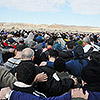 By reading Kabbalistic texts, we draw the upper force upon ourselves according to strict laws derived by Kabbalists from nature. They explain that this force originates from a system called the Rosh of the world of Atzilut, the head part of the system.
How can we attract this force? Through our unified desire, referred to as MAN. In the Torah, this is described as “manna from heaven.”
In Kabbalah, we engage in real spiritual actions, the results of which we must begin to sense within ourselves. This helps us understand our unity, to desire it and simultaneously not desire it.
In other words, our egoistic force must grow, and at the same time, the altruistic force above it must grow as well. Both develop within us—downward and upward—and form a spiritual vessel in which we begin to feel unity above our common egoism, known as Mount Sinai. The word “Sinai” comes from the Hebrew word “Sina,” “hatred,” symbolizing mutual rejection.
Like Moses, we must ascend Mount Sinai, this mountain of hatred, unite with one another, and reveal the Creator, becoming acquainted with Him. For this to happen, a massive mountain of mutual hatred and rejection must form beneath us. Despite this, we must rise above it in an effort to achieve unity and love.
When you reach this state, you undergo a phase of adaptation and self-correction, referred to as the “forty days on Mount Sinai.” This corresponds to the level of Bina, the quality of bestowal. At this stage, you achieve adhesion among all members of the community and begin to sense within it the manifestation of the upper force.
With the help of this force, you continue to correct yourself within the community, thereby progressing further. A real system arises between you, in which you interact and advance together like climbers. You know your goal, understand the path, support one another, and become spiritually “sighted.” This is what we must achieve.
[339924]
From KabTV’s “I Got a Call. Kabbalistic Meditation” 5/23/10
Related Material:
The Place of Contact with the Creator
At The Foot Of The Mountain
The Method of Revealing The Creator
 Question: What is the meaning of reading Kabbalistic sources? A person simply opens a book, reads it, and by doing so he already influences nature, suppose, a volcano?
Answer: Yes, of course, by doing so he already influences the volcano.
Question: There are eight billion people in the world, and how can you prove to them that some book can influence all of humanity?
Answer: First, there is no way out anyway, and a person will accept the method of Kabbalah whether he wants to or not. Suffering will make you believe in anything.
Secondly, why not try? After all, there is logic in the science of Kabbalah; it contains such a harsh, ironclad, and all-crushing truth that a person sees this is really so.
It works very directly and is based on specific data, parameters, combinations of two forces that a person sees around him, and they suddenly explain to him everything that is happening to him so simply and so specifically. As a result, a person becomes convinced of its truth even from his earthly logic, not to mention that this is a science that the whole world respects and appreciates although it is afraid of it. As a saying goes, if one is afraid, then he respects.
[339538]
From KabTV’s “I Got a Call. Come to Harmony” 4/19/10
Related Material:
A Journey To The Foundations Of Creation
Experiment Commissioned By Nature
Psychology Of The Soul

Talks about the Steps of the Ladder, Part 67
Why Do We Agree with the Disregard in Corporeality?
In spirituality there is no concept of agreement or disagreement with what happens. On the spiritual path, we acknowledge and accept the state we are in, which depends on the intensity of the light shining upon us. When a certain light shines and sustains us in a specific state, we can be called a “thief.” If less light shines, we are considered a “robber.” If more light shines, we are a “righteous person.” Therefore, there is no point in lamenting, “Oh no, I’m a robber!” The state arises naturally, and only then do we define and name it. We can deceive ourselves with the label, “I am righteous,” but this will not change our state or make us righteous. It will only alter how we feel.
We should thus focus on accepting our state as it is, instead of reacting to it. Whether we like it or not, agree or disagree, such is the reality. When we begin to engage with internality, we neglect corporeality almost entirely. This phenomenon is not subject to judgment as good or bad. Like in nature, we do not judge a lion for hunting a gazelle; its nature compels it to do so. Similarly, for those on the spiritual path, the nature of spiritual work requires constant renunciation of corporeality.
From a Talk 5/29/2002, “What Does It Mean that the Torah Was Given Out of the Darkness in the Work?”
Related Material:
Talks about the Steps of the Ladder, Part 66
Talks about the Steps of the Ladder, Part 65
Talks about the Steps of the Ladder, Part 64
 Daily Audio Version-MP3
 Get the Weekly eNewsletter
 Follow on Twitter

 Video:
  Audio: