New Life 1300 – Listening Connects

New Life 1300 – Listening Connects
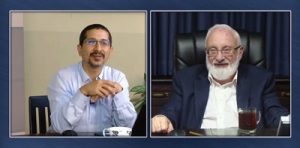
Dr. Michael Laitman in conversation with Oren Levi and NitzahMazoz

A Kabbalist doesn’t listen to himself or the person before him but to the force of love and bestowal that we live in. If I want to connect to someone, I have to show him that he is dear to me and that what he says is important to me. The speaker also needs to pay attention to the response of the listener. As human beings, we look for attention, respect, and appreciation rather than solutions. We want to feel a sense of security and support through an internal connection. What is important is not how much I understand but how much I show my respect for the speaker.
[279305]
From KabTV’s “New Life 1300 – Listening Connects,” 3/7/21

icon for podpress Video: Play Now | Download
icon for podpress Audio: Play Now | Download

“When The Ego Rots” (Linkedin)


My new article on Linkedin “When the Ego Rots”

For as long as we can remember, the ego has been our ally. It has earned us great achievements: We came out of the caves, developed agriculture and learned to produce our own food, became lords of the earth and of the sky, defeated plagues and enabled every person on earth to potentially have a life that only two centuries ago, were fit for kings.

In the past several decades, the ego has taken over everything we do, and our relationships with others are now based not only on the desire to build ourselves, but to a great extent, if not mostly, on the aspiration to hurt, humiliate, and even destroy others. Once the ego begins to focus on destruction, it ruins everything. When this happens, it is time to bid it farewell before it drags us into another world war.

But we have not come to this. While some of us enjoy unimaginable affluence, others are worse off than their ancestors had ever been; they die like flies without food, water, or dignity. We could have defeated the plagues, but it seems as though we ourselves have become a plague that is infesting the world with bile and abhorrence for our fellow humans, for all of life, and for our planet. The ego, which has gotten us all that we have, appears to have rotted and is now destroying everything that we’ve achieved through it.

As long as we used the ego to grow and develop, it worked in our favor. We’ve always used the ego not only for development, but also to defeat enemies and rivals, but we did not let it take over. In the past several decades, the ego has taken over everything we do, and our relationships with others are now based not only on the desire to build ourselves, but to a great extent, if not mostly, on the aspiration to hurt, humiliate, and even destroy others. Once the ego begins to focus on destruction, it ruins everything. When this happens, it is time to bid it farewell before it drags us into another world war.

We still don’t see it yet; we still think that the ego is our friend, but as all parents tell their children, “Stay away from bad company!” The ego is now bad company because it looks for nothing but troubles, to fight with everyone and destroy everyone, so we must turn away from it or it will drag us down along with it.

There is an alternative: The way forward is by joining hands and joining forces. The ego may not be satisfied in this way because we will not destroy anyone, but we, as opposed to our egos, will gain security, joy, and confidence in our future. Today, only a united society can thrive. Only when people of different backgrounds, faiths, and ideologies join hands, they can create a vital and pliable society that can adjust to the changing circumstances in the world. When only one ideology reigns, it quickly becomes rigid and fragile, and will collapse before long. Just look at what happened in Nazi Germany, Fascist Italy, and the Communist Soviet Union to realize that to succeed, diversity is a requirement, and diversity cannot thrive where the ego reigns. It’s time to dethrone the ego.

“The Case For Paradoxical Thinking” (Linkedin)


My new article on Linkedin “The Case for Paradoxical Thinking”

Paradoxical thinking is something that various systems, such as educational systems or various advanced organizations, are trying to promote. We feel comfortable when matters are unambiguous, but it turns out that the ability to keep in mind conflicting ideas develops people’s minds very effectively. Paradoxical thinking contributes to people’s mental health, mental development, and builds a better society overall. But what is the highest level of paradoxical thinking that we can achieve? Let’s examine some insights.

Another paradox that can develop the world is our relation to our raging egos. On the one hand, the egoistic desire to subdue everyone is destroying our lives. On the other hand, if we learn how to use our egos correctly, we will be able to turn them into what is called “help made against him.” In other words, we will be able to turn them into levers for development that will raise us from one level to the next on the spiritual ladder.

When we are confined to one system of thinking, contradictions confuse us and create internal collisions. Alternatively, when we develop a dual system of thinking, we can maintain one thought in one system, and a completely opposite thought in the other. This allows for complete opposites to exist within us simultaneously, since each thought is in a different system. Therefore, our challenge is to know how to build an additional system of thinking. This is what the wisdom of Kabbalah is all about.

Imagine that there are tiny insects that do not grasp the dimension of height, and live only according to their perception of the surface. They can move from side to side in their space, but not up or down. In relation to them, we have another level of perception. Similarly, a person who lives in one system of thinking feels the world very differently from one who lives in two systems of thinking.

It is one thing to understand this notion, but it is a different matter altogether to achieve it. To do that, we must awaken evolutionary forces that will develop that system within us. We cannot really know what these forces are, but we don’t really need to. It is enough to want to develop them to make them act on us more forcefully. The trick, if you will, is to know how to approach that evolutionary force and make it build in us that advanced system.

One good example of an exercise in building such a dual system is the Biblical story of the tying of Isaac. God said to Abraham about Isaac, “Through Isaac your descendants shall be named” (Gen. 21:12), meaning that Isaac was to have children of his own and continue Abraham’s dynasty. But on the other hand, God instructed Abraham to “offer him … as a burnt offering” (Gen. 22:2), which would prevent the continuation of Abraham’s dynasty. How can one reconcile such contradicting instructions? This is when the third party must intervene. In such a case, we cannot use reason since it will direct us one way or the other. Instead, we must “summon,” meaning want a higher intellect—from which the contradiction came, the root of the paradox—to come and reconcile the conflict.

In the wisdom of Kabbalah, the root, where all the conflicts are reconciled, is called “the Creator.” The Creator is the general force in nature; it is the force that sustains all of reality, the root of the universe and everything that evolves in it, the origin of our lives. In the end, each and every contradiction points precisely to it, to the source from which everything comes and in which everything unites.

Since we cannot connect the opposites with our current mind, we must replace our minds with an “upgraded” mind that we receive from that higher source. This is how paradoxes elevate us to a spiritual level.

Another paradox that can develop the world is our relation to our raging egos. On the one hand, the egoistic desire to subdue everyone is destroying our lives. On the other hand, if we learn how to use our egos correctly, we will be able to turn them into what is called “help made against him.” In other words, we will be able to turn them into levers for development that will raise us from one level to the next on the spiritual ladder.

Our spiritual aspiration should not be to erase the ego from the world, but rather to want it to remain and even grow. As we strain to rise above it, to cover it with a good relation toward others, we also rise to higher degrees in spirituality.

The key to dealing with paradoxes is therefore in shifting from a system where we shift from thinking only of ourselves into a system where we think about others, feel their needs and understand them. In this way, we build within us an additional system, which will provide us with contradicting views. Then, when we learn how to connect those views, a higher intellect will appear among us, which will resolve today’s paradoxes at a higher level of connection and complementation.
[279588]

“Should We Resist “Election Fatigue”?” (Linkedin)


My new article on Linkedin “Should We Resist “Election Fatigue”?”

On March 23, Israelis will go to the polls for the fourth time in less than two years. There is a saying in Israel that one who votes influences (one’s future and the future of the country). Voter turnout in Israel is similar to that to other democratic countries, but this time, the fourth election in less than two years, many are saying they will pass on the chance to influence. People are fed up, disillusioned, and don’t believe in the system anymore. I think it’s fair to say that people are experiencing what we might call “election fatigue.”

The unity of the nation is, of course, the only value that I see as important. If we have unity, we will resolve all other problems and carry out our obligation as a Jewish nation. However, you can only unite with the living, not with the dead. Therefore, currently, my one and only question when I cast my vote is who will do the best job of protecting Israel from its enemies.

I understand them. I, too, can feel this apathy creeping in. Nevertheless, I think we should not succumb to it. Israel is unlike any other country. There are many issues to resolve here: poverty, inequality, high cost of living, lack of opportunities to the disadvantaged, social rifts around every corner, and countless other problems. However, we will not be able to resolve any of them if we don’t have a country where we can work on them. And because we are under a constant threat of destruction, to me, the sole criterion for choosing who to vote for is security. Israel’s prime minister must be someone who can secure Israel’s existence, and everything else, completely everything, comes next.

The unity of the nation is, of course, the only value that I see as important. If we have unity, we will resolve all other problems and carry out our obligation as a Jewish nation. However, you can only unite with the living, not with the dead. Therefore, currently, my one and only question when I cast my vote is who will do the best job of protecting Israel from its enemies.

I am not saying this from a political perspective whatsoever, but from a spiritual one. In order to perform its role in the world, in order for Israel to set an example of unity and be a light unto nations, it must first of all exist, and second, it must exist in security so it can focus on building unity above the incalculable rifts in the Israeli society. This is why I attribute such importance to security, and this is why it is a spiritual consideration rather than a political one.

Politics aside, I think it is time for the people of Israel to start being what the people of Israel should be—to fulfill its obligation to the world, unite, and set an example of rising above all differences. The ingathering of the exiles has already happened on the physical level. Jews immigrated to the State of Israel from all over the world. Still, internally, we have remained apart. Now we must perform our spiritual task and turn the exiles into one nation, a symbol of union above division. This will be the realization of our vocation, our gift to the world, the best, and indeed only guarantee to our safety and prosperity.
[279616]

Mutual Guarantee

264.01The need for mutual guarantee stems from the fact that we all belong to the integral Kli, to the globe. Every desire in it, even the smallest and insignificant, can become the highest and most important if you turn the ball so that this point is at the top.

It turns out that no matter how you turn the ball, one of its points will be higher than all of them. If you turn the ball a different way, then another point will be at the top. Therefore, the mutual guarantee is an immutable law, obligatory for correcting the breaking of the common soul. Then we merge into one soul.

There is no other way to make of yourself that soul which the Creator created and broke. After all, every point in this soul must be the highest and vouch for everyone.

There is nothing more important than mutual guarantee because it brings us to the likeness of the Creator.
[279130]
From the Daily Kabbalah Lesson 3/4/21, “The Mutual Guarantee”

Related Material:
Arvut Obliges Bestowal
A World-Wide Mutual Guarantee
Mutual Guarantee Is What Love Really Is

Gradual Transition To Spirituality

565.01Question: Is there a connection between crossing the Machsom and crossing the Red Sea? Surely the Kabbalists described this transition, but they did not call it Machsom.

Answer: In general, yes.

Question: Are there any other descriptions that speak of the Machsom in allegorical language?

Answer: The fact is that man’s exit from an egoistic property to an altruistic one, i.e., the transition from one world to another, occurs gradually. And it is impossible to clearly indicate: now it is happening this way and then another way. This is all associated with many changes in a person.

Question: Can we say that the exodus from Egypt, when a group of 3,000,000 people left it, is crossing the Machsom?

Answer: The exodus from Egypt is a whole process including crossing the Red Sea, then approaching Mount Sinai after a long time, and receiving the Torah. And then there was breaking of the tablets, a seemingly untoward way out of egoism. But we see that it could not be otherwise and that is how they had to come out.

In general, all this is a transition. You cannot register it with a date or one action.
[278635]
From KabTV’s “Spiritual States” 2/6/20

Related Material:
Spiritual Surprise
Who Leads Us Across The Machsom?
The Miracle Of “Coming Out Of Egypt”

How Long Does It Take To Cross The Machsom?

503.02Question: How long can it take to cross the Machsom?

Answer: It is not possible to say for sure. Maybe a few years, maybe even a few decades. It all depends on how much a person invests, how deep his soul is.

If he has a serious, deep soul, this means that he has a great egoism, and then it is very difficult for him to cross the Machsom, to exit into the feeling of the upper world, to begin to correct himself and others in it.

There are people who went through it quite easily, even in a couple of years.

As a rule, it depends on the size of the soul’s egoism. Therefore, a lot of work is required with heavy egoism. But then this soul can do much in our world and in the upper world.
[278986]
From KabTV’s “Spiritual States” 2/6/20

Related Material:
Spiritual Surprise
Machsom—Transition From One Quality To Another
Breaking Through The Machsom

If You Change Your Intention You Change The World

610.2Question: You often say that life begins beyond the barrier, Machsom. Can we assume that the place people go after death is behind the Machsom?

Answer: No. In Kabbalah, a quality is called a place. Our world is a quality of egoism, a place where we feel it.

Question: Can we say that the crossing of the Machsom is identical to the change of a person’s intention?

Answer: Yes. This is absolutely accurate. If earlier all his intentions were only for himself, for the sake of his egoism, when he imagined himself in the center of the world and did everything only for himself, now he puts the Creator in the center of the world and does everything only for Him. This is a completely different feeling.

Question: How does a Kabbalist see this world when he crosses the Machsom?

Answer: The Kabbalist sees the world as an absolute good, as bestowal and love that fill absolutely all space, and he exists in these qualities. Their revelation is the revelation of the upper world.
[278693]
From KabTV’s “Spiritual States” 2/6/20

Related Material:
Crossing Machsom
What Happens To A Person When He Transcends The Machsom?
The Machsom Is A Psychological Barrier

“What Does The 8th Commandment Consist Of (Thou Shalt Not Steal)?” (Quora)

Dr. Michael LaitmanMichael Laitman, On Quora: “What does the 8th commandment consist of (Thou shalt not steal)?“

The eighth commandment, “Thou shalt not steal,” is the same as the previous commandment, “Thou shalt not commit adultery,” with the sole difference being that adultery and theft relate to two different levels of desires.

Nature is constructed of four levels of desire: inanimate, vegetative, animate and speaking (also, human). These four levels of desire exist in nature in general as well as within us.

Theft is then a similar action to adultery, but it is a prohibition at a different level of desire. Committing adultery is when we use people for the sake of self-benefit, whereas theft is when we use the inanimate, vegetative and animate levels of nature for the sake of self-benefit.

Therefore, where “Thou shalt not commit adultery” is an act of using others for self-benefit at the human level, “Thou shalt not steal” is an act of using the inanimate, vegetative and animate levels of nature for self-benefit.

Based on the TV show, “Spiritual States” with Kabbalist Dr. Michael Laitman on December 26, 2019. Written/edited by students of Kabbalist Dr. Michael Laitman.

The Value Of The Kabbalistic Archive

962.3Question: How do you feel about the books that your students write?

Answer: I have not personally read these books. In general, I do not know in what form they are produced and how they are processed.

I believe that if a person wants to seriously study Kabbalah, he should take notes from my lectures. Over the past 25 years, there have been videos of all the lessons that I teach every day for at least three hours.

Moreover, during the day I hold various meetings, conversations, and explanations. All this huge mass of information is stored in our archive. You just need to try to understand it and start studying it.

In addition, there are courses, all kinds of preliminary classes. Basically, you need to go through them quickly and start my classes.

I do not in any way deny the books my students write. Among them there are people who have been studying Kabbalah for decades. But it seems to me that serious studies of Kabbalah are in my video archive.
[278809]
From KabTV’s “Questions about Kabbalistic Books” 10/22/19

Related Material:
The Writing Man
The Influence Of Kabbalistic Books
The Effect Of Kabbalistic Books