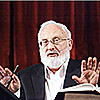
Rebellion Against the Way of Life

571.03Question: Today’s children do not want to listen to older people. What would you do if your students were the same, if they were disobedient and did not want to listen to you?

Answer: Wasn’t I like that myself with my parents? Did I really obey them in anything? They enrolled me in music school; I left it. Moreover, I left with a big scandal. They tried to push me to a medical school, but I ran away from it as well.

I did everything my own way. I went to one college, and I did not like it. I went to a different one, graduated from it as an external student, moved to Israel, and found an occupation for myself: Kabbalah. Why? For what? I abandoned a profitable business and so forth.

From their point of view, it seemed that I was doing everything possible against them: “After all, there are two doctors in the family, but the son is completely different.” He chose some path, he attached himself to some eighty-year-old man, and dedicated his life to him. From the age of thirty he devoted himself to being next to this old man and to learn from him. What can one learn from an eighty-year-old teacher without an education? To study some Kabbalah, wickedness, mysticism?

Imagine this was the early 80s. They looked at me as a very strange person, someone with an education, a wonderful business with opportunity to develop, and suddenly he left it all. What for? In order to study who knows what. During those years it seemed completely abnormal.

I couldn’t explain anything to them rationally at the level of our world. What was I gaining in money, in health, in wellbeing, in better education for my children, in life? The loss was in absolutely everything.

Therefore, no one supported it. When my parents asked religious people, “Our son is engaged in Kabbalah. What do you think? What is it?” they would answer “We feel sorry for you.” Hence my parents were at a loss. I understood it, and I felt for them.

It means that I was a rebel no less than today’s youth. My rebellion was not in wearing a cool jacket or a hat or shaving my head in a special way. It was a serious rebellion against the entire way of life. This rebellion is when you abandon an opportunity to earn millions, to live in luxury, to travel around the world, and so forth.

Comment: Disagreements between fathers and children is a well-known theme: the eternal struggle of generations.

My Response: No, before it was a battle of the greater egoism of the young generation and the lesser egoism of the previous generation when the latter did not agree with small changes made by the next generation at the same animalistic level.

However, now something completely different is taking place. Now the young generation totally rejects the way of life that the previous generation had. Now there is an absolute re-evaluation of values. It is not the kind of values where I need a car instead of a cart or a city instead of a village. The dispute is that I do not want to live if I have to live like you.
[351541]
From KabTV’s “I Got a Call. Children of Israel, Part 1” 10/1/10

Related Material:
Life In Search
A Rebellious Generation
Why Does A Person Need To Be Educated?

How Can You Use the Desire to Receive for Good?

232.03Question: How can one feel the desire to receive as evil?

Answer: Suppose I stole something and was caught. At that moment, I scold myself: “Why am I stealing? I must put an end to this, because I feel suffering from having such qualities.”

This also applies to our work. It is said that Adam HaRishon was a thief. Any reception without the intention to bestow is called theft.

If I were to see this as evil, I would rid myself of it. It is said: “The advantage of the light is revealed from within the darkness.” If I knew that through acts of bestowal I would reach good, then I would see that the act of reception brings me to evil.

How can I see this? Either through suffering when I perform actions within the desire to receive and receive blows. Then I simply do not want to have this desire; I want to restrict it.

“Less wisdom, less suffering. Do not demand much, and it will be better for you. Why chase after something? Sit quietly, and everything will be fine.” This is how the whole world understands it.

This path is called the path of suffering. But nevertheless, we are not able to live and advance by this path, because our desire to receive is constantly developing and burning. And although we do not control it, it nevertheless demands its due, and then, whether we want it or not, we make use of it. However, we suffer even from the fact that we want to use it, but we do not receive what we desire. This is called the path of suffering in its various forms.

And there is the path of Torah, when through study and various actions, I begin to reveal that in spirituality, in the intention for the sake of bestowal, there is a great attraction, very significant things: eternity, perfection, and attainment, which does not exist at all within the desire to receive.

Then I see that the desire to receive is evil, not because I receive suffering within it, not because I get caught when I steal, not because I desire but do not receive fulfillment, but because it does not allow me to reach the good things that exist in spirituality. Thus, I begin to compare the desire to receive with spirituality, and therefore, I simply want to remove this desire from our world, remove it from myself.

This is called the path of Torah; it is when I begin to see the desire to receive as evil and wish to move to bestowal by means of the upper light which illuminates me just a little. In this, the desire to receive does not interfere with me. The greater it is, the better. I do not destroy it, I do not go against its development, since this will not help me anyway. On the contrary, I take it in its entirety and begin to demand from the light that it return it to good.

Therefore, the path of development when the light that returns to the source operates is natural. It goes together with the development of the desire to receive and with the development of humanity. This is the only path that can give a person an answer to all questions.

A person asks: “Why do I suffer?” Then do not suffer, use the desire to receive that is developing within you, but use it correctly. Therefore, the use of the desire to receive with the intention to bestow is the perfect answer to all questions. You do not need to restrict yourself or artificially flee from pleasures. On the contrary, you begin to use the desire to receive with full force.
[352168]
From the Daily Kabbalah Lesson 1/20/26, Rabash, Article 12, “What Are Torah and Work in the Way of the Creator?”

Related Material:
An Apple In The Creator’s Garden
Two Ways to Adhesion with the Creator
A Spiritual Booster

Look at Yourself from Creator’s Perspective

235Only light and Kli that exist in the universe. Just as light has different kinds of manifestation before Kli, so does the Kli have different ways of feeling itself. It feels itself in this world as  either inanimate, vegetative, or animate where it is not aware of itself at all, does not know what it is, and acts solely in accordance with its desire to receive.

These are the inanimate, vegetative, and animate levels where creation does not see itself from the outside, and cannot study itself. Then follows the degree of “speaking,” “human,” when the creation can relate to its desire to receive and to all its qualities from the outside. However, this is also very subjective.

Even if it perceives itself incorrectly, cannot understand what is inside the desire to receive, and does not see that all this is predetermined in advance, nevertheless it tries to know itself as some kind of independent point, as a neutral objective researcher who studies himself from the outside.

When can the creation, the Kli, truly judge itself completely freely? When it receives the opportunity to look at itself from the Creator’s perspective. To the extent that the Kli acquires the desire to bestow, it can relate to the desire to receive in the same way the Creator relates to it. And there are no more than these two points: either to relate as creation or as the Creator.

If a person acquires the Kelim of bestowal, then he can see that there are two worlds, that is, two kinds of awareness, sensations, that exist on two planes. And before he receives the Kelim of bestowal, he does not understand at all that there is some other angle of vision, completely different from his own.
[352318]
From the Daily Kabbalah Lesson, 1/25/26, Rabash, Article 28, “What Is, His Guidance Is Concealed and Revealed?”

Related Material:
The World through the Creator’s Eyes
An Inseparable Pair: The Light And Desire
A Look At Life Through The Creator’s Eyes

So That the Creator Will Be Pleased

629.3Question: Is there always a fear in a person that the Creator will not give him something?

Answer: Such fear is always present in a person. If I believe even a little that I receive from the Creator, then I am afraid that He will not give to me. Then I run to the synagogue, give a donation, or do anything at all, just to receive from Him.

This has nothing to do with Kabbalah. Kabbalah speaks about how I should relate to the Creator so that He will be pleased, without any connection to myself.

First of all, we make a restriction (Tzimtzum) and acquire the qualities of Bina, which are not connected to any calculations regarding ourselves, but exist solely for the sake of bestowal (“Al menat lehashpia”). We cover our desire to receive so that it has no contact whatsoever with receiving, and only then do we begin to receive for the sake of bestowal.

The method of Kabbalah is the only method that works in the opposite direction. All other methods are based on the principle “I give to You, You give to me.” This is trading, calculation: You want commandments? I will fulfill the commandments, and You fill me, my life, give me health, some money, honor, respect, a family so that everything will be fine.

Hasidism and other methods are built on this approach.
[352415]
From the Daily Kabbalah Lesson 1/26/26, Rabash, “Lishma and Lo Lishma

Related Material:
Fear Of Not Being Afraid Of The Creator
From Awe to Love
“Fear God”

Daily Kabbalah Lesson – 2/6/26

Preparation to the Lesson

icon for podpress Video: Play Now | Download icon for podpress Audio: Play Now | Download

1st part of the Lesson — Writings of Rabash, Article 21, “Concerning Above Reason,” (1986) (2.2.2003)

icon for podpress Video: Play Now | Download icon for podpress Audio: Play Now | Download

2nd part of the Lesson — Writings of Baal HaSulam, “Study of the Ten Sefirot,” Vol. 2, Part 5, Item 24

icon for podpress Video: Play Now | Download icon for podpress Audio: Play Now | Download

3rd part of the Lesson — Preparing to Attack at the Congress

icon for podpress Video: Play Now | Download icon for podpress Audio: Play Now | Download

Audio Version Of The Blog – 2/5/26

Listen to an Audio Version of the Blog
Download:MP3Audio

What Is Free Choice?

938.01Question: We study that freewill consists of choosing one’s society. Is this, essentially, our only choice?

Answer: We are not precise when we say that our only choice is the society we need. It is more correct to say not society, but environment, because it is a broader concept.

The environment includes the books, the sages who wrote those books, friends, the teacher, and everything except the Creator and me (if a person believes there is something in him).

Thus, I must say that the forces of the Creator and the force within me are the same Creator, only manifested from different sides. Therefore, if I decide something, or it seems to me that the Creator decides, it is, in fact, the same source.

If I want to acquire some force other than the Creator who, according to my perception, is outside of me, or other than the Creator that is in me, meaning apart from the nature He created and with which He endowed me, then I need something external, something outside. Everything outside is called the environment.

As Baal HaSulam writes about a wheat seed that is place it in the soil in the article “The Freedom.” What do you have besides that seed and the environment in which it is placed?

It is the same with us. If we want to arm ourselves with any additional forces—forces that, as Baal HaSulam explains, we choose—and our independent choice entirely constitutes our individuality, the expression of our own “I,” then it turns out that nothing else remains.

I should not turn to my own nature, because all of it is the Creator, and I should not turn to the Creator. Do you understand the paradox? I should not turn to Him! Because every turning to Him is planned by Him; He programs it.

So, what am I supposed to do?! If I have the power to turn to the Creator, then it turns out that He is turning to Himself?! Then who am I here?! A puppet?! By fulfilling what the Creator placed in me, I turn to Him.

The point is that I must turn to the Creator with what I acquire from the outside, through my own free choice. Outside of me, the Creator intentionally creates several sources of inspiration, and I am impressed by each of them in different ways. For me, the main inspiration is the one that directs me toward the Creator. In principle, the result of that inspiration does not matter; what matters is what I choose.

Now the question arises: “So what exactly am I choosing?” After all, the Creator placed all my inner nature within me, so where does choice begin? Again, from the very force that He placed in me.

As Baal HaSulam said: “The Creator places a person’s hand upon a good fate and says: Take it.’”

Meaning: choose this environment and not another. And a person must strengthen himself in that choice. Ultimately, the choice is not in the environment itself (the Creator also points me to the environment), but in strengthening and in holding on to what He has shown.

You must not have the slightest doubt about whether free choice exists! It does! However, you attain it not by your own power, and the discernments are also not yours. Free choice is not attained by searching for new continents. But the moment when you feel something that directs you toward the Creator, you must apply all the forces of your soul to strengthen yourself, to remain on the right path, and to hold on to the inspiration you already have.

The result, of course, does not depend on you; that is clear. How much you hold on to the group will be the result.
[352426]
From the Daily Kabbalah Lesson 1/27/26, Rabash “Lishma and Lo Lishma

Related Material:
Born Free
A Person Is Sustained By The Environment
Where Is The Freedom Of Choice Hidden?

Beware of the Poor

239It is written, Be careful with the sons of the poor… from them, Torah will emerge. A person who feels poor, who does not have real Kelim (vessels) to receive the light of the Creator’s revelation, is called a poor man. For example, “poor in knowledge.”

What does “be careful” mean? The fact is, a person neglects such states, does not want them, and flees from the feeling of poverty when he has nothing. After all, the desire to receive, egoism, is unwilling to suffer, such is its nature.

A person always calms himself down and glosses over the feeling that he lacks something, that something is wrong with him. He does not feel ready to reveal his true desires.

Egoism is ready and likes to give him the opportunity to feel sorry for himself and to “gnaw” at himself, but this is not called a feeling of poverty.

Here, the feeling of poverty is a lack of strength to bestow, and here the desire to receive leaves us no opportunity, it always leads us away from it. Therefore, it is written: “Be careful with the sons of the poor,” that is, we must pay attention precisely to the consequences of feeling poor, to what I demand as a result of this. After all, it is precisely from this demand that the Torah comes through, and it is from here that the light that returns to the source comes. The Kli for receiving correction is called “the poor.”
[352117]
From the Daily Kabbalah Lesson 1/18-19/26, Rabash “What Are Torah and Work in the Way of the Creator?”

Related Material:
Beware Of The Poor Because They Will Bring Our Salvation
Help from the Teacher
“Go Make A Living Off Each Other”

Justify a Friend

235Question: How can a person look at others and see them as flawed, see their desire to receive in an uncorrected form, but not see it in oneself?

Answer: How is it that a person looks at others and sees they are all in the desire to receive, but he is not?

Rabash gives a very simple example: I have a child, and the neighbor has a child. My child is cute, adorable, smart, and well-behaved. I look at him and see a small man. But when I look at the neighbor’s child, he looks dirty, ignorant, neglected, rude, and loud. Why? It is all in the attitude.

Is my child unlike the neighbor’s? They are both children, there is no difference, but in my child, I see the good half, and in the neighbor’s the bad half. That is, both you and your friends are the same. It is only that I can justify myself, I know why I am like this. But why is the friend so? That is the difference.

Later, you will discover something different, you will see negative things in yourself, and positive things in your friend, and then you will start to envy him. This will be a good envy. At first, it is bad, and then maybe good, when you want to be closer to him to learn from him and grow stronger with his help. You will bestow on him, and he will reciprocate.
[352172]
From the Daily Kabbalah Lesson 1/20/26, Rabash “What Are Torah and Work in the Way of the Creator?”

Related Material:
Mechanism of Spiritual Ascent
The Environment Can Do Anything
Pulling Up To The Ten

Society as a Single Spiritual Organism

75.01Question: When we speak about an integral state, do we mean society, or according to Kabbalah is it a single spiritual organism?

Answer: It is one and the same. We are speaking about a society that begins to sense itself as one common whole. Within it, a collective mind, a collective feeling, collective needs, and a collective outlook on everything emerge. That is, the entire society becomes one unified whole and begins to feel all levels of nature as fully interconnected. And when a person includes this vast nature within himself, sees it and feels it inside himself, he begins to internalize its program.

As part of this program, he starts to perceive it in its entirety. It is as if he sees himself as having originated billions of years ago and as continuing his development billions of years into the future because he begins to be included in this immense organism of integral nature. He starts to feel all the forces he exists within, and understands how this works, how it influences him, and how he can influence himself, his destiny, and his future, as the only active element in nature, not instinctively, but consciously.

However, he will attain this only when he is integrally included in all levels of nature. Then he rises to the highest level of nature, to the level of the Creator, so to speak. There is no Creator as such; nature itself is the Creator. But a person reaches such a level.

Question: How can we define the very concept of society, since society and an organism are perceived as different things? Society is sometimes compared to an organism, but this is a metaphor, an image.

Answer: These concepts are perceived as different in a society where all the elements are not interconnected. If it is an organism broken into parts, into fragments, like a sick person in a dreadful state, when all the systems are out of balance, then you are right. That is the state of today’s society that we are trying somehow to save from destruction, from the complete disintegration of all its systems. But when all systems are in mutual support and balance, each one and all together, like the human body, then this is simply an integral society.

Comment: So we must draw a clear line between the notions of society that prevail in sociology. There everything is very simple: there is a simple society, a primitive community, a tribe, and there is a complex society, which must be highly differentiated.

My Response: Primitive communities, by the way, were practically integral communities. For them this was based on an instinctive level, as in the animal world.

But we differ from the animal world in that egoism has grown in us. And now we begin to unite on a different level.

Animals are instinctively united in an integral community. Nature holds them together through its general law. Then, above our animal body, egoism grows, and we must begin to integrate above it, together with it. That is, egoism itself gives us a new level of integration.
[96031]
From KabTV’s “Integral World,” 11/26/12

Related Material:
Growing Interdependence
The Wisdom Of Kabbalah, A Patent For Infinite Pleasure
The Transition To An Integral System