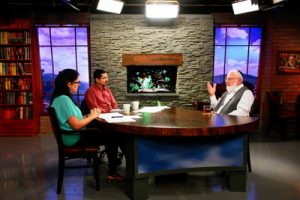
Eight Tips For Educating Children

Dr. Michael LaitmanFrom My Facebook Page Michael Laitman 4/18/19

We love you as you are”, “Look at the others and see how successful they are,” “You have nothing to fear, go for it”—what advice is right and what is harmful? Eight phrases we use, and the correct position of the wisdom of Kabbalah towards them.

“Turning On” Mutual Guarantee

laitman_943Question: Should we constantly cultivate the importance of the principle “There is none else besides Him”?

Answer: If the friends in the group think about how none of them should forget to identify the Creator as a root cause of their states, then you will really help each other.

This stage is called mutual guarantee; it begins from the fact that we simply mechanically want to help each other keep ourselves in the thought that “There is none else besides Him.” At the same time, each of us thinks about the other.

When we all think this way about each other together, we “turn on” the mutual guarantee and it works. In this case, each member of the group remembers more often that the Creator is the source of his or her thoughts and feelings, and they begin to form, to connect with each other into one network.

By constantly helping the friends remember that we are mutually included into each other and connected to the Creator, we try to identify the Creator as our common source. Each of us then becomes connected with others in such a way that the signal from the Creator passes through each one to everyone else. This is another level of connection.
[243008]
From the Kabbalah Lesson in Russian 2/11/19

Related Material:
To Tango With The Creator
Forward, Toward Concealment
The Protective Shield Of The Concealment

The Source Of All The Forces Of Nature

laitman_753Question: Who is the Creator?

Answer: The Creator is the upper force that includes in itself all the other forces of the world.

Question: It is written in the original sources: “It is impossible to understand the Creator without having experienced Him.” Is this right?

Answer: Yes, because everything we understand, we learn from sensations—like a child who puts everything in his mouth in order to touch, to feel. For him, taste is the most important receptor, the most important organ of sensation. In the same way, we should experience everything in our five senses including sight, hearing, smell, touch, and taste.

When we feel something in them, it all assembles into a precise system and all our sciences originate from it. In addition, we complement our senses with tools that expand the range of our natural sensory organs: binoculars, microscopes, telescopes, etc.

However, there are forces in the universe that our senses do not perceive. The science of Kabbalah lets us develop an additional organ of sensation that includes the same five senses, but on a different level.

Exploring their nature, we reveal their common source, called “the Creator,” and begin to attain how they affect us, how they determine all conditions, forces, and circumstances in which we exist. Then, we already study the system of forces that determines our life.

So begins the conscious existence of man, when we already know what has been, what will be, why it has been and why it will be, whether we can change something in the future, etc. That is, life becomes not only conscious, but also manageable. This is the subject and the purpose of the science of Kabbalah.
[243407]
From KabTV’s “The Essence of the Science of Kabbalah, Part 3” 11/12/18

Related Material:
Understand The Hidden Forces Of Nature
Helplessness Before Nature
Preferential Treatment For Discovering The Creator

New Life 215 – Sibling Relationships, Part 2

New Life 215 – Sibling Relationships, Part 2
Dr. Michael Laitman in conversation with Oren Levi and Nitzah Mazoz

What is jealousy and sibling rivalry, and how do we teach children through games and workshops to use such qualities to create a relationship in which personal satisfaction and mutual giving exist? Jealousy between siblings is natural and can help children develop. We educate children by giving them an artificial system of behavior in which to build a second nature. Children can be rewarded for efforts to connect and be considerate.
[123595]
From KabTV’s “New Life 215 – Sibling Relationships, Part 2,” 7/25/13

icon for podpress Video: Play Now | Download
icon for podpress Audio: Play Now | Download

Daily Kabbalah Lesson – 4/19/19

Lesson Preparation

[media 1] [media 2]

Writings of Rabash, Vol. 2, Article 22, “Why Are Four Questions Asked Specifically on Passover Night?” (1989)

[media 3] [media 4]

Audio Version Of The Blog – 4/18/19

Listen to an Audio Version of the Blog
Download:MP3 Audio

My Thoughts On Twitter 4/18/19

Dr Michael Laitman Twitter

After revealing the entire evil in egoism, if one hasn’t run away from advancing toward the goal, one merits seeing that there is no Pharaoh or servants, but the Creator Himself revealed the egoism in him so he would see his entire egoism and his separation from the Creator.
Only then does the Creator bring him closer.

It is precisely for those who wish to come out of egoism that the Creator reveals egoism’s evil so they see themselves as more and more immersed in egoism, which contradicts common sense. But if they advance towards the truth—revelation of the entire evil in egoism—the Creator helps them, and they reveal that He has always heard them.

Egoism rules over man only to the extent that he thinks that it is egoism and not the Creator who rules over him. But as soon as he realizes that “There’s none else besides Him,” and from both sides, evil and good, he is ruled by the Creator—he feels it as the light of redemption from his ego-nature.

The easiest and clearest way to rise in the world is to demonstrate hatred for Israel. By that one stands out and rises above others, in opposition to bestowal, unity (work for the Creator), and aspiring only toward the use of egoism, for one’s own sake (work for #Pharaoh).

Those who exert for the sake of reward, in this world or the world to come, do not need the Creator since they have forces and can do everything alone, without the Creator, to the degree of their faith in the reward. And they do not feel that they are in exile (from the quality of bestowal, from the Creator).

The realization and sensation in exile (from the quality of bestowal) is that one is unable to bestow to (please) the Creator since one feels that he receives everything from Him. This is what he regrets—and it is the beginning of his connection to spirituality.

Precisely after all the attempts to come out of egoism on one’s own does a person sense that he is in exile inside the ego—and realize that only the upper force can pull him out of egoism. Only then does a prayer to the Creator for help from the bottom of the heart start to be created in him.

8 Tips for #Parents
We love you as you are,” “Look at the others and see how successful they are,”—What advice is right and what is harmful? Eight phrases we use, and the correct position of the wisdom of Kabbalah towards them.

Despite understanding that only the Creator can pull me out of egoism, it’s difficult to turn to Him with this request—there’s no faith and no example that He helps. Besides, I’ve asked the Creator for help many times and it didn’t help.
Yet it is precisely this disappointment that we must overcome —and ask!
From Twitter, 4/17/18

Related Material:
My Thoughts On Twitter 4/17/19
My Thoughts On Twitter 4/16/19
My Thoughts On Twitter 4/15/19

What Is Pharaoh in Kabbalah?

Dr. Michael LaitmanFrom My Facebook Page Michael Laitman 4/17/19

What do I wish the people of Israel this Passover?
Connection. That’s all we need.

“Is Basel III A Gold Standard For Human Relations?” (Newsmax)


My article in Newsmax: “Is Basel III a Gold Standard for Human Relations?”

It’s very likely that you are not familiar with the term “Basel III.”

But for those involved in the financial system, Basel III is a phrase that represents the disillusionment that followed the trauma we all experienced in the global economic crisis of 2008.

Basel III is a binding standard determined by the central bank of all central banks, which located in Basel, Switzerland, away from the public eye. Since 2011, banks around the world have implemented the Basel III standard as part of a plan to strengthen their stability against financial crises and challenges.

This month, a new section of Basel III came into effect: the status of the gold that is held in the balance sheets of the banking system has received an upgrade.

Gold is now considered a first-class safe asset and will be worth 100 percent of its market value, as opposed to 50 percent so far. In other words, gold has risen in its financial value at the expense of bonds and securities of various kinds, behind which there is no tangible asset.

Today’s analysts are debating whether the world is once again approaching the “gold standard,” a policy whereby every dollar is pegged to and backed by actual gold that sits in the basement of central banks.

Leading banks have begun to increase their gold inventories, and some argue that the price of gold is expected to rise significantly.

But even after the Basel III gold reform, the economic system will remain egoistic as it used to be. It will continue to reward those who manage to best exploit the other players, and increasingly concentrate power in their hands.

At the same time, the gold reform is an important link in the chain towards changing the socio-economic order: it is the recognition that the economic relationship between people must be anchored in the tangible and limited resources of nature.

The disengagement from the gold standard allowed for the unrestrained thriving of a mostly financial economy, debt-based and high-risk, volatile and prone to frequent crises.

The possibility of reintroducing the gold standard indicates the need to return to sanity; to take the air out of the artificial and inflated economy, and restore stability to the entire system.

This is a significant step towards establishing a new, balanced, and realistic economy. An economy that serves the individual as well as our social and personal development; an economy that will serve us instead of having us serve it; an economy that will focus on our growth as human beings, rather than the growth of GDPs and stock markets.

In fact, we can look at upgrading the status of gold as a kind of exercise that prepares us for a new and more truthful order.

In the future, Kabbalah explains, the nature of human development will lead us to a reality in which the spirit transcends matter. If today’s world is immersed in materialism where the chase for money has become our “spiritual fulfillment,” in the future we will strive for higher and loftier satisfactions than those that our current money can buy.

Spiritual satisfactions that result from the healthy participation in a more advanced human society whose members feel connected to each other in mutual care.

And what is the future of matter in such a society? It will serve our social and spiritual development, and will be well anchored with two feet on the ground.

The future society will cover all of the individual’s physical and material needs, and the individual will receive supreme spiritual satisfaction through his contribution to society. That will be the true gold standard.

The preeminent Kabbalist of the previous century, Yehuda Ashlag, had elaborated on the conduct of such a society in his “Last Generation” articles.

Revealing The Creator’s Attitude

laitman_962.1The descent of the worlds from top to bottom is built in such a way that due to its actions, the creation increasingly reveals its Master’s attitude toward it. It seems to be in the process of research. In the spiritual world, it is impossible to search for answers with our rational logic—we must penetrate it sensorially and then we will understand more. Then, from our sensations, we can find an explanation in our reason.

Imagine that I am standing in front of the Master with my desire to enjoy and now I reveal His attitude toward me at a certain level. I begin to work with it; I reject this pleasure, and make clarifications. At the same time, my desire is developing and refining after the spiritual action I have made, and so I suddenly feel that the Creator has done much more for me than I previously thought. It seems that I have grown up and realized it, similar to how, after becoming older, a child justifies his parents for what they demanded of him.

Then, my screen is reduced; I can no longer stand up against what I had managed before. It would seem that the screen should have grown because I understood more. But this is not what happens and I feel that I can do nothing but annul myself before the desire of the upper one.

I reveal the growing love of the Creator toward me and my inability to respond to Him in the same way. Therefore, all the degrees of the descent of the worlds (Olamot) are called the degrees of concealment (Alamot). The creation has no way out; it blocks itself with screens, hiding the upper light and the Creator’s attitude toward it in order to hide behind them and somehow survive. These are not degrees of honor, but rather degrees of weakness. All this is happening not at the expense of the creation, but at the expense of the Creator who is building a spiritual vessel.1
From the 1st part of the Daily Kabbalah Lesson 3/25/19, Writings of Baal HaSulam, “Preface to the Wisdom of Kabbalah,” Item 20
1 Minute 1:06:05

Related Material:
Balaam And Moses – Two Forces With Identical Possibilities
Between Concealment And Revelation
The Correct Attitude Towards The World