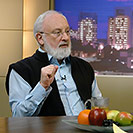
Question:In classifying interpersonal relationships, the main thing is considered to be the contact between man and nature. What is the basic principle of the connection between man and the upper nature?
Answer: The principle is very simple: a person must bring himself to convergence with the upper nature. The upper or inner nature is based on the quality of bestowal, love, and mutual assistance. In this, it is the opposite of a person who is in egoistic love for himself. If we attune ourselves properly to feeling nature, then we will discover it.
Question: How should a person relate to himself, to his “I”?
Answer: As to a certain detector, a receptive device, that is located in certain conditions and must use itself and these conditions to reveal the essence of everything that is happening, the real nature of our world.
Question: Most of the time a person talks to himself, conducts an internal dialogue. Although this happens unconsciously, is there any way to control what this dialogue should be about?
Answer: In Kabbalah, there is a whole technique about the inner dialogue of a person with himself, with friends, with a group, with the world, and with the Creator. In this regard, we must always be in the continuous flow of information. [271787] From KabTV’s “Communication Skills” 7/30/20
Question: Governance is the observance of the laws of communication. You are constantly in contact with people, gather a team, manage them. How do you see the difference between a boss and a leader in relation to subordinates?
Answer: A leader has nothing to do with his subordinates. He gives out his vision of the world, his plans, prospects. He is not very interested in the attitude of people to his idea, because how to perceive it is already the concern of subordinate managers.
Question: As a rule, the boss is appointed from the top and the leader grows from the bottom. Do you agree with this?
Answer:The boss is appointed from above because they see which of the subordinates is capable of solving practical problems. And the leader is set by the higher governance or as we used to think by chance. This is a person with a philosophical, forward-looking view of the world, who perceives the whole world as something of his own. [271160] From KabTV’s “Management Skills” 6/11/20
If we start navigating through these turbulent seas, seeking how to meaningfully connect above our drive for momentary pleasures, then we can rest assured that our ship will reach a safe shore.
Oct 9, 2020; Lake Buena Vista, Florida, USA; Miami Heat forward Jimmy Butler (22) shoots the ball against Los Angeles Lakers forward Anthony Davis (3) during the fourth quarter in game five of the 2020 NBA Finals at AdventHealth Arena. Mandatory Credit: Kim Klement-USA TODAY Sports
This might be the beginning of a cultural revolution. American entertainment and sports have shaped US society and influenced and appealed to the interest of a global audience for decades. This, however, seems to be changing. Media analysis shows that ratings of the once most popular programs are hitting historic lows as a result of the coronavirus crisis. I would not pay it particular attention were it not for pop culture’s predominance in people’s lives. Undoubtedly, it indicates a turning point, a shift, a new quest for more meaningful fulfillment that can only be achieved through human connection.
Just recently some of my students asked me about what might be the deeper reason for the low viewership of the 2020 NBA finals. Earlier this year, viewing of the Oscars and Emmy awards plummeted to all-time lows. How can this significant trend in the Covid-19’s era be interpreted? Particularly if we consider the prominence of pop culture in America and its influence around the world mainly through the media, music, and film industry until now.
The reason is that the pandemic has marked a before and after in people’s priorities and sources of enjoyment. Prior to the virus’ impact on all realms of our society, our generation lavished in excesses of entertainment and sports more than any other. We placed them on pedestals and showered their proponents with our attention, adoration, and respect. However, all such ways of enjoying and fulfilling ourselves wane at a certain point, especially now since they appear to be ephemeral and non-essential.
This new situation responds to the evolution of the human desire to enjoy which constantly grows and demands new and different pleasures as soon as the previous ones are fulfilled. While all kinds of influences can grab people’s attention, from a major tournament one minute to popular celebrities the next, they will eventually find those attractions do not appeal to them anymore.
The reason is that our desire has outgrown what previously gave us enjoyment. Similar to children outgrowing their toys, we too will start feeling drives for more mature and meaningful fulfillment—to genuine human connection and answers to deeper questions about our life’s ultimate meaning, which will itch away at us more and more.
Sailing the Titanic to a Safe Shore
The coronavirus struck our lives, highlighted our vast interdependence all around the globe, and placed us all into a common global situation. It is as if we found ourselves aboard a new global Titanic without any clue as to where we are heading or what will happen next. As we float along together on this giant global ship, nobody really knows where to turn or what to do; some sharply turn right, others turn left, and we find ourselves in an increasingly polarized society.
Therefore, as our desires start outgrowing what previously fulfilled them, and while we increasingly realize our tightening interdependence and interconnectedness worldwide—as we share one common global problem—it is no wonder that the interest in what used to be the most popular shows and games has declined so drastically. It will improve only if the entertainment industry transforms itself and champions warmth, mutual care, and connection.
We are growing up. I am optimistic that we will become more aware of how our human nature operates on us, how it is growing to new heights, and how it starts demanding different and more meaningful kinds of fulfillment. If we start navigating through these turbulent seas, seeking how to meaningfully connect above our drive for momentary pleasures, then we can rest assured that our ship will reach a safe shore.
I am also hopeful that we will succeed in providing our more mature needs the fulfillment they seek, realizing the need for deeper and more positive human relations, and by doing so, feeling a much fuller, more expansive and authentic reality compared to our current one. [272540] — Published on October 11, 2020
The Sukkot holiday symbolizes the beginning of building the soul. The soul begins from the quality of the Creator, the quality of Abraham, which is called Hesed, bestowal, an open heart, everything that is aimed at loving the created beings for their benefit.
Obviously, it is impossible to reach the purpose of creation in this form because the quality of Abraham does not yet have the quality of creation, the will to receive, which must be present in all this process. After all, that is what it was devised for.
We need to correct ourselves because the purpose of creation is to bring a person to the degree of the Creator, to adhesion and equivalence with Him. The quality of Abraham is not enough for this; we need to add to it the matter of creation, the will to receive.
The quality of Abraham, Hesed, fills the entire space created by the Creator. The Creator wants to see all the created beings there, connected with each other in love and unity together with Him. However, there is no creation there yet. Creation appears only after the birth of Isaac, the will to receive that joins the quality of bestowal of Abraham.
Abraham and Isaac are opposite to each other. The result of their combination is also not enough to reach the goal of creation and complete adhesion with the Creator, but it is still a great step that gets closer to this. This is mainly due to the sacrifice of Isaac, the main action performed on this quality, on the will to receive, to which the second day of Sukkot is dedicated.
The patriarchs, Abraham, Isaac, Jacob, Moses, Aaron, Joseph, and David, are not people, but are the main spiritual qualities that exist in the system created by the Creator through which we can correct our souls.
However, every person also has to go through all these changes within themselves: first to completely annul themselves before the quality of Hesed, then to awaken a critical attitude a little and allow the will to receive to reveal itself. Then one begins to combine the quality of Abraham, Hesed, with the quality of Isaac, Gevura, by faith above reason.
This means that we use our will to receive only in order to establish over it the control of the desire to bestow. Only in this form do we allow ourselves to work with our egoism. When we correct it in this way, the middle line, Jacob, will come out of it.
How do we ensure that the left line in the ten obeys the right one? Everyone bows their head and lets the others be higher. We are competing by who nullifies themselves the most. The one who will be the lowest will gain the most and rise the highest. This is a competition in who uses more their will to receive in order to bestow. [271861] From the Daily Kabbalah Lesson 10/4/20, “Sukkot”
As much as we may dislike one another, science has proven that curbing Covid-19 requires national solidarity. The inconvenient truth is that the pandemic does not distinguish between left and right, orthodox and secular, Jews and Arabs; we are all equal before the virus. If we stand together, we will defeat it. If we don’t, it will defeat us. This is as true for every country as it is for all of humanity.
A few days ago, Eran Halperin, Professor of Social Psychology at the Hebrew University in Jerusalem, and Ron Gerlitz, CEO at aChord – Social Psychology for Social Change, published an Op-Ed piece in The Jerusalem Post titled “To slow coronavirus, disparate groups in Israel society must come together.” The piece mentions a recent international study where more than 100 researchers from all over the world examined tens of thousands of citizens from 67 countries, among them over 1,200 Israelis, “to understand what would most influence their willingness to obey pandemic-related instructions.” The researchers found “that the key factor motivating people to adhere to distancing and hygiene guidelines is the level of their national-group identification; that is, how connected they feel to their national group and how central they consider it in their identity.” Judging by this conclusion, the fragmentation in the Israeli society is the culprit behind our failure in overcoming the virus, and not the policy of the government or the disobedience of this or that group to instructions. We are witnessing the beginning of a social breakdown in Israel. If we don’t rise above our sense of righteous indignation, we will inflict an unprecedented catastrophe on our country.
The people of Israel emerged from people who belonged to different, often rival tribes and clans from all over the Near and Middle East. These “refugees” left their countryfolk because they believed in the idea of unity above differences. Under Abraham’s leadership, they found a place where they could live out their idea.
Today’s people of Israel are nothing of the kind. We are fragmented once more, divided in every aspect—religion, culture, ethnicity, education, language, politics, and every other aspect you can imagine. Except for our name, we are not a nation anymore. We have returned to being strangers, aliens to one another. If we want to merit our name, “the people of Israel,” we have to start over.
Back then, Abraham’s group continued to develop until, at the foot of Mt. Sinai, having experienced the ordeal of the exile in Egypt, the Hebrews united “as one man with one heart” and established their nationhood. Soon after, clashes and conflicts began to rage within the people and the newly formed nation struggled to maintain its core value: “Hate stirs strife, but love will cover all crimes” (Prov. 10:12).
Two millennia ago, we suffered a bitter defeat to our hatred and were exiled and dispersed all over the world. Wherever we went, we were regarded as outcasts, outsiders.
Even when we returned to Israel and reestablished our sovereignty, we did it only to protect ourselves from the odium of the nations, and not because of the initial value of unity above differences that had fashioned our nationhood. To this day, many Israelis feel out of place in Israel. They see it as temporary residence until they find a calmer place to live in.
But without a sense of belonging to a single nation, Israel will disintegrate. We can already see how a pandemic that we could have curbed had we all participated in defeating it is tearing us apart. It is not because the virus is so terrible; it is because there is no solidarity among citizens and no trust between citizens and government. The lack of affection and trust leads to inaction, which in turn leads to contagion. And contagion leads to loss of lives.
The introduction to the article just mentioned states simply that “the logic underlying the basic individual behaviors required for curbing the contagion … is grounded in belonging to [a] collective.” We have no sense of a collective, and we are paying for it with our lives, the lives of our loved ones, and the livelihoods of hundreds of thousands of people in our small country.
It doesn’t matter what we believe or who we think is right. If we don’t come together, then we are all wrong, we are all paying, and we will pay much more. [272246]
Jacob is the most important spiritual attribute, and therefore, he is called our forefather.Abraham symbolizes bestowal from the Creator and Isaac is the revelation of the desire to enjoy in the creation.
Jacob is a combination of two qualities, giving and receiving, the right and the left line, due to the inner work of a person. Man connects these two lines that come from above in order to achieve similarity with the Creator.
Man, Adam, means similar (Domeh) to the Creator. Therefore, Jacob is the most important of the three because these are the qualities revealed within a person to the extent of his similarity to the Creator. This is why the property of Jacob is called Tifferet—splendor, beauty, honor—the properties of the Creator revealed within the creation.
It is through this work that man reaches spirituality. We are granted these two qualities from above, the good and the evil inclinations. The good inclination comes from the Creator through Abraham. The evil inclination revealed in creation also comes from the Creator who created it. But the right combination of these two forces is achieved through man’s work, and we must execute it.
The left and the right lines do not cancel each other, but rather emphasize each other. If there is the right line, bestowal, then it is permitted to awaken the left line, reception. And it is precisely because the left line is opposite to the right that it increases and highlights it.
This is why Jacob includes both lines and intensifies them. The miracle of correct spiritual work is that opposite qualities are emphasized and increased even more, each one emphasizing the other.
Precisely because of the fact that there is the force of bestowal against the force of reception and the force of reception against the force of bestowal, each becomes more intense, more significant. This is why the quality of Jacob is called Tifferet (splendor) because it combines two opposites in one.
When they are correctly combined and enhance each other in the middle line, they are manifested in man not as a simple sum of the right and left lines, but as an illustration of their opposites and glory.
In our world, there is plain darkness and plain light. But if we mix darkness with light, we get a lot of different shades that can be distinguished neither in the bright light nor in the dark.
Our whole life is based on combining the left and right lines. If we want to reveal the Creator, we need the two forces bestowal and reception. By creating all possible combinations of one with the other in all forms, we will reveal the quality of the Creator relative to the quality of creation.
Abraham is the desire to bestow, Isaac is the desire to receive, and Jacob is the combination of desires to receive and to bestow. In combination, these two qualities begin to enhance and emphasize each other. As a result, the right and left lines are revealed in Jacob 620 times stronger than they were before they combined in him.
It turns out that correctly combining the force of reception with the force of bestowal allows us to experience the force of bestowal in contrast to reception 620 times greater. It is through the middle line that we increase the creation made by the Creator from a tiny Kli, a single black dot, in infinite white light to the scale of the entire light of infinity. As it is said “The darkness will shine as light.”
Thus, we reveal the Creator inside our Kli and attain the entire light of Infinity in it. But this Kli begins as a black dot with a very small change in the light. [271867] From the Daily Kabbalah Lesson 10/5/20, “Sukkot“
Before asking about who would be a more supportive US president for Israel, we in Israel would be wise to question what we have done to merit the backing of a world superpower.
What are we projecting to the world? Beyond our impressive technological output, what are we contributing? And is advanced technology what the world really needs from us?
Today, the global environment we live in is changing, and likewise, the expectations upon Israel are gradually shifting as well. Heading into the future, if we will want to receive support from a major superpower, or from anyone for that matter, we will need to start paying more careful attention to what we project and contribute to the world, and whether it is what the world ultimately needs from us.
We are a unique nation because unlike other nations, we have no common biological root. Our ancestors, who were from originally from different clans and tribes, united as a nation under an idea: to unite (“love your neighbor as yourself”) above division (“love will cover all crimes”), which granted us the ability to project a positive force to the world, or in other words, to be “a light unto the nations.”
After living for a short period of time upholding our unification “as one man with one heart,” we soon afterward lost awareness of this common value that tied us all together as a nation. Likewise, as we failed to hold onto a mutual umbrella of love above our differences, then our differences eventually got the better of us, and we became exiled: we both lost our unification, and a land of our own.
Goaded by anti-Semitism throughout our exile, many of us rounded up in the land that would become known as the State of Israel, and after the mass tragedy of the Holocaust, a majority of nations agreed to its establishment.
Today, as we head toward the end of 2020, we stand after a decade of rising anti-Semitism, peaking in 2019 with its highest-recorded year of anti-Semitic crimes and threats in the United States, the United Kingdom, Germany and the Netherlands. We also face growing anti-Semitic sentiment worldwide dressed in a “criticism of Israel” rhetoric, which has gained considerable support diplomatically, academically and culturally, largely due to the efforts of the BDS movement.
If today the United Nations needed to reach a two-thirds majority vote on whether to establish the State of Israel, would it pass? It certainly doesn’t seem so.
We need to understand the root of the negative attitude toward the people of Israel from the nations of the world. When we do, then we can focus on what we need to do in order to invert the negative attitude into a positive one.
The source of the nations’ negative attitude toward us is due to our failure to live up to what made us the people of Israel to begin with: our unity (“love your neighbor as yourself”) above division (“love will cover all crimes”), which granted us the ability to project a positive force to the world (to be “a light unto the nations”).
As the previous decade was characterized by rising anti-Semitism that peaked in 2019 in many countries, including the United States, another characteristic of the last decade was that it was one of ongoing crisis: from aftereffects of the financial crisis that opened the decade with mass unemployment, home foreclosures, austerity measures in many countries, global protests and the forthcoming wars in the Middle East, the constant gray clouds of terrorist acts, mass shootings and a 9.17 percent increase in natural disasters hitting the planet, as well as higher levels of depression, anxiety, stress, loneliness, social division and opioid abuse in the United States than in previous times. In short, as history has shown, such as during the time of the Black Death pandemic that led to mass killings of Jews throughout Europe, or Germany’s First World War defeat and subsequent depression, which eventually led to the rise of Hitler, the Nazis and the Holocaust—when crisis hits, anti-Semitism rises.
Therefore, with our current divisive track record coupled with the crises humanity continues to experience around the world, and especially in America, we can expect more and more detractors eyeing us critically. Likewise, the next United States administration’s attitude to Israel as either positive or negative will depend on whether we upgrade our attitudes to each other to become a more unified people.
Question: How can decisions be made in the family correctly? Is there some kind of hierarchy here?
Answer: All decisions in the family are made by the wife. At least that is how it should be. Abraham was told: “In all that Sarah tells you, listen to her.”
Question: Isn’t this said allegorically?
Answer: Both allegorically and not. I believe that a woman is more sensible than a man and can take part in decisions. Men should look at women’s attitude toward problem solving and learn from them how to lower themselves instead of pushing their opinions. [271348] From kabTV’s “Management Skills” 6/11/20

 Question: In classifying interpersonal relationships, the main thing is considered to be the contact between man and nature. What is the basic principle of the connection between man and the upper nature?


 Michael Laitman, On Quora: