The Goal of the Will to Receive

253Question: Is it correct that in order to act opposite to the advice of the will to receive, one must be aware of the importance of making an effort?

Answer: No. The importance of making efforts is only a test. What is required in order to recognize the importance of acting contrary to the advice of the will to receive, is the awareness of this very fact.

One must be aware that the will to receive, that is, the intention we currently have, along with the urges and impulses we experience, always aims to detach us from the Creator, and we must resist this.
[355378]
From the Daily Kabbalah Lesson 4/9/26, Rabash, “It is Forbidden to Hear a Good Thing from a Bad Person”

Related Material:
How Can We Get Closer to the Quality of Bestowal?
What Restricts Us from Knowing the Creator?
Get Over Yourself

Stay Young!

254.01Question: What would you wish people who are setting out on the path of searching for the meaning of life?

Answer: I wish people to enjoy the metamorphoses that are taking place in them. Everything that is happening in them, everything that is bubbling, that is life! Don’t grow old before your time. Don’t try to, at least not inwardly.

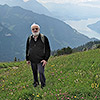
I may no longer be able to climb mountains or battle the waves in a raging sea. No, but deep within myself all this still exists, and all of it gives me the sense of being truly alive.

Question: So, is that what you mean by a person remaining young regardless of their age?

Answer: Of course!
[355455]
From KabTV’s “News with Dr. Michael Laitman,” 4/2/26

Related Material:
Don’t Get Old Prematurely
I Am Still Young
Old Age Is A Relative Concept

Where Is Evolution Leading Us? Part 2

707All the forms that preceded the appearance of man are hidden inside us. In the process of evolution, matter progressed through the stages of inanimate, vegetative, animate, and human.

At each stage there were also four stages of development: four within the inanimate, four within the vegetative, four within the animate, and four within the human.

That is, from the beginning of the inanimate level to the end of the human level, one must traverse sixteen distinct steps before a human finally emerges from the ape. Thousands of years ago Kabbalah asserted that man appeared as a result of the evolutionary development of the ape.

Nature evolved from the inanimate to the vegetative through an intermediate form, corals; from the vegetative to the animate through a hybrid vegetative-animal form known as “Kelev Sade” (field dog); and from the animate to human through the ape.

We, in turn, must continue to develop as human beings until we attain the stage of development of the spiritual human, one who begins to ask about their root and ultimate purpose.

In other words, we will undergo profound internal, sensory, and intellectual development that we become capable of rising above our innate animal nature and begin to ask questions that are no longer pertain to the animal level: “Who are we? Who created us?” People who are concerned about such issues begin their spiritual development and who turn to the science of Kabbalah.

If a particular species becomes extinct in the course of evolution, it does not truly disappear; rather, it simply sheds its external form and transforms into the next one. This implies that we are the same dinosaurs, only now in the form of humans.

The same form continued to evolve and develop, much like the classic illustrations of Darwin’s theory of evolution, where the ape is followed by a figure grasping a stick, and gradually transforms into modern humans.

This means that all kinds of creatures that have evolved in the past and continue to evolve are ultimately designed to lead to the emergence of a person who will ask himself “Who am I? Why am I here?”.

He will want to discover his root and will reveal it using the method of Kabbalah; that is, he will become similar to the Creator. Consequently, he will be called “Adam,” a name derived from the Hebrew word “Edomeh,” similar to the Creator.” He will become so similar to the Creator that they will achieve a state of fusion, a complete correspondence between them, like two parts of a single whole.

Question: Does it mean that all living beings have something in common?

Answer: What we all have in common is that we all come from the same root, which is called “Creator.” It is He who created our shared substance, the desire to enjoy or “creation.” Subsequently, these creations begin to differentiate into levels and species distinguished by a multitude of diverse attributes.

Question: Over the last two hundred years, a rapid process of species extinction has begun. If in the past centuries only fifty species disappeared each year, today thousands of different species disappear per year. Why is this happening?

Answer: Apparently these species are not required in the process of evolution to advance to the next steps. In this case, these species do not disappear altogether, but take on hidden forms that are incomprehensible to us, and they contribute to the existence of more advanced forms.

Consider, for instance, the dinosaur that ceased to exist in the form of dinosaurs, yet they continue to exist within us in a different form, as latent potential forces. Without this potential, we would not have been able to develop to the level of humans.

This leads to a very important conclusion about the proper attitude toward nature. There is no need to keep endangered species by force, nor to forcibly develop those species that seem more useful to us.

The main thing is to take care of the human species while not destroying anything in nature. In other words, you cannot destroy anything, but you do not have to go against nature and artificially keep species that disappear naturally from it.
[218986]
From KabTV’s conversation “New Life 931 – Evolution: The Next Stage,” 12/12/17

Related Material:
Where is Evolution Leading Us? Part 1
Why Are There No Dinosaurs Today?
There Are Many Surprises Up Ahead

Daily Kabbalah Lesson – 5/3/26

Preparation to the Lesson

icon for podpress Video: Play Now | Download icon for podpress Audio: Play Now | Download

1st part of the Lesson — Writings of Rabash, Article 15 “What Is the Blessing, ‘Who Made a Miracle for Me in This Place,’ in the Work?” (1991) (3.18.2002)

icon for podpress Video: Play Now | Download icon for podpress Audio: Play Now | Download

2nd part of the Lesson — Recording of Rabash, Writings of Baal HaSulam, “Study of the Ten Sefirot,” Vol. 2, Part 5, Item 46

icon for podpress Video: Play Now | Download icon for podpress Audio: Play Now | Download

3rd part of the Lesson — Writings of Baal HaSulam, “Matan Torah” (The Giving of the Torah)

icon for podpress Video: Play Now | Download icon for podpress Audio: Play Now | Download

Audio Version Of The Blog – 5/2/26

Listen to an Audio Version of the Blog
Download:MP3Audio

Not Making Calculations for Your Own Benefit

942Question: What does it mean to annul oneself in our present state?

Answer: What does it mean to annul oneself before the group in our current state? Self-annulment means that you do not make calculations in your own favor. To the extent that you are capable of doing this, do it. This is called “in your state.”

Not making calculations in your own favor means that the benefit will not come directly to you.

Comment: By doing that, I am deceiving myself.

My Response: Deceiving yourself is not the problem. You do not intend to lie to yourself; you are trying as much as possible to make the correct calculation.

Question: What would be an example of me not making a calculation in my own benefit?

Answer: Acting for the sake of the group. Undoubtedly a benefit for oneself is hidden within in, but…

Baal HaSulam writes that people who do not dedicate themselves to the group, who do not invest their whole heart in it, and who do not work with complete self-sacrifice for its sake, are a burden to it. This raises the question: where is the group and where is the burden?

There are people now who can hardly be called a part of the group. There is a core within it that advances; it consists of those who truly want to be in the group. The rest come to study, to participate with a half or a quarter of their strength, to whatever extent. And this too is welcomed and is treated with special consideration. How many such people are there in the world?

Each person must make a calculation: do they truly want to belong to the advancing group? A person must assess how much they are investing in the group, because this, in essence, is their very advancement.
[355437]
From the Daily Kabbalah Lesson 4/11/26, Rabash, “What Are the Four Qualities of Those Who Go to the Seminary, in the Work?”

Related Material:
Subjective Calculations
For Everyone Else’s Sake
The Ten—A System Of Ten Sefirot

You Must Radiate Goodness

938.04Question: What is the recognition of evil at the level of the entire group?

Answer: If we discuss this and study together, then naturally, we reach the recognition of evil even without words.

In general, you should not speak about negative things with each other. Under no circumstances should a person dwell on their own personal recognition of evil. We are obligated to talk only about the
positive, sharing nothing bad with a friend, but only good.

It does not matter how bad your state is; you are obligated to radiate goodness to another. Otherwise, nothing good will come back from them. That is the only way you work for him and for yourself. Therefore, the common recognition of evil is transmitted from one another without words, through spiritual channels.
[355151]
From the Daily Kabbalah Lesson 4/7/26, Rabash, “The Connection between Passover, Matza, and Maror”

Related Material:
What Can We Talk about in the Ten?
Never Talk about the Past
Share with Friends

Through the Prism of the Laws of Bestowal

928The Creator did not create anything except the final correction. We are in it even now. Everything depends only on our inner development—that’s all! By adopting a different attitude to reality, I will see a different reality. It is not that I will see it as merely a bit more pleasant, a bit more palatable, or perhaps worse, no. I will perceive it as fundamentally something else through all my sensory organs.

Our attitude to reality is called “intention.” To transcend the perception of reality as something existing independently to the understanding that it does not exist by itself, but rather, it is the result of my attitude to it. This signifies the transition from this world into the spiritual world.

In other words, one must rise above matter, above the assumption that “this exists and that’s it.” This does not exist! It is I, who, through my attitude and my intention, determine what truly exists. This is known as shifting from the external to the internal, engaging in the internal. The internal is defined as intentions.

We tend to take intentions for granted. What does it mean “to work with intentions”? “I will relate to this differently and then I will feel better” That is what psychologists say. Therefore, people often advise each other: “Take it more calmly, accept it as a fact.”

In reality, we are speaking of something completely different, something distinct from the conventional human attitude. If I relate to the reality I find myself in from the level of the final correction, it does not simply mean that I relate to it more calmly or passively accept it as doctors and neighbors might advise. Rather, I relate to it differently in its essence: the reality I am in operates according to different laws, not the laws of reception, but the laws of bestowal.

Consequently, I begin to perceive it in an entirely different form, I discern completely different connections between its parts. I see that the whole world, all people, only bestow to one another in absolute similarity to the Creator, and the Creator is clothed in each one and fills them; all are absolute righteous and are in the final correction.

Everything depends on how I perceive the picture of the state, whether I look through the prism of the laws of bestowal or through the prism of the laws of reception.
[355507]
From the Daily Kabbalah Lesson 4/15/26, Rabash, “What It Means that the Generations of the Righteous are Good Deeds, in the Work”

Related Material:
How To Enter The Upper World Without Moving
Intention Changes Reality
Intention And Its Influence On Reality

Intermediate States

528.04Although he is not going, his reward is that he should be pleased because the Creator has given him a desire and yearning to observe Torah and Mitzvot. He does not see any merit in himself compared to other people, to whom the Creator did not give this desire and yearning, while he did receive from the Creator this desire. He believes that everything happens through private Providence (Rabash, “What Are the Four Qualities of Those Who Go to the Seminary, in the Work?”).

A person feels that beyond this he is incapable of anything more; he cannot add anything. Yet the Creator gives him something to do, for example, simply to come here and sit. He sees that he has no intention, that he is incapable of self-sacrifice, cannot invest anything more, but at least he performs these actions, like a parrot.

After all, there are people to whom even this is not given. A person comes, sits, and listens, and is incapable of anything beyond that. But in this, he sees a gift from above that the Creator gives him. This is called “the reward for the action is in his hands.” He is grateful to the Creator for this. As for intentions, he measures them and sees that he has none.

All these are intermediate states that everyone passes through, at times in one state, at times in another.
[355440]
From the Daily Kabbalah Lesson 4/11/26, Rabash, “What Are the Four Qualities of Those Who Go to the Seminary, in the Work?”

Related Material:
According to a Person’s Aspiration
An Action Without An Intention
Don’t Let Your Spark Be Extinguished

Audio Version Of The Blog – 5/1/26

Listen to an Audio Version of the Blog
Download:MP3Audio