Entries in the 'Torah' Category

The Wells Of Isaac

laitman_741.02There is a phenomenon that after many years of studying the wisdom of Kabbalah, a person suddenly discovers that he has lost all the desire for spirituality, all motivation, the entire urge that he had before, and he does not know where to get strength from. He does not even have the strength to ask the Creator to give him strength to yearn for spirituality.

And besides, he should take care of having the power to overcome his desire to receive pleasure and use it for the sake of bestowal. Therefore, the work proceeds in two stages that alternate with each other.

Sometimes I fight my desire to receive pleasure in order to overcome it and perform actions of bestowal. And sometimes I fight for the very desire for spirituality because it disappears, I become as if dead in relation to the spiritual, and I do not want to either ask or receive help.

We have to work on both of these states, and this is called digging the wells of Isaac. Inside the desire to receive pleasure, which is called earth, wells must be dug, symbols of the feeling of lack, the desire to achieve spirituality after which these wells will be filled with water, the waters of the Torah, the light of Hassadim.

I am digging a well because I want to acquire the desire for spirituality, the desire to attain the Creator and merge with Him, the need for bestowal. There is a simple land before me, and I want to turn it into a spiritual field. Therefore, I perform actions within the egoistic desire, I want to unearth it and open the voids in it in order to reach heaven, the spiritual world, from this earth. This is the work of Isaac.

I dig my desire to receive pleasure in order to understand how to use it for actions of bestowal, for love of friends, and through them love, for the Creator. I want to extract from this desire the desire for bestowal, love, unity. We have no other material than this, and it must be brought to correction.

First, I dig a hole in my will to enjoy, the desire to work with my desire for the sake of bestowal. And then this hole is filled with water and becomes a well, which allows me to work properly with the earth, with a common desire.

If we want to build a house, then first we need to dig a hole for the foundation. And the same thing happens in spirituality; you need to dig in the ground, that is, in the heart, and clean out all the dust from there. It means to extract all egoistic intentions from your desires. And then you can start building in this place, that is, add intention to the desire for the sake of bestowal and erect a building. When the heart remains empty without any filling, then the time for building comes.

Man must from his desire for his own sake extract intention. The Creator deliberately placed egoistic intentions into our desire, as if driving construction piles. And we need to pull them out and fill the remaining holes with water to make a well. We will get fertile land and can build on it.

The desire remains the desire to receive pleasure, and our job is to replace the egoistic intention in it with bestowal. If there is an intention for the sake of bestowal, then one can already use the desire and construct buildings from it, the steps of bestowal, our forms similar to the Creator.

It is possible to separate the egoistic intention from the desire only through the group, uniting with friends. Alone, it is impossible to change the intention or even come close to it.

We unite and dig our common desire together, like building a house on stilts together, the wells are dug, filled with concrete, and a house is erected on these columns.

We find that all our intentions are egoistic, for our own sake. And so we want to dig them out of the ground, out of our desires, and put intentions in their place for the sake of bestowal.

There are many stories In the Torah related to wells. It tells of how Abraham opened wells in the desert near Beer Sheva, then about the wells of Isaac. The meeting with the future bride also takes place at the well. The hero drives away villains from the well, removes a heavy stone from it, and gives water to everyone.

This symbolizes a person who, due to acquired intentions for the sake of bestowal, can move a stone (heart of stone) that clogs the well, and then everyone can enjoy the water in the well.

So, the Torah speaks about working in one line and in three lines, about different spiritual levels, but this always happens by a well filled with water.

A well filled with water, that is, with the light of Hassadim, turns into a well with living water. The light of Hassadim can give strength to the earth and grow crops.

To dig a well means to receive the intention for the sake of bestowal within a corrupted desire, which is simply called earth. We need to find a place where the well should be. Feel the lack and start digging the ground until this groove in the ground begins to fill with water, the properties of Bina, that is, with our aspirations to work not for ourselves but for the sake of bestowal.

When the intention for giving fills this whole hole within the desire to enjoy, then we can use this water to irrigate the earth and revive crops, to water animals—donkeys, camels, or people—and gradually come to corrections. Digging wells is the beginning of spiritual work.
[274338]
From the Daily Kabbalah 11/21/20, weekly chapter “Toldot

Related Material:
A Well For A Thirsty Humanity
Searching For A Red Heifer And A Well Of Water
A Man’s Talk With A Rock

New Life 500 – The Bible As The Foundation Of Life

New Life 500 – The Bible As The Foundation Of Life
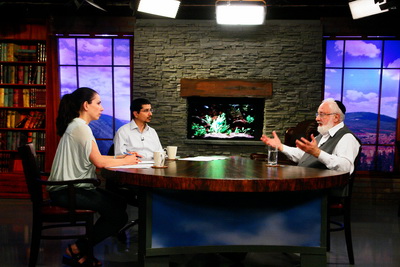
Dr. Michael Laitman in conversation with Oren Levi and Tal Mandelbaum ben Moshe

We can discover and actually experience the latent secret that is within the Bible through the study of the wisdom of Kabbalah. The Bible and all the sacred writings were written in the “language of the branches.” In order to understand these writings, it is necessary to ascend to the “roots.” Kabbalists are people for whom the text of the Bible streams within them since they have a unified embrace with it. A Kabbalist corrects his nature from a desire to receive to a desire to bestow and thereby discovers what is truly written in the Bible. The book is indeed ours but we are in exile from it. When bestowal and love are built between us, we will discover its truth.
[152173]
From KabTV’s “New Life 500 – The Bible As The Foundation Of Life,” 1/15/15

icon for podpress Video: Play Now | Download
icon for podpress Audio: Play Now | Download

“Out Of Zion Shall The Torah Come Forth”

239The land of Israel is called Zion, from the word Yetzia, meaning going out of one’s egoistic properties into altruistic ones.

Besides, it is written: “Out of Zion shall the Torah come forth.” It means that a person who starts to feel a way out of their egoism has conditions for receiving the upper light, the revelation of the Creator.

This upper light is called the light of the Torah. Therefore, it is said that through the attempts to exit our egoism, the light of the Torah will come to us.
[271686]
From KabTV’s “Systematic Analysis of the Development of the People of Israel” 11/25/19

Related Material:
The State Of Israel—The Place For Revelation Of The Creator
The Call Of The Soul For The Promised Land
Come Quickly To The Promised Land

“Simchat Torah”

Dr. Michael LaitmanFrom My Facebook Page Michael Laitman 10/9/20

When we gather with people who also wish to overcome their egoistic inclination and exert a positive influence in the world, we get ready to receive the Torah. By doing so, we set the foundation for a society that is capable of switching the current chaotic direction the world is treading to a positive and balanced one.

We can rejoice then in our recognition of the real cause of all our problems—our egoistic nature—and in our having the means at our disposal to redirect this nature to a good direction of connection, love, and giving. That is already a major step toward the reformation the Torah speaks about.

Happy holiday to all!
Read my full post

“What Is The Joy In Simchat Torah?”

Dr. Michael LaitmanFrom My Facebook Page Michael Laitman 10/9/20

Friday is the day of Simchat Torah [lit. The Joy of Torah]. On this day, we celebrate the completion of the cycle of reading Torah portions and the beginning of a new one. But why is completing a cycle of reading only to start over a reason for celebration? It isn’t. If we look only at the superficial level of things, there is nothing to celebrate.

If we want to make sense of this festive day, we have to go beyond the exterior, to the inner, true meaning of the Torah. It is written, “I have created the evil inclination; I have created the Torah as a spice” (Masechet Kidushin). This means that the Torah is not some piece of text that we must recite without applying its content to ourselves, but a means for correcting our evil inclination. If we use it for any other purpose, we are missing the whole point.

If we achieve correction of our evil inclination, then we have a reason for celebration. If we do not, then we should keep working until we reach the state of Simchat Torah, namely the correction of our evil inclination through the “spice” of Torah.

In Hebrew, the word Torah means both “light” and “instruction.” The “light” in it is regarded as “the light that reforms,” a force that “corrects” our evil inclination into a good inclination. The “instruction” part of the Torah refers to what we have to do in order to “reform” ourselves, and that is to love our neighbors as ourselves. Old Hillel said about this, “That which you hate, do not do unto your neighbor; this is the whole of the Torah” (Masechet Shabbat, 31a), and Rabbi Akiva added, “Love your neighbor as yourself; this is the great rule of the Torah” (Jerusalem Talmud, Nedarim, 30b).

At the moment, the festival of Simchat Torah is simply a reminder of what we should be doing, and in that sense I’m happy about it. But in truth, we have no cause for celebration since there is anything but love of others among us. Even if we weren’t corrected but at least wanted to use the “light” in order to reform ourselves, it would be reason enough for celebration. But currently, I do not see that we are acknowledging our desperate need to change or that we are willing to and feel accountable for the state of our nation.

The situation is even more serious when it comes to our relations with the nations of the world. As Jews, we are constantly under the world’s watchful eye. They judge us by a different yardstick than they judge any other nation, and with good reason: They feel that it’s our duty to bring them light, to be “a light unto nations.” That is, we are not only required to use the reforming light on ourselves, but we are also required to pass it on so the rest of the world can be rid of the evil inclination. Even if the nations don’t articulate this request explicitly, their accusation that we are causing all that is evil in the world is in fact the flip side of saying “You are not bringing the light you are supposed to, the light that will reform us and stop the evil among us.”

Even our own sages tell us that our task is to bring the light of unity to the world, and when we do not, we inflict trouble on the nations. The Talmud writes, “No calamity comes to the world but because of Israel” (Masechet Yevamot, 63a). The Midrash is even more specific: “This nation, world peace dwells within it” (Beresheet Rabbah, 66).

We see that when antisemites accuse us of causing wars, they are in fact saying the same thing that our sages have been saying for generations but we refuse to listen. Because we wouldn’t listen, we have been given antisemites to intimidate us and force us to listen. Perhaps if we tried to do what our sages, who certainly want our best, have been advising us for millennia, we wouldn’t be suffering from antisemitism to this day, eighty years after the horrors of the Holocaust.

The Book of Consciousness writes, “We are commanded at each generation to strengthen the unity among us so our enemies do not rule over us.” With these words, I would like to wish us all that this coming year, we will unite “as one man with one heart,” learn the true meaning of the Torah, rejoice in it, and merit the words of King David in Psalms 29, “The Lord will give strength to His people; the Lord will bless His people with peace.”

“Simchat Torah, Reasons To Be Joyful” (Times Of Israel)

The Times of Israel published my new article “Simchat Torah, Reasons to Be Joyful

Simchat Torah marks the conclusion of the Tishrei holiday cycle with a celebration of joy in the Torah. But is it possible to feel a happy atmosphere when the world is facing such a conspicuous pandemic? Indeed, the current situation gives us an opportunity to recognize the cause of our predicaments—our egoistic inclination of self-concern—and to transform them into the right direction of love and connection. What is the real meaning of rejoicing with the Torah? Where is this joy rooted? To understand the deeper meaning behind this celebration we should first understand what the deeper meaning behind the Torah itself is.

The Torah is the “light that reforms” [Midrash Rabah, Eicha, “Introduction,” Paragraph 2]. It refers to the force that develops and sustains all living organisms. The light is a desire to give, and its creation, particularly us, is a desire to receive. The joy we feel during Simchat Torah symbolizes our discovery of this light, i.e., the attainment of its characteristic quality of giving onto our innate desire to receive. Such attainment is feeling a much more expansive reality than the one we feel when we only receive.

Although we are a desire to receive, completely opposite to the light’s giving quality, we don’t feel the full intensity of this oppositeness, its “evil” (“the inclination of a man’s heart is evil from his youth” [Genesis, 8:21]). What we do feel is that the more we develop, the more problems and pains emerge. The purpose of the unfolding crises in every field of life we’re experiencing today is to make us seek out why they are happening and how they can be resolved.

Moreover, today’s globally interdependent condition, particularly evident due to the pandemic, shows us that the more we develop without working together to resolve the many personal, social, ecological, and financial issues pressing on us and looking at them as a common state that demands mutual responsibility, then we’re bound to tumble into deeper chasms.

The global crisis today is occurring in order to bring us to the discovery of our nature—the desire to receive pleasure for self-benefit alone—as the cause of our problems. We need to learn how to redirect our desires in order to fix these problems at their core. As it is written, “I have created the evil inclination,” and “I have created for it the Torah as a spice” [Babylonian Talmud, Masechet Kidushin, 30b] because “the light in it reforms them” [Midrash Rabah, Eicha, “Introduction,” Paragraph 2.].

In other words, our egoistic desires were created with a means of redirecting them into a form of giving, the Torah, and by doing so correcting them, thereby adding fulfillment and pleasure to our lives, a spice. The question then is: How? How can we work with this light? How can we invite it into our lives, let it work on us, and allow it to bring about positive changes? The answer lies in our connection.

When we gather with people who also wish to overcome their egoistic inclination and exert a positive influence in the world, we get ready to receive the Torah. By doing so, we set the foundation for a society that is capable of switching the current chaotic direction the world is treading to a positive and balanced one.

We can rejoice then in our recognition of the real cause of all our problems—our egoistic nature—and in our having the means at our disposal to redirect this nature to a good direction of connection, love, and giving. That is already a major step toward the reformation the Torah speaks about.

Happy holiday to all!
[272186]

Shavuot—The Holiday Of Finding A Connection With The Creator

laitman_744A special holiday is coming – Shavuot, the holiday of the giving of the Torah. It symbolizes the revelation in the world of the Torah to us, that is, the connection between the Creator and people.

This happened about three and a half thousand years ago, in the Sinai Desert, near Mount Sinai. Such symbols exist in our world because each spiritual root is obliged to touch its material branch.

This holiday is significant in that a person receives a connection with the upper force. Otherwise, we would remain animals that exist aimlessly on Planet Earth, which is rushing somewhere in a lifeless space.

And now we can connect with the very force that created the universe, the globe, and the people on it, and that launched the entire process of evolution. We can find out what is behind this process, what are the forms of relations between us and the higher power.

Shavuot is a great holiday because we celebrate gaining connection with the Creator, which allows us to rise from this life, from its aimlessness and meaninglessness, above this animate existence. There is no holiday bigger than the giving of the Torah; everything starts with it! If it weren’t for it, our lives would be in vain.

We would remain ordinary animals born in order to live and die. The Torah gives us the opportunity to rise above our lives, comprehend a higher power, and enter eternity, perfection, another dimension that is based on bestowal, not reception.

Our world exists only within egoism, reception, and the spiritual world exists for the sake of bestowal; therefore, it is eternal and perfect. Thanks to this means, which is called the Torah, we have the opportunity to rise from the lower world to the higher one.

Therefore, we celebrate Shavuot, in which there are not many symbols: white clothes and dairy food are symbols of bestowal. Those are all the characteristics of this holiday.

According to history, the giving of the Torah occurred after the people of Israel left Egypt, that is, after fleeing from the selfish intention and crossing the Red Sea (Yam Suf), which meant breaking off from egoism and entering the Sinai Desert, the place where hatred (Sinaa) between altruistic and egoistic desires is revealed.

And then a person faces a mountain of doubts. Har (mountain) comes from Hirhurim (doubts). How many objections we have against the desire for bestowal is revealed to us and we need to work on them. Therefore, we shout: “Where is the tool that will allow us to achieve bestowal? We do not have such strength!”

Then we get a power from above called “the upper light,” “Torah,” that is, “light” (Ohr), “program,” “technique” (Ora’a). Thus, we begin to develop purposefully.

Until now we are making correction after correction in our egoism, generation after generation, until we come to the end of correction. All this is possible thanks to the hidden power of the Torah, which is called “the light that returns to the source,” the highest light of correction.

In the days of this holiday there is a special power in the world. And if we study it together, it will move us forward.
[265378]
From the 3rd part of the Daily Kabbalah Lesson 5/27/20, Writings of Baal HaSulam, “Matan Torah [The Giving of the Torah]“

Related Material:
Invitation To Reveal The Torah
Shavuot
The Holiday Of Shavuot

“Did God Give The Torah To Moses In Public? If So, Is There Solid Proof?” (Quora)

Dr. Michael LaitmanMichael Laitman, On Quora: Did God give the Torah to Moses in public? If so, is there solid proof?

It is only an allegorical statement. Do we really think that God or the Creator descended from heaven holding the Torah in His hands?

The Creator is a force of nature that connects harmoniously between all elements of reality.

Some people have more of an inclination to reveal this force, feeling questions about life’s meaning and purpose more succinctly than others, and also feeling attracted to a deeper connection with reality.

Those who feel such an attraction, and who find a method to develop it into a new revelation of reality become Kabbalists. They engage in its attainment and revelation, and it gradually becomes a science of how to discover the Creator.

The Creator is immaterial, and thus unattainable using physical and corporeal devices.

However, if we develop a force opposite to our egoistic nature, an altruistic force, then we will start feeling the Creator completely surrounding us.

Kabbalah And Torah

Laitman_137Remark: There is a saying that Kabbalah is aerobatics, that one needs to study it only after one has studied the Torah, Talmud, and other primary sources.

My Comment: Kabbalists write that it depends only on a person. If he does not have craving for spirituality, then let him study everything in order from the Torah to the Talmud and so on, that is, to the stage where he is drawn and sees that he does not need more. If a person initially has a very strong desire for knowledge of the Creator, then he immediately comes to Kabbalah.

Question: There is no ban on this?

Answer: No.

Question: Is this the opinion of Kabbalists? Others say there is a ban.

Answer: Others can talk. What do they understand in this? The Torah is given for us to comprehend the Creator. This is its property, its strength, its goal. We need to return to the Creator—to this stage. If someone believes that he does not have the strength or desire for this, then let him simply study what everyone else is studying, nothing more. Once I brought 40 more students to my teacher and we all learned only Kabbalistic material.

Question: And he did not demand knowledge of the Torah from you?

Answer: None.
[256381]
From KabTv’s “Fundamentals of Kabbalah,” 1/29/19

Related Material:
The Torah And Kabbalah
What Came First, The Torah Or The Wisdom Of Kabbalah?
Torah And The Wisdom Of Kabbalah

The Meaning Of Kabbalistic Books, Part 5

laitman_933Who Wrote the Torah?

Question: Who wrote the Torah? Is it true that Moses wrote it?

Answer: Moses did not write it. It was written by people in the days of Moses and Joshua. It ends like this: a description of Moses’s death and entering the Land of Israel.

Question: So Moses kind of dictated the Torah to people? Or he taught them and from their attainment they later wrote it? In principle, even Kabbalists attribute the authorship of this book to Moses.

Answer: The point is not the authorship. The fact is that a person who is writing the Torah is experiencing these states and describing them with the corresponding letters. Therefore, the people who wrote the Torah in the time of Moses and Joshua depicted the states they experienced in the form of such signs.

Question: Similar to The Book of Zohar that was written by the ten disciples of Rabbi Shimon, the Torah was also written in that way?

Answer: The fact that the method of the Torah was to be implemented in a group is undoubted because it comes from the very nature of creation. When not fewer than ten different, disparate egoistic desires begin to conjugate above their egoism, only then can they describe their above-egoistic state, called spiritual, in the correct letter designations.
[252275]
From KabTV’s “Fundamentals of Kabbalah,” 12/18/18

Related Material:
The Meaning Of Kabbalistic Books, Part 4
The Meaning Of Kabbalistic Books, Part 3
The Meaning Of Kabbalistic Books, Part 2