Audio Version Of The Blog – 5/18/25
Posted on May 18th, 2025 at 10:55 pm
Listen to an Audio Version of the Blog
Download:MP3Audio

Listen to an Audio Version of the Blog
Download:MP3Audio
 Comment: Baal HaSulam writes that if even one person does not fulfill the condition of mutual guarantee, no one else will not be able to come to the tenet of “love your neighbor as yourself.”
My Response: No, Baal HaSulam is writing about the ideal, because if we are talking about the common soul of Adam HaRishon, which is built from six hundred thousand souls—it does not matter if it is several billion; everyone has a soul, they should all connect.
There is no problem to do it from above: a small change in the light and the whole world will start going crazy and rush to where it illuminates. There is nothing complicated here. The difficulty is how to spur the world to come to the realization of evil, to the understanding that it is actually in a state that requires change.
Question: Baal HaSulam’s article says that even if a single person does not agree with the condition of mutual guarantee, no one will be able to fulfill it. What is meant by this “single person” who is immersed in self-love?
Answer: Are you asking if this single person is to blame for thinking that way? Can the others influence him to think differently? Could it be that everyone is in an effort to fulfill the mutual guarantee, but this one is not? After all, there are 599,999 more corrected parts in this single person! Can only one part be uncorrected?
Baal HaSulam offers this simply as an example, as a theoretical situation; yes, everything and everyone should be corrected and united by mutual guarantee, down to the last detail, in all properties. This is the condition of a perfect common Kli, when it is fulfilled, the Creator reveals himself in it, and the Kli becomes equal to the Creator.
[343822]
From the Daily Kabbalah Lesson 5/7/2025, Writings of Baal HaSulam “The Arvut (Mutual Guarantee)“
Related Material:
Arvut – For Each and Every One
The Inner Revolution
The Wind Of Change
 Question: What force preserves mutual guarantee from the moment we begin to desire it until the moment it is revealed?
Answer: You preserve it. The group itself preserves it. What does it mean to preserve? It is the feeling of necessity! Other than that, there is nothing.
Then the question arises: what helps maintain the feeling of the necessity for mutual guarantee so that it always stays before my eyes as the most essential thing? It is the group! And how can the group avoid falling and avoid forgetting about this a quarter of an hour later, a minute after we finish speaking about it? The prayer! And what is a prayer? A common desire!
Such questions arise because a person thinks he is in a world where there is no law. What does it mean to pray? When I cry out to the Creator, does that help? The Creator is called the general law of reality that acts upon all of existence from the highest level at which I am in adhesion with Him. From there, He expresses His attitude toward us.
I do something and it corresponds to His attitude toward me; I do more, His attitude changes; I do less, it changes again. That is, the general law is a law, just like the fulfillment of other laws of nature! “Elokim” in gematria means nature!
What does it mean to pray? If I change my desire and acquire an aspiration, then I am already in a different internal state. It seems to me as if the Creator has changed. He is unchanging! I change! And in accordance with my change, a different light, a different state is revealed to me.
So I am as if projecting my changes onto the Creator. “I cried to Him, I wept, and He helped me!” How did He help, what did He do? I came to such a state! I reached it through my internal change as a result of which the situation changed for the better. Therefore, it is said that “He helped.”
We ourselves change the states. But He, in His attitude, is unchanging. “For I, the Lord (HaVaYaH), do not change.” Both before and now He relates to you as good who does good, not only to the good, but to the bad as well, always!
“No,” we say, “Before He was bad, and now He is a little better.” “I corrected the Creator, and now He has become kinder.” Is that how it seems?
But it is a law. And if we want to follow it properly, in a healthy form, then the Kabbalists tell us what the corrected state is and how we should appear in it. And now think about how to be in this. By what means: what to give, what to invest, what to build.
[343854]
From the Daily Kabbalah Lesson 5/8/2025, Writings of Baal HaSulam “The Arvut (Mutual Guarantee)”
Related Material:
Does the Creator’s Attitude Toward Us Change?
Is God Good Or Evil?
Why Did The Creator Make The Evil Inclination?
 We are at a turning point between two very serious epochs. There are only two of them. This is not what it was before and will be in the future. This is a transition from the world of the sole rule of egoism in everyone, in groups, in states, and in civilizations to a common, global, unified world, as it should be.
In principle, only man is a violator of this globality. The rest of nature is completely controlled from above, there is no way for it to change itself in anything and there is no need to. Humans are the only creation that are opposite to all others and represent an object that must change itself, on its own, intelligently.
So, we have a special time. We have a special task. Over the course of many incarnations of our lives we have come to a point where we need to solve this problem.
I am happy that we are in such a generation. We really have all the tools to solve this and move forward beautifully, easily, and freely, not with a stick to happiness, but with the awareness of a great task, a great dream, and a great fortune that we are now revealing.
This is not some kind of sky-high idea, but a very real idea that speaks about the whole of nature, tells us in a clear, scientific style what we can do, why and how. We should be happy that we have this opportunity.
[343556]
From KabTV’s “I Got a Call. Congress of the New Generation” 8/22/10
Related Material:
A Specific Point
Critical Point of Human Development
The Path To Complete Transformation
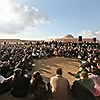 Question: How does spiritual seclusion differ from physical seclusion? What results can be achieved through one and the other?
Answer: If I remain alone physically, any thoughts can come to me, in any direction, completely unrelated to truth and the true purpose. But if I am in a group, we have a common goal.
We seclude ourselves for a special work in which each one annuls themselves before the group, and then instead of separate individuals, we turn into a new unified organism, a new personality called “the group.”
This makes us similar to the nature of the desert or the sky because we become zeroes and join together in order to attain the goal of life, but essentially, we have nothing of our own. In this state, we prepare a desire from ourselves, not of one person, but of the entire ten. Each one relates to the others as if considering themselves to be a zero.
Question: Why is it important that it be the desire of the ten and not of one person?
Answer: A single person cannot be a zero, relative to whom would one consider oneself that way? If I seclude myself alone, I remain with myself. To be secluded means to escape from oneself, beyond one’s own limits. How can a person do that alone?
It is as if I leave myself and join others. This is my only opportunity to exit my egoism and perceive something outside of myself. When ten people together make such efforts, they become a spiritual vessel, a shared desire capable of perceiving the essence of the desert or the essence of the sky.
They exit themselves, annul their egoism, and unite with each other. The center of their unity becomes a new entity, a quality of bestowal capable of perceiving the essence of life. This was the purpose of seclusion: to find the meaning of life.
But if a person secludes themselves alone, they will not reveal the meaning of life; at most, they will write some book and think about something material. There will be no spiritual attainments because they have not exited themselves.
[217917]
From KabTV’s “New Life 925 – Inner Solitude,” 11/28/2017
Related Material:
Alone With Oneself, Part 2
Alone with Oneself, Part 1
The Desert, Part 2
Preparation to the Lesson
 Video: Play Now | Download Video: Play Now | Download |
 Audio: Play Now | Download Audio: Play Now | Download |
1st part of the Lesson — Writings of Baal HaSulam, “There’s None Else Besides Him”
| Video: Play Now | Download |
Audio: Play Now | Download |
2nd part of the Lesson — Writings of Baal HaSulam, “Study of the Ten Sefirot,” Vol. 1, Part 2, “Inner Observation,” Chapter 9, Item 113
| Video: Play Now | Download |
Audio: Play Now | Download |
Selected Highlights
| Video: Play Now | Download |
Audio: Play Now | Download |
Listen to an Audio Version of the Blog
Download:MP3Audio
Listen to an Audio Version of the Blog
Download:MP3Audio
 Question: What happens to a person when they isolate themselves and are left alone with their thoughts?
Answer: It depends on the person and on the purpose for which they seek solitude. If one is striving toward a special spiritual goal, then it makes little difference whether they isolate themselves in the middle of Manhattan or in a true desert.
Question: If a person goes into the desert with the intention of clearing their thoughts and listening to their inner voice, is there a chance for them to understand who they really are?
Answer: If a group of people goes into the desert, far from the rest of the world, in order to attain an inner, shared spiritual goal, then such solitude certainly makes sense. Undoubtedly, the desert is a more suitable place for this than a forest, because it is silent, empty.
The desert leaves a person with no illusions, it makes it absolutely clear that nothing good can come out of life in it, just as nothing good comes from ordinary human life. That is why in the desert we feel in tune with nature.
I love the desert because there you have nothing but earth and sky, especially at night. It gives a person a special mood, impression, and feeling, especially when many people are together there, searching for the meaning of life. Then the desert and the heavens begin to speak to them, showing: “This is all there is, and you are here alone in this empty vacuum. So seek the hidden source of life!”
Question: You are talking about a group of Kabbalists going into the desert with a special purpose. But if an ordinary person isolates themselves in the desert, is there a chance for them to discover their inner essence?
Answer: On their own, it is impossible. I believe that even the Torah, when telling about Abraham, Isaac, Jacob, and Moses, is referring to whole groups. Because a single person cannot be spiritual; one does not exist in relation to spirituality as a separate element, but only in connection with others, ideally no fewer than ten.
Question: Isn’t it a contradiction: “solitude in a group”? Isn’t it either solitude or a group, one or the other?
Answer: Solitude is only possible within a group! Because the solitude of the individual is just an animalistic act, physical isolation of the body. But solitude within a group is spiritual solitude.
Being connected with one another, we begin to reveal how much we lack the meaning of life and the force that sustains it.
[217820]
From KabTV’s “New Life 925 – Inner Solitude.” 11/28/2017
Related Material:
Alone with Oneself, Part 1
The Desert, Part 2
The Desert, Part 1
 Question: If a person is divided in two, between egoism and the point in the heart, how can they build a mechanism that would constantly give them the strength to be on the right side and not on the side of the evil inclination?
Answer: How can one build a mechanism that helps us attain the feeling of mutual guarantee (Arvut)? That is precisely what we are building. It is the group.
From all my internal qualities and all the external conditions surrounding me, the only thing in which I can act freely is in choosing my environment. Because my character and all my qualities are predetermined for me. And society, if I do not choose it, acts upon me however it wants. I am in its power, and whether I like it or not, I absorb everything from it.
It turns out that I am capable of making a choice when I am given such an opportunity from above, and I make efforts in that. Only that is called free choice.
Either I choose a good environment that advances me toward mutual guarantee and final correction (Gmar Tikkun), or I am a puppet, a marionette, completely devoid of freewill, and in that case, there is no reward, no punishment, no one to ask, and no one to complain to. Everything flows according to nature.
So who then is a sinner? The one who wants to become righteous. Who has free choice? Only the Kabbalists. And the rest? The rest are like animals. As it is written: “He is like the beasts that perish.” (Psalms 49:13). There is nothing to demand from them; they have no choice because that is how the laws are set: either you choose mutual guarantee or you do not.
Remember how elections used to be held in the Soviet Union?
– “We are choosing the city’s mayor!” – “How many candidates are there?” – “One!”
It is the same with the Creator. If it is the truth, it has to be one. Not ten! What does it mean, ten candidates? It means nine liars and one honest one. But the idea itself is right.
You are not choosing one out of ten. The idea is different: there is one true One, and you decide whether you are really choosing Him. Essentially, through your choice, you examine yourself, do you truly intend to “cast your ballot” as confirmation that you agree with the corrected state. That is called a choice.
[343810]
From the Daily Kabbalah Lesson 5/7/2025, Writings of Baal HaSulam “The Arvut (Mutual Guarantee)”
Related Material:
Strengthening One’s Choice
Mutual Guarantee: The Decision Is Ours
Mutual Guarantee as the Law of Life
 Daily Audio Version-MP3
 Get the Weekly eNewsletter
 Follow on Twitter
