Audio Version Of The Blog – 10/10/19
Posted on October 10th, 2019 at 9:55 pm
Listen to an Audio Version of the Blog
Download:MP3 Audio

Listen to an Audio Version of the Blog
Download:MP3 Audio
 From My Facebook Page Michael Laitman 10/10/19
Yehuda Leib HaLevi Ashlag is known as Baal HaSulam (Owner of the Ladder) for his Sulam (ladder) commentary on The Book of Zohar. Baal HaSulam dedicated his life to interpretations and innovations in the wisdom of Kabbalah, disseminating it in Israel and throughout the world. He developed a unique method to the study of Kabbalah, by which any person can delve into the depth of reality and reveal its roots and purpose of existence.
Baal HaSulam was born in Warsaw, Poland on Sep 24, 1884. At the age of nineteen he was ordained as a rabbi by the greatest rabbis of Warsaw, and for sixteen years he served as a Dayan (Jewish orthodox judge) and a teacher in Warsaw.
Baal HaSulam’s teacher was Rabbi Yehoshua of Porsov. In 1921, Baal HaSulam immigrated to Israel and settled in the Old City of Jerusalem. The word of his coming quickly spread among Jews who emigrated from Poland, and he soon became known as an authority in Kabbalah. Gradually, a group of students formed around him, attending Kabbalah lessons in the wee hours. Later on Baal HaSulam moved from the Old City and settled in Givat Shaul, which was then a new neighborhood in Jerusalem, where for several years he served as the neighborhood rabbi.
Baal HaSulam spent the years 1926-1928 in London. During his time in London he wrote the commentary to the Aris Tree Of Life Panim Meirot uMasbirot, which he printed in 1927. Throughout his stay in London, Baal HaSulam conducted extensive correspondence with his students in Israel, which were assembled in 1985 in a book titled Igrot Kodesh (Letters of Sanctity).
In 1933, Baal HaSulam published the tractates Matan Torah (The Giving of the Torah), HaArvut (The Bond), and HaShalom (The Peace).
Baal HaSulams two major works, the result of many years of labor, are Talmud Eser Sefirot (The Study of the Ten Sefirot), a commentary on the writings of the Ari, and Perush HaSulam (The Sulam Commentary)on The Book of Zohar. The publications of the 16 parts (in six volumes) of Talmud Eser Sefirot began in 1937. In 1940 he published Beit Shaar HaKavanot (The Gatehouse of Intentions),with commentaries to selected writings of the Ari. Persuh HaSulam on the Zohar was printed in 18 volumes in the years 1945-1953. Later on Baal HaSulam wrote three additional volumes containing commentaries on The New Zohar, whose printing was completed in 1955, after his demise.
In his Introduction to the Book of Zohar, Baal HaSulam writes as follows (item 58): And I have named that commentary The Sulam (ladder), to show that the purpose of it is, as with every ladder, that if you have an attic full of goods, then all you need is a ladder to reach it, and then all the bounty of the world is in your hands.
Baal HaSulam wrote a series of introductions that prepare the student for proper study of Kabbalistic texts. Some of these introductions are Preface to the Book of Zohar, Introduction to the Book of Zohar, Preface to the Wisdom of Kabbalah, Preface to the Sulam Commentary, General Preface to the Tree of Life, and Introduction to Talmud Eser Sefirot.
In 1940, Baal HaSulam published the first and, as it turned out, the last issue of the journal HaUma (The Nation). The journal was shut down by the British Mandate authorities after having received malicious information that the journal propagated communism.
Baal HaSulam encountered enormous difficulties printing his books. We can learn of the importance he ascribed to printing and disseminating Kabbalah from the 2003 Israel Award laureate Prof. Shlomo Giora Shohams description of his meeting with Baal HaSulam in the early 1950s.
“I found him standing in a dilapidated building, almost a shack, which housed an old printing press. He couldn’t afford to pay a typesetter and was doing the typesetting himself, letter by letter, standing over the printing press for hours at a time, despite the fact that he was in his late sixties. Ashlag was clearly a tzaddik (righteous man) – a humble man, with a radiant face. But he was an absolutely marginal figure and terribly impoverished. I later heard that he spent so many hours setting type that the lead used in the printing process damaged his health.”
This excerpt was published on Dec 17, 2004 in Haaretz newspaper, in a story by Micha Odenheimer.
Baal HaSulam did not merely put his ideas on paper; he acted vigorously to promote them. He met with many leaders of the Jewish settlement in Israel of the time, leaders of the Labor movement and many public figures. Among these figures are David Ben-Gurion, Zalman Shazar, Moshe Sadeh, Chaim Arlozorov, Moshe Aram, Meir Yaari, Yaakov Hazan, Dov Sadan and the great poet Haim Nahman Bialik.
According to Ben-Gurion, he met with Yehuda Ashlag several times, and was apparently surprised:
“I wanted to talk to him about Kabbalah, and he wanted to talk about Socialism.”
(Ben-Gurion Archive, Diaries, Aug 11, 1958).
In his essay Three Meetings and In Between (Amot, Tel-Aviv, 1963, p.49), Dov Sadan writes:
“Rabbi Yehuda Leib Ashlag, among the greatest Kabbalists of the time, aimed at turning the fundamentals of Kabbalah into a historic engine of our generation. Through his socialistic perception, which is based on the above, he sought contact with the Kibbutz Movement.”
It might be surprising to think that Baal HaSulam sought connection with the Hebrew Labor Movement and its leaders, considering the mental and educational chasm between them. However, deep study of his writings reveals a fascinating and intriguing figure of an erudite who was very much involved in the events of his time, both in Israel and the world over, a figure whose ideas are considered revolutionary and daring even to this day.
 The Many Faces of the Torah
Question: When we open the Torah, we find a collection of historical stories with many characters. How should we correctly relate to them?
Answer: If the Torah did not come from a special source but was an ordinary book written, suppose by a person in the Middle Ages, then it would just be an interesting historical novel.
The Torah itself is presented in very interesting language, and when you start reading it, you cannot stop, because it captivates you. There is something in it that makes you never get tired of reading it.
I speak of this as an ordinary reader who has nothing to do with the origin of this book, religion, history, geography, or with anything else. It is just written in an interesting style.
Some perceive the Torah as a historical document, others as fiction, or, perhaps, as a collection of instructions or legal documents. It contains a lot of information about the interaction of people and nations in ancient times, about their view of the world.
In general, the Torah is a very interesting book. We see something similar in Josephus Flavius, if it is possible to compare the Torah and his works at all. To some extent, he retells the Torah and describes it as a historian.
Josephus is a truly stunning historian with a broad outlook and a deep knowledge of historical facts. He wrote his works while in exile in Rome where a huge institute was created especially for him, where hundreds of people worked for him.
But all the same, what he wrote cannot be compared with the Torah itself.
[251953]
From KabTV’s “Fundamentals of Kabbalah” 12/18/18
Related Material:
What Is The Torah?
What Does The Torah Tells Us?
Understanding The Meaning Of The Torah

Today is a special day, the Yahrzeit, the day commemorating the death of Kabbalist Yehuda Ashlag, Baal HaSulam.
Who is Baal HaSulam? He is the soul that connects us to the Creator. He was a person who opened all the gates of the wisdom of Kabbalah to the last generation we’re now in.
Without Baal HaSulam’s teaching, we would be unable to be awarded with what we have already received. Moreover, without Baal HaSulam’s teaching, we would be unable to progress to what is ahead of us, both in terms of the knowledge and the method of Kabbalah, and also its stages of attainment.
No matter what will happen as we head forth, we will reach a need for the Creator. However, such a need will have to pass through this great soul.
“A person has the choice of going to a place where there are righteous. One can accept their authority, and then he will receive all the powers that he lacks by the nature of his own qualities. He will receive it from the righteous. This is the benefit in ‘planted them in each generation,’ so that each generation would have someone to turn to, adhere to, and from whom to receive the strength required to rise to the degree of a righteous.”
– Baal Hasulam. Shamati article 99. “He Did Not Say Wicked or Righteous.”
One of the reasons why the wisdom of Kabbalah is called “the wisdom of Kabbalah (reception)” is because it passes through each generation, and every generation needs a teacher, a Kabbalist, one with spiritual attainment, in the world. That is a necessity in the wisdom of Kabbalah. Only extremely rare and unique individuals can reach attainment of the Creator by receiving special treatment from above. As such, we need to always be connected to great sages who are in spiritual attainment, so that in each generation, we can make spiritual progress.
Since the wisdom of Kabbalah discusses phenomena that a person can only attain through the teacher, then he learns sources, through the teacher, which pass through all generations. The key to the student’s attainment of what passes through his teacher is subjugation, through which the small can receive from the great. Accordingly, there are degrees of the student’s subjugation to the teacher.
Therefore, we need to understand how great and unique Baal HaSulam was, and how much we need to subjugate to what he left us, his writings, with the hope that to the extent of such subjugation, we will be able to connect to his spirit, through which we can receive the upper force from the Creator.
Kabbalah Lesson on the Topic “Baal HaSulam Memorial Day” on October 10, 2019.
 Question: How can you understand that the soul was born and is developing?
Answer: The fact is that you get a very vivid sensation, a filling, awareness of its existence, which leaves no doubt that it has happened and is happening.
Question: Is it possible to develop too fast? Is there a recommended time limit?
Answer: There is no limit, develop as quickly as possible.
Question: Can I study Kabbalah on my own?
Answer: No, I do not recommend that. You will get confused and will not understand anything.
Question: How many people are aware of these things in life?
Answer: There are very few. But in terms of quality, they are much higher and more accomplished than others; they overshadow everyone else.
[251226]
From the Kabbalah Lesson in Russian 6/16/19
Related Material:
Blitz Of Kabbalah Tips – 6/16/19, Part 1
Blitz Of Kabbalah Tips – 5/12/19
Blitz Of Kabbalah Tips – 4/28/19

New Life 281 – The Source Of Emotions And Their Role
Dr. Michael Laitman in conversation with Oren Levi and Nitzah Mazoz
Emotions exist in order to lead us to the most internal source of all life where matter disappears. Emotions are the desire to enjoy pleasure, expressed through bodily sensations and feelings. The mind is enslaved to the emotions and directs a person toward what feels good. The desire to receive pleasure is in constant movement, growth, and change and can therefore never be fulfilled. This leads a person to despair at which point he begins to ask himself questions about the meaning of life. He starts to disagree with the process of life and criticizes what is truly good. He develops new desires as a result of his growing awareness in both mind and body. He discovers a way to experience an absolute and full sense of goodness by leaving the body completely and going directly to the unlimited source of all life and fulfillment, the foundation of nature.
[127855]
From Kab TV’s “New Life 281 – The Source Of Emotions And Their Role,” 1/2/14
 Video: Play Now | Download |
 Audio: Play Now | Download |
Lesson Preparation
| [media 1] | [media 2] |
Lesson on the Topic “Baal Hasulam Memorial Day”
| [media 3] | [media 4] |
Listen to an Audio Version of the Blog
Download:MP3 Audio

The Times of Israel published my new article “Anti-Semitism in Australia: The Deeper Cause and Solution”
Two anti-Semitic events involving children that hit Australia in the past week are just the tip of the iceberg showing a worldwide boost in anti-Semitic sentiment, crimes and threats.
The first was a 5-year-old who was revealed to be subject to anti-Semitic bullying at his school’s bathrooms regularly for months. It reached such scales where the boy would wet his pants in class rather than use the bathroom to avoid the ridicule. All it took was his classmates finding out that he was circumcised for the abuse to begin, which included calling him a “Jewish cockroach.”
At another school, a 12-year-old Jewish student was taken to the park by his classmates, who forced him to bend over and kiss the shoes of a Muslim boy. Of course, the act was photographed and spread on social media. In the months following, the child suffered from anti-Semitic slander, physical assaults, threats and curses. Beyond an injury to his face, which ended with a visit to the hospital, the child began to suffer from acute anxiety.
In both cases, the schools denied involvement in the incidents, and faced minor backlash from the Jewish children’s parents and Jewish organizations. Both Jewish children eventually left the schools.
Despite these events coming to light in the media, there is no guarantee of a safeguard from future such events. We are left with no reason to believe that other Jewish children won’t face similar or worse bullying.
The 2018 Anti-Semitism Report of the Kantor Center reported an unprecedented 59% increase in anti-Semitism cases in Australia compared to the previous year. The cases included phone and email harassment and threats, verbal abuse, vandalism, and anti-Semitic posters and graffiti spreading in the public sphere unimpeded.
These are just some of the cases. Most cases are not reported at all, and Jews continue encountering harassment and curses on a regular basis whether on their way to synagogues on Shabbat, whether at Jewish festivals or other Jewish events.
It’s no wonder that Jews and Israelis living in Australia are starting to feel uncomfortable, to say the least.
I have quite a few students and friends there. Debbie and Avi are part of a large Jewish and Israeli community, living in Bondi Beach in Sydney. Debbie stated that she shivered when she saw the pews of Sydney’s northwestern neighborhoods covered with swastikas and graffiti that call for killing Jews.
Aviva and her family also migrated to Australia a decade ago in her work for a small town near Byron Bay, which has a large community of Israelis. One day when Aviva was sitting in a little café, as she usually did, she was surprised to discover a swastika adorning her coffee. When she asked the waiter what this meant, he explained that Hitler was basically pursuing peace and equality, and his ideas had good intentions.
Apparently, even in a stable and tolerant democracy, in which Jews are free to maintain their beliefs and customs, there is reason to fear. Again, we find that Jews have nowhere else in the world to escape and shake off their role.
The wisdom of Kabbalah explains that Jews have a special role in the human puzzle: “Israel’s purpose is to unite the entire world into one family,” writes Rabbi Kook. The people of Israel are a special people who rose with the common agreement to love one another and live “as one man with one heart.”
The method of uniting the Jewish people, which can also unite humanity, has been instilled in us Jews. Therefore, it is our duty to use it, and to bring about the long-awaited union between us—to set an example for a humanity that is suffering from increasing division and hatred. But as long as we continue letting ourselves get driven into conflict with each other, failing to transcend our egos and connect with each other, anti-Semitism intensifies and gives us a hard reminder that we have a role.
The only way to stop and even reverse the rising trend of anti-Semitism around the world is if we Jews realize our unity above our growing divisions, and to spread this unifying tendency to the world.
[253625]
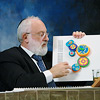 Baal HaSulam, “Peace in the World”: … the benefit of each and every person within his collective is evaluated not according to his own goodness, but according to his service to the public. And vice-versa, we appreciate the attribute of evil of each and every individual only according to the harm one inflicts upon the public in general, and not by one’s own individual value.
These things are crystal clear both from the perspective of the truth in them, and from the perspective of the good in them. This is because what is found in the collective is only what is found in the individual. And the benefit of the collective is the benefit of each and every individual: who harms the collective takes his share in the harm, and who benefits the collective takes his share in the benefit, since individuals are part of the whole, and the whole is not worth in anyway more than the sum of its individuals.
Here is a constant calculation, absolutely complete and very real.
I see before me a vast integral system of the entire world, not our world, but all the worlds. I feel like I am locked in this system through the rest of humanity, an enormous amount of interconnected cogwheels. And I have absolutely no freedom to turn by a few degrees in one direction or another.
After all, a cogwheel is like a sphere: I can spin here and there, in different directions, at different angles.
Yet, wherever I turn, I am connected with other cogwheels. I affect their rotation, their state, and they affect me. This is the world.
This means that nature is absolutely whole and interconnected and we have no way to do anything against it.
[252356]
From KabTV’s “Fundamentals of Kabbalah,” 7/21/19
Related Material:
Discovery Of The Integral Interaction Of All Parts Of Nature
New Life #246 – An Integral Education Course, Part 2
New Life #245 – An Integral Education Course, Part 1
 Daily Audio Version-MP3
 Get the Weekly eNewsletter
 Follow on Twitter

