Where Should We Have Equality?

268.02We are all created differently by nature; there is no need to neutralize, erase, or destroy these differences or consider them bad, unnecessary, or completely useless. On the contrary, we should highlight all the differences between us as much as possible and make them more prominent.


Where should equality be? In making sure that each person does as much as possible at every moment to benefit the whole society.

Comment: But even here we are not equal. You can do more, I can do less.

My Response: But if I do everything within my power and you do everything within yours, then we are equal relative to our unique abilities. You are made this way, I am made that way. So I do as much as I can, and you do as much as you can. One is smart, the other is strong.

Question: And who can determine this?

Answer: No one can. We must be taught to have a correct understanding of nature. Then we will evaluate a person not according to his contribution to society, because some can do more and others can do less in different quantity and quality, but by how much one applies himself given his specific circumstances.

Comment: Nevertheless, a person should have equal opportunities. You talk about upbringing, but not all are the same.

My Response: That is another matter. We should provide everyone not the same but suitable education and upbringing.

From the point of view of nature, a person must be provided with the optimal opportunities he or she needs for correct development in society so that society receives from the person the maximum one can give for its benefit. This is what equal opportunity means.

Question: And who determines what is good for society?

Answer: Society itself and the educational system. It is all depends on education. It should be such that it compels one to feel the need to do everything one can for society. When, ideally, all members of society feel this way, then we can talk about their equality.
[277752]
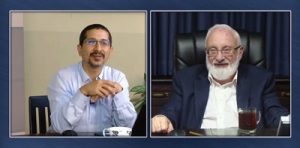
From KabTV’s “Spiritual States” 4/29/19

Related Material:
Conditional Equality
How To Build Equal Relations In Society?
Equality And Diversity

Living In Wholeness

448.12Baal HaSulam, Shamati 34, “The Advantage of the Land“: What should one do in order to come to love the Creator? For this purpose, we are given the remedy of engaging in Torah and Mitzvot [commandments], for the light in it reforms him.

We need to attain the state in which we will permanently feel the Creator. The permanent revelation of the Creator ensures that we will be in eternity, in wholeness, in pleasure, in filling and attainment. The only thing we need to do is to attain the revelation of the Creator.

There is light there which lets him feel the severity of the state of separation. Bit by bit, as one aims to acquire the light of Torah, hatred for separation is created in him. He begins to feel the reason that causes him and his soul to be separated and far from the Creator.

A person feels very sharp and accurate sensations of getting closer to the Creator or further away from Him, but he does not know how to coordinate them with his development. But this is not a bad thing since nothing disappears. We do not disappear, and we do not go anywhere, not from this life or death.

All we need to do is to ascend to the next level, in which we will float in constant energy and general love.
[258517]
From KabTV’s “Fundamentals of Kabbalah” 12/22/19

Related Material:
Aspire To Sense The Creator
Faith: A Reward For Work
Difficulties Are An Invitation For Revelation

Daily Kabbalah Lesson – 2/16/21

Preparation to the Lesson

[media 1] [media 2]

Lesson on the Topic of “Envy” 

[media 3] [media 4]

Selected Highlights

[media 5] [media 6]

Audio Version Of The Blog – 2/15/21

Listen to an Audio Version of the Blog
Download:MP3 Audio

“The Guide To Life Online” (Linkedin)


My new article on Linkedin “The Guide to Life Online”

Whether we like it or not, we live online. Staying home has taken on global proportions after more than a year of the pandemic. It is now more evident than ever that we are linked to each other in an interdependent way, that we constantly influence each other through various online communication tools and platforms. How can we make the best out of this new reality? We will obtain the ultimate benefit by putting on accurate “glasses” to examine the nature of our new relationships.

Since what we call “normal” life may never fully return, we would do well to learn to live in the new environment in a proper and meaningful way. Imagine invisible threads that connect all the hearts, all the minds, all the desires, all the thoughts—connecting between everything and everyone. This network of connections has two possible states: an initial natural state, and a more advanced state that we must reach through proactive choice and recognition.

The prolonged closure of workplaces and businesses as a result of the extended COVID-19 crisis has transformed employment and lifestyle for millions of Americans and people around the world who now work, study, communicate and socialize virtually. Online living is expected to remain a long lasting part of our lifestyle even after the health crisis ends. A recent Pew Research study revealed that of the 71% of the people surveyed who work full time from home, 54% would want to keep doing so even after the pandemic is under control if they are offered such an option.

Since what we call “normal” life may never fully return, we would do well to learn to live in the new environment in a proper and meaningful way. Imagine invisible threads that connect all the hearts, all the minds, all the desires, all the thoughts—connecting between everything and everyone. This network of connections has two possible states: an initial natural state, and a more advanced state that we must reach through proactive choice and recognition.

In the first situation, individuals within the network feel only their own interests, and try to use others to fulfill their desires. Such a self-focused approach fills the network atmosphere with a negative and destructive sense of competition, control, divisiveness and hatred. Basically, no one sleeps quietly; everyone suffers in one way or another.

In the more advanced situation, individuals begin to feel that they are parts of one collective with a common goal and that they are completely dependent on each other. The relationship between members of the collective is based on reciprocity, completion, giving, and love. The definition of success in the second scenario is communal, where everyone strives to do the best for others.

These two situations are completely opposite from each other. The world that is felt in the first state is a difficult world, while the world that is felt in the second state is a beautiful one. Who is it that determines where I will live? I do, by my attitude toward others!

If I relate to everyone through an egoistic view of self-gratification, I live as usual in a world where our relationships deteriorate day by day. But if I succeed in developing an attitude above my personal egoism, to include the concerns of others who are not me, an upside-down world will open up to me, a higher and more positive world will be revealed. The reason that I cannot feel it now is because I have not yet developed the attributes required to grasp it. This is somewhat similar to the way radio broadcasts work: what determines which station I will listen to is the internal frequency to which my receiver is tuned.

The network that we live within is one and the same, the connections between everyone already exist whether we feel them or not. If I manage to develop a new nature of “love your neighbor as yourself” and I treat others with love and consideration, I will begin to feel that in this network of relationships there is an eternal and complete power line which fills me with goodness.

This power source directs us perfectly and clears our understanding to reveal that life has a very lofty purpose unable to be hindered by anyone or anything. If this shift in attitude is put in practice in our human relationships, it will illuminate our virtual environment and we will realize that every moment of our lives will become an opportunity to connect with the force of love that fills all of creation at the touch of a finger.
[278384]

“On The Verge Of Despair” (Linkedin)


My new article on Linkedin “On the Verge of Despair”

Little by little, the realization sinks in: Nothing seems to make things better: not the new year, not the new administration, and not the vaccines. Living on the fast-track simply isn’t working anymore. It hasn’t been working for the past year, and it seems like it isn’t going to start working anytime soon. And the more we realize it, the more we become despaired.

There is a good reason why it seems like the world is running out of gas. Since time immemorial, our fuel has been the search for the next pleasure, the next thing to gain, or the next advantage over others. We’ve been running on a fuel that boosts the ego; where the ego saw no benefit, we had no fuel to work.

There is a good reason why it seems like the world is running out of gas. Since time immemorial, our fuel has been the search for the next pleasure, the next thing to gain, or the next advantage over others. We’ve been running on a fuel that boosts the ego; where the ego saw no benefit, we had no fuel to work. Over the past year, our egos have had so many let downs that many are beginning to doubt whether the ego is really the king we should be serving. Perhaps the futile pursuit of pleasures, which we stop wanting soon after we obtain them, has exposed its inevitable pointlessness. After all, if you already know that once you get what you want, you’ll soon get tired of it, what’s the point of getting it in the first place?

Our time is a time of recognition of the truth about our motivations, our civilization, our values, and ultimately about who we are as human beings. The picture that this realization exposes is not pretty, but it is very sincere, and from a point of sincerity, healthy growth begins. This is why I think our time is so amazing, for all its difficulties.

We are in a time of a great shift; we are shifting from perceiving the world as individuals to perceiving it as an integral system of which we are all parts, and in which we are all one. Perceiving the world as individuals compelled us to seek only our own benefit. However, this put us at odds with the direction of nature’s development. Nature is evolving toward increasing complexity, interdependence, and reciprocity. When you’re trying to go in the opposite direction to all of reality, bad things are bound to happen. This conflict between nature’s trajectory and our trajectory has been the root cause of all our misfortunes, especially since we’ve begun to accentuate our individualism, early in the 20th century, but it has picked up pace tremendously since the turn of the century.

As long as we continue to go against nature’s trajectory, everything we build will collapse. This is why these days, nothing seems to work: The vaccines are here but so is the virus; the election is over but no one is calm; and most of all, no one feels confident about the future, and no one knows what to do about it.

Yet, the answer is in plain sight: If we go against nature and keep thinking as individuals, we will have no future and no solution will work. If we think as an integral humanity, which is a part of the integral planet, we will succeed and our plans will work.

In truth, I am very hopeful. I see how nature leaves us no choice but to rethink everything. Unity is the clear direction of our movement, since this is where all of nature is evolving, and we are not excluded. The only question is how much we will agree to suffer before we go along. The end is good for sure; it’s the road getting there that worries me.
[278324]

“What Is The Future Of National Borders?” (Quora)

Dr. Michael LaitmanMichael Laitman, On Quora: “What is the future of national borders?“

There will be no borders, nations or countries in the future.

We will all become members of one nation that spans the entire globe, with a language that is clear to everyone.

Also, religions, beliefs and customs will lose their importance and fade away in the process.

In other words, we will eventually realize our complete interconnectedness and interdependence as a single whole, in balance with nature’s integral laws.

Replacing all kinds of geographic and ideological boundaries will be a good and positive attitude among all human beings.

The transition to that final state will take place through understanding that we cannot achieve a good life unless we each concede our egos to some extent.

While in our present reality, such a picture seems utopian and unrealistic, and that each individual, group and nation is responsible only for itself and its own citizens, the laws of nature stipulate that we need to advance toward an absolute state of connection, with attitudes of mutual consideration dwelling in such connection.

This kind of connection exists above every limit we have in our world, whether it be borders, gender, race or language, among others, which we have developed over the generations.

In short, nothing will stop us from integrating with each other, as nature necessitates this process.

Written/edited by students of Kabbalist Dr. Michael Laitman.

“What Is The Root Cause Of Antisemitism, And How Do You Fight Anti-Semitism Concretely?” (Quora)

Dr. Michael LaitmanMichael Laitman, On Quora: “What is the root cause of antisemitism, and how do you fight anti-Semitism concretely?“

Antisemitism stems from Jews having a special role in the world, which they are neither aware of nor do they carry it out.

That role is to positively connect “as one man with one heart,” i.e., to develop harmonious unified relations.

If the Jews developed their connections to unite above their differences, then antisemitism would subside and humanity’s attitude toward the Jews would shift to a positive one.

Until the Jews positively connect, people will feel increasing rejection and repulsion toward them. Developing positive connection among Jews depends on developing the “inner Jew” within, which means elevating the desire to connect in a good and kind way toward one another over egoistic desires to use and exploit each other for personal benefit.

This special quality and role that the Jews inherited stems from their foundation as a nation some 4,000 years ago, when Abraham gathered people from ancient Babylon who were willing to unite, since they felt the rampant social division of the time as a major problem that needed solving. Thus, they applied Abraham’s method, which led them to attain the lofty principle of “Love your neighbor as yourself.” By doing so, they became known as the “people of Israel” (“Israel” coming from the words “Yashar Kel” [“straight to God”], i.e., people with an intention to be as loving and giving as the force of love and bestowal itself). They later became known as “the Jews,” from the word for “unity” (“Yichud”). The uniqueness of this quality is that unlike other nations, the Jews had no natural biological root. Instead, they were a group of people from different nations who gathered based on a unifying ideology, and who worked on themselves in order to attain the quality of love for one’s fellow man.

People are thus either attracted to or repelled by Jews due to this unifying quality that dwells in them. If the Jews develop positive relations and friendships with one another above their differences, they will awaken that tendency to unite in the tectonic plates of human consciousness, and humanity will also find that it gains the strength to unite above its growing divisiveness. If not, then humanity will increasingly feel that the Jews are behind their problems, and antisemitism will continue rising as a force of nature that surfaces in order to awaken the Jews to re-discover their unifying role in the world.

Written/edited by students of Kabbalist Dr. Michael Laitman.

To Not Feel A Lack Of Anything

294.4Question: According to the recent research of physiologists, the level of family well-being in the first five years of life can determine the entire future fate of a person. For example, people who grew up in poor families have a high level of cortisol in the body, a stress hormone that makes a person more cautious.

People who grew up in wealthy families have a thickened cortex in the parietal and temporal areas, which are responsible for visual perception and long-term memory. It is directly connected to a person’s high level of achievement.

Well provided for children are less likely to be self-sacrificing and altruistic. They share money less eagerly with others. And it is the other way around for children who grew up in poverty who are more inclined toward altruism, eager to share, to sacrifice.

What affects the fact that a person attracts or repels money, his earnings?

Answer: If we are talking about human nature, of course, it is strictly individual. Does someone have compassion for his close ones or not? Did he see it in his parents or was he taught? It all depends on a person plus the environment.

But, on the other hand, if he gets into a certain environment, it can be instilled in him. There they prove to him that the state of empathy corrects him, makes him a completely different being.

Question: Is the key to everything to feel the one who is near you. This feeling must be developed. What suggestion can be given to a person so he always feels provided for?

Answer: A person is a product of society. He must be in a certain society that will educate him in this way.

Question: What advice can be given to the whole of humanity in order to feel that there is no lack of anything?

Answer: Show each other an example of how you wish well for everyone.
[277678]
From KabTV’s “Kabbalah Express” 1/12/21

Related Material:
Poverty And Wealth
Being Content With Necessities
The Upper Law Of Nature

New Life 1293 – Phases Of Dealing With Conflicts

New Life 1293 – Phases Of Dealing With Conflicts
Dr. Michael Laitman in conversation with Oren Levi and Yael Leshed-Harel

Flip it, invert it, and do a U-turn! Conflict is a fact of life and can help us experience new levels of enjoyment when we know how to use it properly for the benefit of everyone. The wisdom of Kabbalah teaches us how to manage conflicts so that everyone should be satisfied. First, we need to put the disagreement aside and focus on the connection between us, as if there were nothing to fight about.

After we have risen above the conflict together in this way, we invert the issue so that it increases the connection between us. In other words, each person puts the connection between them first, ahead of the conflict or their own personal interests.

Each one engages with the others in a sort of game of compromise and mutuality so that we are together at the end of the day. Often there are no corporeal solutions to conflict. The key to resolving it is to learn to enjoy what the other person enjoys.

It is about changing the way we think to integral thinking. Personal enjoyment is limited, but integral enjoyment is unlimited. In this way, we end up experiencing double the pleasure in an unlimited way!
[276391]
From KabTV’s “New Life 1293 – Phases Of Dealing With Conflicts, ” 1/3/21

icon for podpress Video: Play Now | Download
icon for podpress Audio: Play Now | Download