Entries in the 'Education' Category

“Look Beyond The Screens” (Linkedin)


My new article on Linkedin “Look Beyond the Screens”

The necessity to switch to virtual learning turned out to be a formidable challenge. The majority of teachers feel that teaching virtually is inefficient and harms both children and educators due to difficulties in communication and lack of physical contact. But is it really all that bad? When children are with each other, they’re in the screens. When they are alone, they’re still in the screens. Instead of speaking on the phone, they speak and chat at the same time through apps on their mobile phones and laptops. Are they really disconnected or do we simply not understand their connections?

I think it is we, dinosaurs, who are uncommunicative because we’re stuck in our old ways and can’t adapt to using virtual communication. Youngsters, on the other hand, use mobile phones and laptops as if they are parts of their own body. If we knew how to use the platforms they use, we wouldn’t think that they are uncommunicative or disconnected, but that they do it differently from us. We would realize that it is we, dinosaurs, who are the misfits.

It is true that many youngsters suffer from depression and other emotional issues. However, it is not because they don’t want to connect or that they can’t connect. It is because we are imposing on them a system of communication that is suitable for us but not for them. When they can’t handle it, we “diagnose” them as having ADHD and other dysfunctions. But it is mostly because we can’t offer them the platforms where they are happy to communicate and do it easily and gladly.

Instead of making them do things the way we think they should, we should tap into the means they are already using and teach them where they already like to be—the virtual realm. Just as there are plenty of online games for fun, and plenty of online courses and tutorials that are fun to learn, there can be plenty of educational programs that teach K12 children everything they need to know, and in a way they like to learn.

Additionally, since they already communicate via the internet, why not keep it that way and find more engaging ways to get them involved? The fact that Zoom was available when schools were forced to shift to virtual learning doesn’t mean that this should be the platform to be used going forward. Children know how to create personal relations and how to convey true feelings through virtual connections. Now educators need to learn how to convey knowledge, support, and guidance through the same channels.

Reality won’t reverse course; it moves only forward. We will all have to adapt; the only question is at what cost to our children. The faster we grow out of our obsolete habits and look beyond the screens at the young hearts pumping behind them, the happier our kids will be.

New Life 1317 – Educating For Global Awareness

New Life 1317 – Educating For Global Awareness
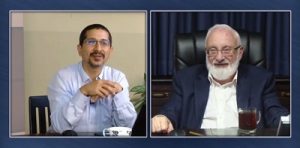
Dr. Michael Laitman in conversation with Oren Levi and NitzahMazoz

Children need to be encouraged to not harm anyone and that, if we preserve our environment and the integrality of nature, we will gain from it. We need to tell children the extent to which we are infinitely connected to nature and emphasize the unity between the forces of nature. We educate them by giving examples and then explaining.

We should first ruin as little as possible and then see how we can better our environment. We avoid doing unnecessary things and, by the mere fact that we don’t destroy anything, we already start building. Examining and determining my attitude to everything that happens in advance, from every angle, before we act, is what we need to learn from life.
[286838]
From KabTV’s “New Life 1317 – Educating For Global Awareness,” 8/29/21

icon for podpress Video: Play Now | Download
icon for podpress Audio: Play Now | Download

The Judicial System Needs To Be Destroyed

294.2

The Meaning of Ubuntu: “In certain regions of South Africa, when someone does something wrong, he/she is taken to the center of the village and for two days he/she is surrounded by his tribe, while they speak of all the good he/she has done. They believe that each person is good yet sometimes we make mistakes, which is really a cry for help. They unite in this ritual to encourage the person to reconnect with his true nature. The belief is that unity and affirmation have more power to change behavior than does shame and punishment. This is known as Ubuntu – humanity towards others.”

Question: How do you like this method of education?

Answer: This is a very powerful method. Imagine sitting for two days and listening to good things about yourself, knowing that they all know about what you did. It would be better if they beat you!

A man eats himself: “How could I do this?! This was their opinion of me! And what is their opinion of me now knowing what I have done?!” This is a double punishment.

Question: And why does humanity not adopt this? A practical primitive tribe, close to nature…

Answer: The primitive tribes were much higher than we are and they remain so.

They understand how a person can be encouraged and put in a good place, how to make him a normal member of society, and put him back in the right state. This is the only way, education by social influence.

Question: Why not adopt it? Give it a try.

Answer: We do not have such societies. Our society is purely egoistic; it is aimed only at censure, at suppression, even to the point of murder. Therefore, we cannot have such a thing.

Question: And how will the society of the future cope with this?

Answer: The society of the future is after correction! Of course, it will already have a different effect on people. But only through love, through the right communication, the right influence. To take a person inside yourself, to warm him inside, so that he feels the good influence of society.

Question: Are you talking about a criminal who has committed a crime?

Answer: Yes. And then he will feel what he can lose, and understand how others think well of him and want to place him among themselves, bail him out, and so on.

Question: But I don’t think well of him, do I? I hate him, is he a criminal?

Answer: No, then it will not work.

Comment: We are talking about a serious step for humanity. We should arrange expeditions there, to this society.

My Response: We won’t understand! Today’s society is not able to correctly perceive such an attitude of people to one another.

Question: What, then, is the future of our judicial system?

Answer: Our judicial system can take the only right step; it is to bury itself. I say this absolutely clearly, calmly, and steadily. This is not a judicial system. There is nothing worse in our society than judges and everything they have done.

Question: So they have ruined their own destinies, and the destinies of other people?

Answer: Absolutely everything!

Question: How can humanity get out of this?

Answer: Only by the correction that we are talking about. Put judges through the training and correction system, so that they do not think that if they have some book in their hands that was written by all sorts of clever people, then this book is infallible, and if they adhere to it, they can judge everyone.

Question: By what law should the corrected judges work?

Answer: The Torah is at the heart of the trial, the charter, and the legal provisions. And so we need to take it in its true form, try to understand it and start following it. Otherwise, nothing will work.

Question: When you say “Torah,” everyone pictures the book of Torah. What do you mean when you say the Torah is the basis?

Answer: Love your neighbor as yourself. This is the main law. And everything else comes from that.

Question: So this principle should be at the forefront of all of law for everyone?

Answer: Yes.

Question: Is it possible?

Answer: We will have to do it anyway. Only when? This is already a problem.

Question: And when, what do you think?

Answer: When we can understand what judges should be like. And we will not agree with the view that they represent today.
[281314]
From KabTV’s “News with Dr. Michael Laitman” 3/8/21

Related Material:
Prison Is Not What Reforms A Rapist
Reeducation In Ancient Times
Violence In Spirituality

Education According To Leo Tolstoy

566.01

“The fame of Tolstoy the novelist has to some extent obscured his writings on education, which were based on first-hand experience. Tolstoy’s ideas on education caused considerable controversy, which continues to rage to this day. …

“Tolstoy, at the age of 21, having opened a school on his ancestral estate at Yasnaya Polyana, made an attempt to begin teaching peasant children.

“Reading Tolstoy’s educational writings, one has an almost physical perception of a living child, presented not in a frozen photographic pose but in the manifestation and development of its individual characteristics, the unfolding of its personality and in mental states which fluctuate in accordance with the many and varied influences to which he or she is subject. …

“Tolstoy said that a child is by nature a perfect and innocent creature whose free development should not be hindered.” (“Leo Tolstoy,” Semion Filippovitch Yegorov, UNESCO: International Bureau of Education)

My Response: I do not agree. What is Individuality? Egoistic. It must be shaped correctly. Give the little person an appropriate form—altruistic. And leave the inner content.

Question: Does the little man have a personality?

Answer: Yes. We need to show him how to realize his individuality. To channel the talents given to him toward altruism.

Question: What is altruism for you when you speak about a small child?

Answer: When I do everything for the benefit of humanity. For the benefit of others.

“Leo Tolstoy,” Semion Filippovitch Yegorov: “The children were punished neither for their behaviour nor for poor progress. The requirement that the personality of pupils should be treated with respect presupposed that, without punishment or coercion on the part of the adults, they would move towards a recognition of the need to submit to the order on which success at school depended.”

My Response: As for the unlearned lessons, this does not interest me. And as for punishment is forbidden, if a person does not know the reward and punishment, then he will not correct himself, he will not straighten up.

He must see himself existing between reward and punishment. Nature was created in such a way and in such a way it controls us on the still, vegetative, and animate levels. And it should be so at the human level.

When I do not work for myself and act not for myself but for the sake of others, then I should receive a certain reward, which will first encourage me egoistically, and on the other hand, it will have to instill a desire in me to correct myself even beyond my comprehension.

Question: So you set this goal: life for the sake of others and work for the sake of others above everything?

Answer: For sure. And then from his actions, he will begin to understand that this is really the goal designed by nature, and so on.

Question: If this little man realizes that he is not moving toward this goal, then some kind of punishment should come?

Answer: He should at least feel that he is not encouraged.

“Writings on Education,” Introduction To Tolstoy’s Writings by Ernest J Simmons: “Tolstoy believed that all education should be free and voluntary. He supported the desire of the masses for education, but he denied that the government or any other authority had the right to force it upon them. The logic of things, and his study of the operation of compulsory education abroad, convinced him that in this form it was an evil. Pupils should come to learn of their own accord, for if education were a good, it would be found as necessary as the air they breathed. If people were antagonistic, then the will of the people should become the guiding factor. Tolstoy’s faith in the ‘will of the people,’ even though the people might oppose commonly accepted notions of progress, contained the seeds of his later anarchism, and was a direct slap at radical reformers who would uplift the masses against their will.”

My Response: In general, they should be encouraged to do this. But it is quite possible that there is a certain necessary knowledge that you just need to teach even by force.

After all, we consist of two levels, animate and human. What is required for the animate level to fulfill the correct existence in our world, we must teach by force.

Drive the necessary basic rules of behavior and communication skills into the new generation.

Question: Simple human communication in order not to offend another person, not to humiliate him? Are you hinting that this is the same thing and that it leads to connection?

Answer: Yes, of course to connection.

Question: You are not talking about nuclear science?

Answer: No, it doesn’t matter. This does not apply to upbringing.

“Leo Tolstoy,” Semion Filippovitch Yegorov: “In Tolstoy’s view, freedom in education was a gnoseological and moral principle that had to be put into practice; it was the antithesis of authoritarian teaching, and essential for a humane attitude to the pupil and respect for his or her dignity as a human being. Freedom in education was a principle that stemmed from the internal laws of cognitive activity. Cognition could not be other than free. In the absence of that condition, activity, initiative, consistency, system and all the other tenets of traditional, classical education were of no use, lacking meaning and purpose. The more firmly education was based on that law, the more successful and fruitful it was. Knowledge that had been assimilated could not simply be transmitted and could certainly not be thrust on pupils if they did not want it. Pupils had to apply their own efforts and engage in independent cognitive activity. This they could do best of all by not being forced by a teacher but guided by their own free will.”

Answer: This, of course, he dreamed up.

Fostering independence is necessary after a person realizes that he is obliged to exist together with others. Then it is already possible to continue thinking about giving them the makings of intelligent development.

Question: When he espoused not forcing children to obey strict rules,  do you disagree? In England, for example, it is different.

Answer: No, why? It depends on the level. Egoism must understand its limitations.

A child must understand that in these, these, and these cases I am in restriction and cannot afford to do what I want. Because I exist in society and I am obliged to comply with such and such rules, guidelines. This is a must.

Comment: Another principle of Tolstoy’s education pedagogy is to allow dissatisfaction. such that students can express their point of view and even criticize teachers.

My Response: I think this is absolutely wrong. Nowhere, in any system except the modern one, if you can call it a system, is there such a provision and it never has been in the entire history of mankind.

Question: Would you allow this kind of democracy?

Answer: This is not democracy. Democracy is when the opinion of the majority is really evaluated, brought into the system, and used by everyone because the possibly deeper layer of governance is in the awareness of the masses. But this is not the kind of democracy that we are talking about here.

“Leo Tolstoy,” Semion Filippovitch Yegorov: “Leo Tolstoy and the teachers at his school encouraged the pupils’ independence, developed their creative abilities and succeeded in getting the children to assimilate knowledge consciously and actively. With this aim in view, they frequently set compositions, particularly on topics of the pupil’s own choice which the children liked very much. In this, Tolstoy’s school saw one way of cultivating a creative personality, able subsequently to establish new forms of social relationship worthy of a civilized person.”

My Response: It depends on what technique we take. Will it be something that he invents and writes about or what we say in Kabbalah: teach according to the clear method of Kabbalah in order to come faster to creating a real person out of himself and to understanding of the entire system in which we exist, and so on.

Question: Does a clear-cut method already exist and should we follow it? Must a person follow this higher method?

Answer: He is required to do so. We have suffered enough already! Look back at our history and that is it! What is there to talk about?!

Comment: Another principle attributed to Tolstoy’s education system it to make your teaching clear. Instead of pure scientific terminology present the children with impressions.

My Response: It is possible that this should be done. You just need to understand how to tune yourself and them to one common feeling so that it is as if we were playing the same instrument together.

Comment: And another element is to live a good life yourself because children understand the world through the behavior of their parents and loved ones.

My Response: Show children by your own example how correct it is when one is constantly improving himself.

Question: And for the children to see it?

Answer: Yes, that is very important.
[284217]
From KabTV’s “News with Dr. Michael Laitman” 10/8/20

Related Material:
How To Raise Children
Educating A Man!
The Use Of Physical Punishment With Children

“Education For Global Awareness” (Linkedin)


My new article on Linkedin “Education for Global Awareness”

The integral reality where we are raising children today is very different from the one where we grew up. In order for them to thrive in an interconnected world, they must be conscious of how connected we are, and the sooner we begin to teach them this, the better.

We should explain to them that we are living on planet Earth, and show them what Earth is like. Not only its round shape, but the soil, the plants, the animals, and the people, and how we are all connected in one system.

Subsequently, we should tell them about our solar system, how the sun and the moon affect the Earth, how seasons change, and how natural forces shape our lives. We should also show them that when civilizations and nations are disconnected, they become hostile, and when they feel close, they help each other.

The main point we need to show is the union among all of nature’s forces in a single, integral mechanism, and how it influences us. We need to come to see that even if we are connected through a mobile device or a computer, and we are living in the virtual realm, we are still connected in the physical world, and not only to other people but to everything.

As a result, children will grow up knowing how important it is to nurture good connections with their surroundings—with the people around them and with all of nature. They will feel that if they do not care for the environment, both social and natural, it will mistreat them, too. That way, they won’t have to suffer the consequences of ignorance, as is happening to us today.

When we think of our treatment of others and of Earth more in terms of a relationship, it is easy to see that reciprocity is necessary. It is clear that a successful relationship requires consideration from all sides, and that the benefits of having friends and loved ones far outweigh the efforts. When we cannot see that we are all connected, we have no impetus to be considerate.

Unlike animals, who do not want to harm others intentionally, people are born with a built-in ill-will, as in, “The inclination of a man’s heart is evil from his youth.” Therefore, we cannot let children grow without cultivating reciprocity and mutual consideration, as is happening now. We must educate them, and educate ourselves to see the interconnectedness and interdependence of all things, and conduct ourselves accordingly.
[286872]

Voluntary Sterilization Will Not Help

49.01In the News (The Guardian): “Several Indian states are considering implementing a controversial two-child policy and incentivising sterilisation as a means of population control.

“The state of Uttar Pradesh, India’s most populous state with a population larger than Brazil, has announced draft legislation which would see anyone with more than two children denied state benefits, subsidies and government jobs. After a family has two children, there will also be incentives if one of the parents undergoes voluntary sterilisation.”

Question: Do you think such initiatives are correct?

Answer: We must not sterilize people like animals. People need to figure out themselves how to regulate the number of children they will have and why they do it.

Question: Are you suggesting a serious educational process?

Answer: Nothing will work without it, not laws or coercion, only creating a framework that a family would be proud of the fact that it brings up not a large number of children but rather special children.

Question: This revolution in thinking must take place by providing them with education?

Answer: Of course! And it will happen anyway. Otherwise, look at what kind of country it is! I was in India, I was in China, and I saw a big difference between people.

Question: Should it be carried out not by a bill on limiting the number of children, but by constant, structured education?

Answer: Yes.

Question: It is interesting that in Europe everything is the opposite, they have to subsidize families to have children. Yet, in countries like Africa and India, families must be subsidized to have fewer children. Why is this happening? What is this different way of thinking in people?

Answer: It is all based on religious beliefs and principles.

Question: Why does a highly educated person, let’s say, with three or four degrees, want fewer children?

Answer: He wants quality instead of quantity. He understands that the main thing is quality. He wants his descendants to be educated, to understand, know how, what, what they live for, create the right environment around them, and put their children on their feet in turn.

Question: And if people would voluntarily have many children and give them good education, is this a cultural feature? Do they do this consciously? Do you welcome this?

Answer: Of course.

Comment: Our people always had many children.

My Response: First of all, it was a small nation. Second, one did not replace the other. People were encouraged to have a large number of children, but every person, every child, at least every boy, had a teacher who educated him. The family has always been proud of the fact that its children, sons, as a rule, were educated. “Look how many pages he knows by heart!” And so on.

That is, it was like a highest ideal, a reward, approval. Everyone aspired for a child to become a sage.

They do not have that there.
[286417]
From KabTV’s “News with Dr. Michael Laitman” 7/15/21

Related Material:
The Global Elite Is Against People
“Loneliness Epidemic”
The End Of Family!

We Are Not Heirs But Debtors

742.03“We do not inherit the land from our ancestors, we borrow it from our children.” (Native American Proverb)

This should force you to prepare everything for the next generation. This is why you live in the present generation. We live to prepare the ground for the next generation. In every sense.

Question: Why don’t we feel this way? And we taint…

Answer: Our egoism obscures this elementary truth from us.
[286551]
From KabTV”s “News with Michael Laitman” 7/15/21

Related Material:
Between Two Epochs
Do Not Impose Оld World Values
Turn Your Heart To The Children

What Is Our Correction?

592.02Baal HaSulam, “Peace in the World“: This is the key to understand the weakness of world reformers throughout the generations. They regarded man as a machine that is not operating properly and needs mending, meaning to remove its broken parts and replace them with working ones.

The fact is that there is nothing faulty in a person and nothing needs to be changed in him. Everything was given to him by nature, so different negative attributes, and even the desire to kill, to rob, etc. were all given to him by the Creator.

The correction is not locking a person in jail or hanging him but integrating him in frameworks in which he can understand that he needs to correct his internality so that he would feel an impulse to connect to others above his most negative impulses regarding others.

A person needs to ascend to the next level without destroying his negative attributes, and he must acquire positive impulses instead of his negative impulses in relation to others.

When he displays his negative and positive impulses this way, he will begin to feel the spiritual state between them like between the negative and positive poles of the same field. Then he will begin to feel the upper world.
[251533]
From KabTV’s “Fundamentals of Kabbalah” 7/7/19

Related Material:
The “Compact” World After The Correction
The Correction Of The Sabbath
The Order Of Correction

Family And The Study Of Kabbalah

959Question: Is it necessary for a person who is on the spiritual path to marry or get married?

Answer: It is desirable for a man. It is not necessary for a woman.

Question: How does one understand that you are with the right person in the family? This refers to the husband and wife.

Answer: This is the person who does not interfere with your spiritual work, supports you in this, maybe even sympathizes and takes part himself.

Question: How can a couple who begins to study the science of Kabbalah unleash the potential of a child?

Answer: Sometimes talking about these topics in front of a child, giving him books from our Internet library and thus determining whether he is interested in Kabbalah. I think that something will interest him.

Question: So, a child, like an adult, has some kind of freedom of choice in this?

Answer: Of course. After all, no one forces him.

Question: Can we learn something from a child in our spiritual development?

Answer: Usually children give parents many such examples. So adults have this opportunity.
[286251]
From KabTV’s “Kabbalah Express” 7/19/21

Related Material:
Kabbalah Is For The Family
Kabbalah – The Method For The Elevation Of Man
The Family As The Center Of The Universe

New Life 1315 – Relations With Grownup Kids Who Have Left Home

New Life 1315 – Relations With Grownup Kids Who Have Left Home
Dr. Michael Laitman in conversation with Oren Levi and Nitzah Mazoz

A long time before kids leave home, we need to get them used to calling their parents once a day and visiting them weekly. It is important for the parents to share what they go through, to show that they care, to ask questions, and to set an example. The parents should prepare their children for the phase of leaving home and raise them to be independent.

Kids who have not received the right preparation for life will feel weak, and will find it hard to build themselves and establish a connection with a life partner. Parents should give their children a sense of security, guidance, and a feeling that we are always there for them.
[286254]
From KabTV’s “New Life 1315 – Relations With Grownup Kids Who Have Left Home,” 8/8/21

icon for podpress Video: Play Now | Download
icon for podpress Audio: Play Now | Download