
What Was Studying with RABASH Like?
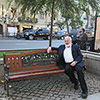 Question: You were always seeking the purpose of life. You were unsatisfied with this world. When you arrived in Israel, you found RABASH. What did you see?
Answer: It took me a while to get to RABASH. At first, I was introduced to people that I was told I could get answers to my questions from. I was asking about the meaning of life and searching for it.
I was sent to all kinds of religious figures who only told me to do this or that, to pray, and everything would be fine. But it did not suit me at all! I had a university education, and in general none of this was for me.
I got to RABASH by accident when, simply out of desperation, I decided to go with my friend to look for a teacher. We had been looking in different places before. But here I was struck by the fact that he began to explain what I was interested in, in simple words without relying on any dogmas or anything.
You can be a man or a woman, religious or not; you can be from any planet, no matter where. He would explain it the same way for everyone, because the truth is simple and the same for everyone! I was instantly bought.
Very clear, simple answers were given to any questions, which raised new questions and new answers. But it was all built, one might say, scientifically, although in front of me sat a man who did not have even a high school degree. But since he studied Kabbalah, he was well-versed in all my questions, and he always had the answers ready.
Question: What was going on in this small group of six people? How was it built?
Answer: At that time RABASH actually had six students who had studied under Baal HaSulam.
They had a very short conversation: “Let us sit down and study. No answers to your questions. There will be no end to them. You have to learn so that you can answer your own questions later.” There is no other way. Just like now with people who come to us, we can explain anything, answer however we want, but until they learn to answer themselves, nothing will happen.
All six elderly people had a very interesting attitude to life. They were not really interested in anything except Kabbalah. Otherwise, everything was very simple: plain food during meals, ordinary songs, etc. But the most important thing was that they had answers to questions that I, with all my education, could not have heard either from myself or others.
Question: You studied together, held meals and gathering of friends. How was it?
Answer: The lessons were held for us every day from three to six in the morning. In the evenings, there were one-and-a-half-hour lessons intended for all. They were attended by different people, not only those who studied in the morning.
We had meals for the new moon. The new moon is a special holiday for Kabbalists.
Question: Were there people responsible for the meals?
Answer: Yes, there were those responsible for everything.
Each month, a different person was appointed for the meals. After two months of studying, I said I was ready to organize a meal, i.e., to order, pay for, and set it up. Not six, but up to 60 people gathered for these meals.
Question: At what point did you feel you would teach?
Answer: I actually taught before that because sometimes I was invited to give talks at the Jewish Agency Sokhnut. I cannot say I was particularly attracted to it, but I did not mind; it inspired me. After all, if I teach, it means I have to prepare, study, and develop. It helped me study such things in Kabbalah that I would not have approached myself because I was not personally interested in them.
Question: Did you understand, purely selfishly, that you had to take everything from RABASH in order to pass it on? Did you have such a feeling?
Answer: Yes, absolutely. If you are sitting among six 70-year-old elders who say this science is about correcting the world and the world cannot exist without it, the question arises: who will continue to lead this science? It turned out that at that time, there was no one.
Therefore I immediately began to record everything I heard in a notebook and on a tape recorder. I could not stop thinking that I had to save all this and pass it on.
Before that, I had never heard the wisdom that I learned from them: the foundations of the world, the foundations of nature, and the interaction of its parts. It is nowhere to be found. That is why I immediately started writing everything down and organizing it.
Question: How did RABASH treat his students and outsiders?
Answer: RABASH liked to feel free, without revealing to anyone he was a great Kabbalist, an expert on nature and on the governance of the whole world. There was no indication of that. Outwardly he did not want to display anything.
He was surrounded by people who had worked all their lives at very simple jobs. RABASH himself worked laying roads, reinforcing concrete, and at construction sites; he carried stones, bricks, and laid walls. His students also worked hard, but in their old age they switched to easier work. In general, they did not want to stand out in the world; they did not need it.
Question: How did RABASH physically prepare for lessons?
Answer: I saw how, in his spare time, he went through the same material we studied in class. Lessons ended at six o’clock in the morning, and he would not even go to bed.
When I went to see him at nine in the morning to take him to the park or somewhere else, I often found him dozing on a book stand, with Talmud Eser Sefirot open in the place we studied. That is, he continued to study by himself.
Comment: RABASH’s group practically started with that revolutionary move when you brought 40 students to him. Despite the resistance of the religious town and religious relatives, he made this revolution; he accepted them.
And then he did something you did not expect from him. He started writing articles about the group.
My Response: The fact is that he started doing it at my request. When I brought the students, he asked me to talk to them. I did not know what to talk to them about. What can I tell them? Then he started writing, literally pieces, half a page, a page, etc.
Question: He wrote 20 articles that we are studying and will always study as we find more and more depth in them. Did he have any hope that the guys you brought would form a group?
Answer: Yes.
Question: But this hope did not really materialize?
Answer: He did not have much time. I brought people to him in 1983, and he died in 1991. Six years is a very short time for people to start interacting with each other properly. Of course, a living, true Kabbalistic group began to form, but it did not have time to fully form. It takes years.
Question: What happened after RABASH left?
Answer: Since I was always attached to him, not to the group, his death was a big blow to me. The source from which I grew and drank as from a spring was as if torn off.
The guys I brought to him were more or less connected to each other in different subgroups, as usually happens in groups of people united by circumstances or internal similarity.
But I had practically nothing to do with them.
Question: So your group was RABASH. Where did you, practically an individualist, later get the powerful desire to create a group? Where did you get the feeling this was the only advancement?
Answer: Because that is how it is. RABASH writes about it everywhere. He and I were also a group, two friends who constantly helped each other. This was a group. I cannot put it any other way. At least that is how he felt about it.
As for the other students, I think RABASH did not let me get close to them. It was probably enough for him that I was attached to him.
[256022]
From the 8th Lesson of the Congress in Moldova, 9/8/2019
Related Material:
In Him Is the Root of My Soul
Contact With Rabash
The Light of Rabash




Discussion | Share Feedback | Ask a question