Do Not Eat the “Unripe Fruit”

600.02Question: What is the spiritual community that we are currently like “unripe fruit”? On the other hand, you said that the task of each person today is to pull their “I” out of themselves and dissolve it into the members of the group.

Answer: Yes, a person must pull their “I” out of themselves and dissolve themselves in the group.

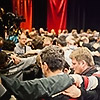
The group is a circle into which we try to throw ourselves, leaving our “I” outside the circle. We do this only in our inner efforts. We do not, under any circumstances, applying this to everyday life. We do not establish a common treasury, as in the kibbutzim or some other communal life; we do not try to create one common family, some kind of community in our world; this all relates to the problem of the last generation. God willing, we will approach it someday as well.

We are not building a Kabbalistic society, but a Kabbalistic group that engages only in inner efforts (each person within themselves) and in combining all these efforts with one another, in order to reach a critical mass and cause the revelation of the Creator, which will immediately raise us all to the next degree.

As soon as, at the next degree, we again reach a critical desire and prepare ourselves through our inner efforts for a common Kli, the Creator will immediately reveal Himself again, correct us again, and in this way, we will again be filled with Him at the next degree. And so it is every time. The method is practically the same at every degree.

We are not engaged now in correcting our lives. Each of us continues to live in their family, continues to work at their job. We only create our spiritual community, an invisible one, where our common desires, our aspirations toward the Creator, come together and cause a great surrounding light to act upon us. This is the only thing we are doing now.

But for this, if necessary, perform some joint actions. However, joint does not mean relating to all our everyday problems and way of life. What we do together is, for example, build a Sukkah, some work in dissemination, or create our common center, that is, everything that relates to the spiritual, but at the same time is some external shell of it.

This can be done, but nothing more. This is what it means not to eat the “unripe fruit,” not to climb onto the “Tree of Knowledge of Good and Evil.” We are not yet allowed to climb onto it, but later we will have to.

From this time onward, you will begin to see how much faster your development will go, and how much faster the states will begin to change one after another. You will see how what previously had to take months and years and was generally so difficult, somehow dragging along, will fly forward.
[362227]
From the Daily Kabbalah Lesson for the Holiday of Sukkot, 9/30/26

Related Material:
Equality Is A Basic Principle Of Nature
How To Build Equal Relations In Society?
Conditional Equality

Talks about the Steps of the Ladder, Part 255

Talks about the Steps of the Ladder, Part 255

Why Do the States Disappear and Return?

The discernments of Lishma and Lo Lishma toward the Creator and toward this world change each time according to the surrounding lights that descend upon us from the world of Atzilut. We exist in the world of Atzilut in potential, that is, in the corrected state, in the corrupted state, and in all the in-between states. The upper light that descends from Ein Sof through the world of Atzilut performs a kind of scan through all these states, from the lowest state, gradually, up to the highest state, to our roots in the world of Atzilut, and accordingly we receive changing surrounding lights. According to what the upper light passes through there, through our states in potential, we change here in actuality. We do not know how we are supposed to change, but we simply change.

After the barrier, in our initial acquisition of a screen, we begin to identify with, desire, understand, and recognize these changes. We even begin to anticipate them, and to such an extent that we already think in advance that we now want to do something, and indeed we do it. We begin to recognize the Creator’s thoughts and identify with them to such an extent that our thought and desire, and the Creator’s desire, unite. This is truly called “Lishma.”

In our present state, we certainly do not know how we change, but we need to believe that we change according to our root in the world of Atzilut. The pace depends on us, on our awareness, on our state, but the changes of states do not depend on us. Our awareness is what changes our inner sensation: we can feel that we are being struck, or we can feel that the blows are not really blows, but a force through which we enter correction. The restrictions can be pleasant if the goal stands before our eyes. This is how we are forcibly compressed into this “pipe,” but with joy that we attain something. Also, if we do not see the goal before us and we are compressed into some “pipe,” we experience it like death.

Therefore, our awareness, our own work, is to change our sensation from one extreme to the other regarding the very same action that is performed on us from above. However, as a result, it is not only our inner sensation of good or bad that changes, nor only the pace. The content changes as well. This is because, from these states we receive lights, and our world changes. It is difficult to explain the extent to which our own intelligent and independent participation in the work of correction, which we ourselves also desire, changes the entire picture. Even though the states that descend from above are predetermined, we determine everything below.

Related Material:
Talks about the Steps of the Ladder, Part 254
Talks about the Steps of the Ladder, Part 253
Talks about the Steps of the Ladder, Part 252

Daily Kabbalah Lesson – 10/13/26

Preparation to the Lesson

icon for podpress Video: Play Now | Download icon for podpress Audio: Play Now | Download

1st part of the Lesson — Writings of Rabash, Article 16, “Concerning Bestowal” (1984) (3.20.2003)

icon for podpress Video: Play Now | Download icon for podpress Audio: Play Now | Download

2nd part of the Lesson — Writings of Rabash, Record 24, “The Main Thing We Need”

icon for podpress Video: Play Now | Download icon for podpress Audio: Play Now | Download

Selected Highlights

icon for podpress Video: Play Now | Download icon for podpress Audio: Play Now | Download

Audio Version Of The Blog – 10/12/26

Listen to an Audio Version of the Blog
Download:MP3AudioAudio

The Holy Still Level of Development

294.3Humanity is gradually developing, and many people are emerging who want much more than what this life offers. But those whose desire is still within the framework of this world should simply do what is written, as everyone else does.

However, those whose desire is directed toward spirituality, who are no longer satisfied with this world, merely observing the Torah is insufficient; they require intention. For them, the action is the intention—a striking coupling with the light (Zivug de Hakaa). This is precisely what is called an action in Kabbalah. Thus, one is intended for the corporeal world while the other for the spiritual world, and one does not cancel the other.

What does it mean to strive for a spiritual action, for Zivug de Hakaa, which is called a commandment, and for receiving the light, which is called the Torah, the holy names? It is written that a person must attain the entire Torah, which is called “buying the Torah.” Buying means acquiring it through the surrounding light so that all the holy names, the entire revelation of the Creator become clothed within a person.

If you have an aspiration for this, you should engage in it. And if not, then study the Pentateuch, the Mishnah, and the Gemara; that is your Torah. The two paths are distinct; we must understand that they are separate from one another.

I learned from Rabash not to antagonize those whose desire remains within the confines of this world. They want to convince me that it is better to halt one’s development than to advance. That is true because “he who increases knowledge increases sorrow.” But they do not understand that it is impossible to stop development, that this world has a goal, and it evolves in accordance with that purpose.

They have a very strong connection with the Creator, which is why they are called the holy still level. But at what level is this connection? At the minimal inanimate level, when a person performs an action exactly as it is written, and nothing more.

This is called the “inanimate” level because a person does not develop: Just as he was taught at the age of their Bar Mitzvah to put on Tefillin and was told that from that age he is a Jew and must observe the commandments, so he continues until the end of his life. And here, nothing must be changed, neither taking away nor adding anything.

The inanimate level remains in the same state, does not change, and is irreversible. In this state, a person is connected with the Creator in a certain way; he continually does the same thing, and this is his measure of adhesion. Therefore, nothing can influence him, no matter what happens in the world: whether going into exile, returning from exile, enduring exterminations, whatever occurs. The “still” can withstand and pass through all of this. It has a foundation, a very strong point of adhesion, that does not change.

However, there is a great deficiency here; it cannot develop and cannot attain the goal of creation. But this point is very important, which is why Baal HaSulam always told his students to preserve this inanimate level within themselves.

Rabash talked about one of the Vizhnitz Hasidim who came to Baal HaSulam one day. At some point, he told Baal HaSulam that he wanted to follow his path, like a Gerrer Hasid, since Baal HaSulam wore the same type of clothing as the Gerrer Hasidim. Baal HaSulam replied: What difference does it make? All of this is purely external. On the contrary, you should preserve all your customs; remain a Vizhnitz Hasid and do what they do.

Why? If you enter a state of descent, you will not fall like an ordinary Jew from the marketplace; at least, you will fall like a Vizhnitz Hasid. And when you gradually begin to rise from the descent, you will still remain a Jew in some way. Therefore, it is important where a person falls. In other words, it is good to rise from the inanimate level of holiness because if you fall, then you fall back into it.

I am not going to abolish this upbringing because without it, the Jewish people would cease to exist.
[360189]
From the Daily Kabbalah Lesson 8/10/26, Rabash, “What Is the Gift that a Person Asks of the Creator?”

Related Material:
The Distinction Between Spiritual and Physical Actions
The Spiritual Inanimate Level
The “Holy Still” Level

Through the Direct Transmission of Feelings

284.06Everything we study in Kabbalah must be translated into an internal, sensory language. In mathematical terms, Behinot, Sefirot, Partzufim, we simply explain more precisely what is happening within us.

We must not imagine this as existing outside us; therefore, images and pictures are forbidden in Judaism. You know that for thousands of years, nothing was depicted.

In earlier times (during the tenth to fifteenth centuries), there were occasional engravings, but as a rule, there were no images. Why? This follows from the law: “Do not imagine anything existing outside you beyond your sensations.” Feelings cannot be depicted; they can only be recorded. And Kabbalists recorded them.

Therefore, the language should not confuse us. When reading the Torah, the Talmud, or Kabbalah, it does not matter in which language they are written, we must bring what we read inside ourselves and translate it into the language of feelings.

Then, beyond the Machsom, we will be able to communicate without language, through the direct transmission of feelings. This is called adhesion; it is achieved by aligning our corrected desires. No external language is needed then; everything is transmitted because a commonality exists: each person is not only within himself but is, to some degree, outside himself.

To the extent that we exist outside ourselves, we become included in the common field of communication known as the Creator. We understand one another completely, express ourselves to one another, and connect without any words.
[361971]
From the Daily Kabbalah Lesson 9/24/26, Sitrin Convention, Sukkot 2003

Related Material:
Kabbalah Is a Sensory Transmission of Information
The Language of Feelings
How To Convey The Knowledge Of The Spiritual World?

So that Spiritual Values Become Imprinted in Us

939.01Question: Where can I find the strength to work before the Machsom?

Answer: Only in the group. The group should give each of us an example of what should be. Therefore, we need to find a group that will transform us.

We cannot change ourselves on our own, but since we were once a collective Kli, despite the fact that we have become individualistic egoists, our root lies precisely in it. Therefore, whether we want it or not, whether we resist it or not, we will ultimately desire what this common Kli dictates to us.

No matter what kind of person you are, advertising, persuasion, and the opinion of the crowd will influence you, because our root is where we are connected to each other. Therefore, no matter how much of an egoist I am or how much I place myself above everyone else, I depend on the collective opinion. Every one of us does. We should make use of this fact.

This is the only aspect of free will that we possess. I now realize that the environment, through its opinion, can change any values in me, dictate my views regarding my entire life, the universe, convince me that dying is good and living is bad, or the opposite, or shape my perception of all of existence.

Therefore, I must organize society in such a way that it will dictate spiritual values to me, values that will be imprinted in me. The friends will convey this information in such a way that I will change, and nothing else will remain in me.

I will change in such a way that I will want to approach Machsom, I will want this Creator, who is now completely opposite to me, I will want to live in the upper world, although that life is completely opposite to the present, egoistic one. Such a re-evaluation of values can take place in me if the group I am in cultivates spiritual values within itself.

Therefore, the most important thing for us is to create such a group.
[361982]
From the Daily Kabbalah Lesson 9/24/26, Sitrin Convention, Sukkot 2003

Related Material:
How Can You Attain an Uplifted Spirit?
Orienting Toward the Goal
The Group Is a Means of Direction to the Goal

When the Awareness of Lishma Vanished

294.2Baal HaSulam clearly distinguishes between the general and the particular Torah. “The opinion of the Torah is opposite to the opinion of the masses,” and the two should not touch each other or interfere in each other’s affairs. We are talking about a completely different Torah, a different approach, a different spirit. The entire course of life for us differs from that of the masses.

Within ourselves, within our thoughts, within our intention, we are constantly tormented by questions: “At what stage am I? What is happening to me?” And so on. Everything for us is internalized. For them, the external part rules: a constant intensification of external actions. And this is good; it is necessary. As long as there is no inner part, we engage in the external. This form of education was introduced by the Kabbalists.

Baal HaSulam writes that the destruction of the First Temple did not have such an profound impact, but after the destruction of the Second Temple, the very concept of Lishma (for the sake of the Creator) vanished without a trace. The surrounding light withdrew, and the Temple was destroyed. The destruction of the Temple means that this illumination was no longer present among the people.

It is the same with us. Sometimes, from the material you absorb, you experience a spiritual ascent, when it seems to you that you sense the Creator, that you have, as if, come back to life and are floating in the heavens.

And then suddenly you feel like a complete fool who has nothing and does not understand a single word. And yet, you have a distant illumination showing you that, compared with a good state, your present state is bad. But what will happen if even this illumination is taken away from you?

That is what happened during the destruction of the Temple. With the destruction of the First Temple, the illumination that had existed among the people, that allowed people to feel they were in spirituality and gave them a sense of inspiration and connection, departed. This illumination disappeared but left them its reverse side, which gave them a feeling of at least some connection with spirituality, a feeling that spirituality exists.

By proceeding from the opposite, people at least knew what Lishma was. Instead of the light of Mochin de Haya, which shone from afar during the time of the First Temple, now, during the time of the Second Temple, the light of Mochin de Neshama came to them. It also shone from afar, but nevertheless, it shone.

And after the destruction of the Second Temple, people lost the feeling that their state was bad compared with the light, and awareness of the meaning of Lishma disappeared. They found themselves in the state of a donkey that knows nothing. Baal HaSulam writes about this in the book A Sages Fruit, in the article “The Essence of the Wisdom of Kabbalah.”
[360326]
From the Daily Kabbalah Lesson 8/12/26, Rabash, “One Should Always Sell Everything He Has and Marry a Wise Disciple’s Daughter”

Related Material:
Two Opposite Forms of Torah
How Does the Torah of the Masses Differ from the Torah of the Individual?
Two Levels of Observing the Torah

Talks about the Steps of the Ladder, Part 254

Talks about the Steps of the Ladder, Part 254

How Is the Desire for Spirituality Structured During the Time of Preparation?

The desire for spirituality during the time of preparation is divided into two desires: a desire to enjoy spirituality for personal benefit alone, and a very small desire to bring pleasure to the Creator. That is, 99 percent Lo Lishma and one percent Lishma.

Although the Lishma is not through a screen, there is nevertheless something of it. Also, everything is still at the expense of the upper one. The upper one holds us in a state in which we have no screen. If we had a screen, we could actually use the quality of the screen, but during the time of preparation it disappears, returns, and disappears again.

Related Material:
Talks about the Steps of the Ladder, Part 253
Talks about the Steps of the Ladder, Part 252
Talks about the Steps of the Ladder, Part 251

Daily Kabbalah Lesson – 10/12/26

Preparation to the Lesson

icon for podpress Video: Play Now | Download icon for podpress Audio: Play Now | Download

1st part of the Lesson — Writings of Rabash, Record 913, “His Law He Contemplates” (3.18.2003)

icon for podpress Video: Play Now | Download icon for podpress Audio: Play Now | Download

2nd part of the Lesson — Studying with Friends

icon for podpress Video: Play Now | Download icon for podpress Audio: Play Now | Download

Selected Highlights

icon for podpress Video: Play Now | Download icon for podpress Audio: Play Now | Download