Entries in the 'Books' Category

Lecture In Beijing


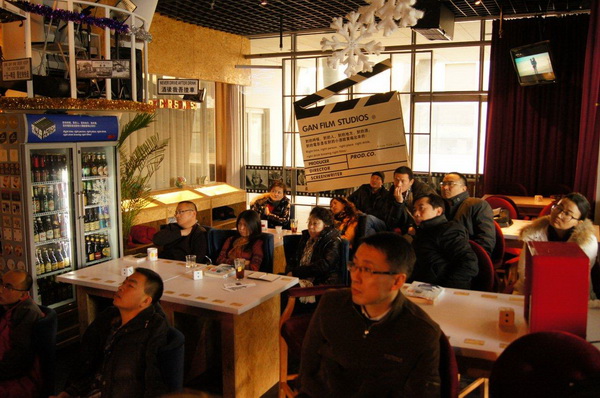
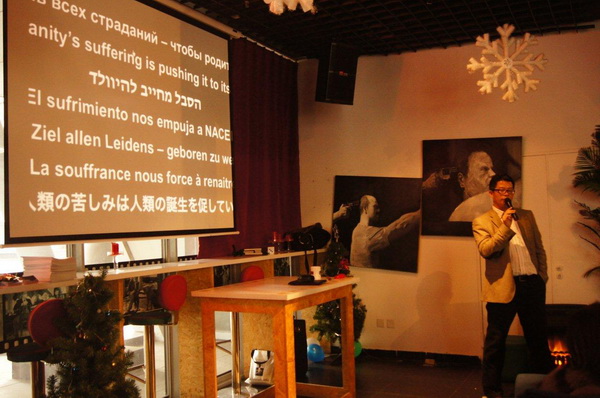
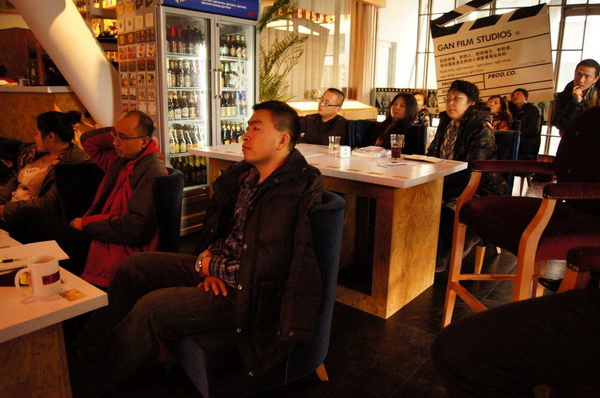
Our students in Beijing, China organized a lecture titled “Kabbalah and the Crisis.” More than twenty people attended the lecture, even though everyone was very busy with Chinese New Year preparations.

The lecture lasted for an hour and a half, and then the audience asked a lot of questions. All participants of the event received a gift: a new book in Chinese The Crisis: Do You Want to Know Why?

The next lecture will take place after the Chinese New Year.


[66718]

Comments On The Book, The Next 100 Years

Dr. Michael LaitmanI was asked to express my opinion on George Friedman’s book The Next 100 Years: A Forecast For The 21st Century.

My Comment: The book is written lightly, for a general audience. The entire book is based on the assumption that the world does not change and that nature has no program or goal to bring humanity to unity, by force or awareness. That is why it all comes down to “mechanical” thoughts about how to keep the US superiority in this predatory world.

It is impossible to argue with this because it is based on the author’s assumption that the world is ruled by the power of man. But if our world develops according to the laws of humanity’s similarity with the whole universe, at all its levels, then the law of social development will bring us to a society of mutual guarantee. This will happen in one of the two scenarios:

  • in disagreement with the need for human correction—through third and fourth world wars;
  • by realizing that there is no other alternative, and wars will solve nothing; that it is necessary to unite consciously so as to fulfill the law of nature in a good way and do it for our own wellbeing, quickly and without bloodshed.

This second method is proposed by Kabbalah.
[66521]

Related Material:
The Crisis Is Here For Our Own Good!
Stubbornness Always Has A Limit
The Blindness Of Egoism

The Science About Oneself

Dr. Michael LaitmanQuestion: What should I cling to during the reading of The Book of Zohar, to the group, the Creator, or Rabbi Shimon?

Answer: There is no Rabbi Shimon, no Creator, no group, no Light—nothing. There is an inner impression of a person who is divided into such terms.

I do not know what exists outside of me. I just know that there is something called “I,” and I do not know what it is. And this “I” is impressed by something. I do not know what impresses it either.

Thus, I am in a certain state called “my reality.” I need to investigate this reality now: Who I am and what do I feel? The science of Kabbalah talks about this: how to reveal this state.

We begin from here. This is called to “grasp the meaning of life.” We are talking not about our life on earth for several decades, but about attaining the very essence of reality in which I and what I feel are namely this presence in my first realization: “I” and “feel.”

The entire science of Kabbalah is intended for a person to reveal the true reality—what happens to you when you get a sense of what it is, what this imaginary world that you see presents, and in general, the entire reality, life and death, good and bad impressions.

Why do they come? In order for you to begin to form yourself: who you are, what you feel, how and so on—until you begin to discover the point of stability from which you will be able to watch and start to organize the whole reality. This is what the science of Kabbalah is.
[65066]
From the 2nd part of the Daily Kabbalah Lesson 1/2/12, The Zohar

Related Material:
The “Matrix” Of The Spiritual World
A Man Of The World
A Miracle Is A Revolution Of Perception

Ultrasensitive Sensor Of Surrounding Light

Dr. Michael LaitmanEverything depends only on the intention. Anyone can open a book and study—from a philosopher to a person who sees this book for the first time and doesn’t understand anything in it. But each one will interpret it in his own way, the way he wants to.

The difference between us and all the others: the clever and the stupid, the scientists, historians, philosophers, or kitchen maids, is that, when opening the book, we want to tune ourselves in such a way that will allow us to penetrate through it. I want this book to tell me about myself, I want to reveal my world inside it.

And external readers don’t do this; they cannot see behind printed letters, they seek human wisdom in this. And that’s why they perform all kinds of studies on these texts: what they talk about in terms of notions of our world, which historic events, which style they are written in—as far as the usual material mind can apprehend.

The difference between internal and external reading is your willingness to enter the text and reveal yourself, your inner life in it. But you can’t blame people for approaching these books externally (The Book of Zohar, the works of Ari and so on). Because an inner need to reveal the internal world hasn’t developed in them yet.

The point in the heart is not present yet, the starting point of the line of connection and the beginning of spiritual revelation. If you don’t have this desire, you can’t reveal it.

When you do have the first point, the surrounding Light can already stick to it. It still cannot enter it, it only surrounds it from all the sides, but because of this we already can’t be in a state of rest. We feel that we exist in a field of forces of the Light, which shakes and swings us.

If I don’t have this point, I don’t feel any field, Light or fluctuations and I feel like everything is fine. But as soon as the Light starts irritating this point, a problem appears and we proceed…. [Read more →]

ForeWord Magazine About The Book The Psychology Of The Integral Society


Favorable remarks about The Psychology of the Integral Society from a leading international book reviewer:

The book The Psychology of the Integral Society written by me and Anatoly Ulianov on the need of an integral and global education to solve the crisis, received very positive commentaries in the latest edition of ForeWord magazine, the 2nd most important book reviewer in the world.

ForeWord Reviews is a print magazine and online review service that influences the choices of readers, booksellers, book buyers, publishing insiders, and librarians. Its publication reaches an audience of 20,000; and the website receives a monthly average of 150,000 unique visitors.

The Psychology of the Integral Society explains the characteristics of an integral society in which all parts contribute to the well-being and success of the society. This one, in turn, is responsible and cares for the well-being and success of its elements, thus forming the only sustainable way to live.

ForeWord Reviews writes, “As a society, we spend so much time competing and trying to get a leg up that the concept of simply working together sounds groundbreaking in itself…”

Read the full review.
[64435]

Related Material:
A New Book: The Development Of Man From 0 To 20
Integral Education With No Sudden Movements
A Course On Harmonious Education

The Book In Zohar In The The Czech Language


A new book, The Book of Zohar, has been published in the Czech language (translation from Russian). The book was translated by the professors at the University of Prague Nikolaj Savický and Stanislava Savická with the participation of our friends from the Prague group.

In 2011, The Book of Zohar was published in Italy as well. In Brazil, The Zohar is planned to be published for the upcoming convention in May 2012.
[63958]


Light On The Surface Of A Page

Dr. Michael LaitmanQuestion: How was Abraham able to unite a nation back in his time if there was no Torah that united them yet?

Answer: The Torah is not a book or words, but the Light that reforms, the force that becomes revealed on the condition that we perform special actions. But all physical objects and words are just symbols.

The science of Kabbalah is called the true Torah, its inner part. But a Kabbalah book by itself is still not Kabbalah. A person can use it to gain the notion called the wisdom of Kabbalah. Everything depends on one’s approach: If he wants to use this wisdom for his own sake, then for him this is abstract information. But if he wants to use it to attain love for the neighbor, it is called Torah.

And this does not even depend on the book so much. Other books, such as the Talmud, Torah, and Psalms also contain the Light that reforms. But the Light contained in Kabbalistic books is closer to us, stands out more, and is much easier to extract. That is why we should use precisely these books.

By virtue of these books, even modern people like us who are small and confused, having no understanding, can imagine that we are coming closer to another state, to a different, new world. The author intentionally placed Light that is close to us into the book.

In contrast, the Light contained in other books, such as the Torah and Talmud, is contained deep inside. But in Kabbalistic books, it shines as if from the very surface since it is closest to you.
[59556]
From the 4th part of the Daily Kabbalah Lesson 11/2/11, “The Love for the Creator and Love for the Created Beings”

Related Material:
The Correct Attitude Toward Sacred Books
This Isn’t The Torah Yet
What Does It Mean To Study And Engage In The Torah?

The Book “The Brave New World Of Work”


Opinion: (Ulrich Beck, the author of The Brave New World of Work): “Those who kick up a fuss only about open unemployment fail to see the really new phenomenon that is drawing ‘ultramodern’ and ‘premodern’ countries closer together: namely, the replacement of standard with non-standard forms of work. Economic growth in today’s world-market conditions is rendering obsolete the idea of classical full employment, lifetime jobs and everything that went with them.

“It is precisely here that the civil labour model offers a key.”
[57542]

Frankfurt Book Fair 2011


Dear friends,

We need your thoughts for the success of our dissemination effort at the upcoming Frankfurt Book Fair. The fair takes place October 12-16, and over ten friends from across Europe are coming to help. At last year’s event we signed 10 foreign-rights contracts, and in 2011 we signed over 20.

Published in 2011: In Italy—three books, in Spain—two books, in Norway—one book, in Brazil—one book, in France—one book, in Germany—two books, in Macedonia—one book, in China—one book, in Sweden—two books, in South Korea—one book, in Slovenia—one book, and in Turkey—five books.

Please see some book covers below.

[57013]

Related Material:
New Book In Spanish – “Cabala Para No Iniciados”
Basic Concepts In Kabbalah – Now In Lithuanian
New Publications In Mexico

Connected: Christakis’ And Fowler’s Bestseller


Recommended: Connected: The Surprising Power of Our Social Networks and How They Shape Our Lives by  Nicholas A. Christakis, MD, PhD, professor at Harvard University,  named one of Time magazine’s 100 most influential people in the world in 2009, and James H. Fowler, PhD, an associate professor at the University of California).

From the Preface: “As we studied social networks more deeply, we began to think of them as a kind of human superorganism. They grow and evolve. All sorts of things flow and move within them. This superorganism has its own structure and a function, and we became obsessed with understanding both.

“Seeing ourselves as part of a superorganism allows us to understand our actions, choices, and experiences in a new light. If we are affected by our embeddedness in social networks and influenced by others who are closely or distantly tied to us, we necessarily lose some power over our own decisions. Such a loss of control can provoke especially strong reactions when people discover that their neighbors or even strangers can influence behaviors and outcomes that have moral overtones and social repercussions. But the flip side of this realization is that people can transcend themselves and their own limitations. In this book, we argue that our interconnection is not only a natural and necessary part of our lives but also a force for good. Just as brains can do things that no single neuron can do, so can social networks do things that no single person can do.

“For decades, even centuries, serious human concerns, such as whether a person will live or die, be rich or poor, or act justly or unjustly, have been reduced to a debate about individual versus collective responsibility. Scientists, philosophers, and others who study society have generally divided into two camps: those who think individuals are in control of their destinies, and those who believe that social forces (ranging from a lack of good public education to the presence of a corrupt government) are responsible for what happens to us.

“However, we think that a third factor is missing from this debate. Given our research and our own diverse experiences in life—from meeting our spouses to meeting each other, from caring for terminally ill patients to building latrines in poor villages—we believe that our connections to other people matter most, and that by linking the study of individuals to the study of groups, the science of social networks can explain a lot about human experience. This book focuses on our ties to others and how they affect emotions, sex, health, politics, money, evolution, and technology. But most of all it is about what makes us uniquely human. To know who we are, we must understand how we are connected.”
[56802]

Related Material:
Nicholas Christakis: The Hidden Influence Of Social Networks
The Net That Caught Every 12th Person In The World
This Has Never Happened Before