Entries in the 'Zohar' Category

One On One With the Mafia’s Attorney

I had a conversation that was recorded with Israel’s leading criminal attorney, Sasi Gez.

Sasi was born and grew up in the country’s most criminal neighborhood – Pardes-Katz, but by a “lucky chance,” instead of learning to steal, be a pimp or a drug dealer, he became the defense attorney for his childhood friends. His “happy childhood” (mostly blood mixed with snot) turned him into a “mafia’s attorney” – a recognized criminal defense attorney of the state. It was amazing to see his “Don Corleone” manners, and to find out how much “the cops and the thieves” can have in common.

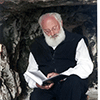
Sasi wrote a very thick book on criminal law. (In the picture above, it lies next to him on the table; and beside it, the somewhat more modest looking Book of Zohar with my commentary.) Sasi’s close work with his childhood friends and acquaintances (who include leaders of the underground business) and his ability to defend them in court have turned him into one of the most influential people in all social circles. It gave me great pleasure to meet a classic hero – the mafia’s attorney, face to face.

On his end, Sasi completely agreed with the fact that man in our world has no freedom of will, and that our world lacks the means to educate and reeducate people. He agreed that Kabbalah can help do this.

Related Material:
Laitman.com Post: Corporeality Has No Effect on Spirituality
Kabbalah Today Article: Spiritual Education
Article: Why Kabbalah? Why Now?

Which Books Should One Read to Learn Kabbalah?

Which Books Should One Read to Learn Kabbalah?A question I received: I am 25 years old and I live in Brazil. I read your book Cabala: Alcançando Mundos Superiores in Portuguese, and felt a deep desire to learn more about Kabbalah in order to become a good servant of the Creator. I don’t know exactly which book I should read now. I am debating between the Torah and The Book of Zohar. In your opinion, which of the two books should I read next?

My Answer: The only books you should read are the books of Baal HaSulam. Additionally, in the beginning you can read our books, since they explain Baal HaSulam. Once you gain a precise understanding of what is Kabbalah from these books, then you will be able to read any other book without straying from the right path to the Creator.

Baal HaSulam wrote about this in many texts. He says that the difficulty of explaining Kabbalah, the difficult examples, and the non-systematic presentation were the main reasons why Kabbalah was misunderstood by the masses.

If you can only read Portuguese, then your choice of books is rather limited. If you can read in other languages, then I advise you to visit our website and see what’s recommended there for beginners – whether it is books, lessons, talks, and so on.

Related Material:
Laitman.com Post: Advice for Beginners – Find the Answers Inside Yourself
Laitman.com Post: By Developing One’s Desires, Kabbalah Also Develops One’s Mind

Don’t Get Lost In All the Angels

Don\'t Get Lost In All the Angels A question I received: What are angels and other spiritual creatures mentioned in the Torah?

My Answer: All Kabbalistic books mention Ofanim, Hayot, and Kruvim. It says in The Zohar (Beresheet, item 77, page 81): “Ofanim are angels of the World of Assiya, Hayot are angels of the World of Yetzira, and Kruvim are angels of the World of Beria.” They all represent a small Light (Vak de Hochma) in each world, and they depend on the human souls. For example, when a person corrects himself, then Kruvim face each other, as it says in the Torah.

There are also spiritual forces that are referred to as lion, ox, eagle, and man; they correspond to Sefirot Netzah, Hod, Yesod, and Malchut. In addition, Kabbalistic books sometimes refer to different levels in the spiritual worlds by the words South (Hochma), North (Bina), East (Zeir Anpin), and West (Malchut). And there are many other terms.

All of this speaks only about the state of the Light in the Kelim (desires) according to the law of equivalence between them – to the degree that the Light and Kli share the property of bestowal, which is attained through our efforts. Instead of getting lost in all these names, I advise you to start using Kabbalistic (scientific, physical) terms, such as Sefirot, Olamot, Masachim, Partzufim, Reshimot, Orot, and etc. After all, no matter how you look at it, not one word in Kabbalah speaks about our world. All the confusion only wears a person out and takes him away from the goal.

Related Material:
Laitman.com Post: Angels in Kabbalah
Laitman.com Post: Demons, Spirits, Angels, Devils – Do they Exist?
The Concise Dictionary of Kabbalistic Terms

Can a Gentile Study Kabbalah?

Can a Gentile Study Kabbalah?A question I received: I’m Jewish. Can I study Kabbalah together with gentiles – people who aren’t Jewish by birth? The Book of Zohar says that every person who teaches even one letter of the Torah to a gentile is responsible for the destruction of the world, and that a gentile who wants to learn must first convert to Judaism. What should I do?

My Answer: “Jew” comes from the word “Ever,” to cross, so a Jew is a person who has crossed the Machsom. Israel is a person who has the intention of “Yashar-El,” “straight to the Creator.” “Yuhudi” comes from the word “Ihud,” meaning “union” (with the Creator). All these notions are properties of love, bestowal, or altruism.

Goy” (gentile) means “a nation” in Hebrew. This word isn’t offensive; it only underlines the uncorrected, egoistic degree. In the Torah or Kabbalah, “Goy” (gentile) refers to egoism, and Jew, Israel, or Hebrew refer to love and bestowal.

We all start out as gentiles – uncorrected. When we choose the spiritual goal and begin the correction (even while we still haven’t attained it), we become Israel (Isra-El, straight to the Creator). Next, when we cross the Machsom, we become Jewish. And when we attain the goal – union with the Creator, we become Hebrew.

We all came out of Babylon, we are all egoists, and we must all correct ourselves and become like the Creator. When a gentile (an egoist) studies Torah (Kabbalah) for his own sake, he is only harming himself. One should study Torah (Kabbalah) only in order to attain spirituality, the property of bestowal. Hence, you should study with the people who have this goal!

In addition, you should ask: can you and should you study the Torah (Kabbalah) with yourself? Maybe you are a gentile (in your intentions and aspirations)? First you should check whether you want to become like the Creator and attain “love for your neighbor.” If yes, then you can study Kabbalah, because this is the only correction Kabbalah makes to a person. However, if you have a different goal – for your own sake, then you are a gentile, and Torah (Kabbalah) isn’t for you. It is written: “A gentile who studies the Torah must die,” because he attracts Light and thereby becomes even more opposite to It. This is how a person kills the gentile within him. It’s written that the entire Torah is the rule, “Love thy neighbor as thyself.”

Conclusion: Everyone should study Kabbalah regardless of their intention! If they have the intention of a gentile, then they will kill the gentile within them and go from “for one’s own sake” to “for the sake of the Creator.”

Related Material:
Laitman.com Post: Kabbalah Is for the Whole World
What Is Kabbalah?
Kabbalah Today Article: “Permission to Reveal”

What to Ask for At a Kabbalist’s Grave

What to Ask for At the Grave of a KabbalistQuestions I received on whether one should visit the graves of the righteous, and what to ask for at these sites:

Question: I want to visit the graves of the righteous on Mount Miron. The trip I’m interested in going on will be held at night, and the trip’s organizer said that according to Kabbalah, you can use the moon’s cycle to calculate what is the best time to ask to be cured from illness. However, I also heard another opinion from someone who studies Kabbalah – he said that this shouldn’t be done. I would like to find out whether it can be done, and why at night?

My Answer: No one ever visits graves at night. The one exception is the night of Lag BaOmer, when people light bonfires all over Israel, including Mount Miron, by the grave of Rashbi, the author of The Book of Zohar. This is an ancient custom. However, asking to be cured from illness when there is a full moon has nothing to do with Kabbalah, but only with mysticism and shamanism.

Rabash and I used to go to Tiberius for two days out of the week, and sometimes we visited the grave of Rashbi on Mount Miron. Rabash respected that place. However, he didn’t see it as a place to ask for people’s corporeal, egoistic problems to be solved, such as healing, but rather only as a place to ask for similarity to the Creator. When one is there, he should ask for the ability to love his neighbor, instead of being concerned with one’s animate body, with healing it, or other benefits.

By definition, Kabbalah is the method of revealing the Creator (the property of love and bestowal) to a person in this world (in this life). Kabbalah bears no relation to receiving something for oneself. (See the definition in the article “The Essence of the Wisdom of Kabbalah.”)

Between the years 1979 and 1991, when I knew Rabash, he visited the Wailing Wall only once – in 1983. He just walked past the wall, at least 2-3 meters away from it, and didn’t even come close to it, not to mention touching it. He visited the grave of the Ari once in ten years.

Baal HaSulam once said that he really doesn’t care where they’ll bury the bag with his bones. When he passed away and his students didn’t know where to bury him, one student remembered that Baal HaSulam used to like walking on a specific hill, and that’s where they buried him.

Once I asked Rabash for permission to fix up Baal HaSulam’s grave – to whiten it, make a place for candles, and so on. Rabash told me to leave this to others, because there were more important things to do.  Rabash also didn’t prepare a burial place for himself, even though it’s a custom among the religious. (In the past bodies weren’t buried, but locked in a cave that was dug for this purpose. They were left there for some time, and when only the bones remained, they were placed into a vessel.)

Kabbalists do not respect anything corporeal. Every person respects what is important to him, and what he is attached to – the body or the soul. To a Kabbalist, the body is intended to do work, just like an animal (for example, cattle). All his attention is focused on developing the soul – the part of the Creator in man, the property of love and bestowal.

Question: Rashbi is buried on Mount Miron, and thousands of people visit his grave every year. Is this something the Creator instructed them to do, or do these instructions come from religious leaders who want to influence people and have power over them?

My Answer: Kabbalah favors this custom, because it brings people closer to Kabbalah, making them respect it and become interested in it.

Related Material:
Laitman.com Post: Only the Upper Light Can Change Our Destiny
Laitman.com Post: Love Thy Neighbor as Thyself
Laitman.com Post: Always With Me
Laitman.com Post: Corporeality Has No Effect On Spirituality
Baal HaSulam Article: The Essence of the Wisdom of Kabbalah

How Can We Overcome Fear?

How Can We Overcome Fear?Two questions I received on overcoming our fears:
Question: In one of your lessons on the book Shamati you spoke about fear, and you said that when a person is afraid, he should immediately connect to the Creator. Can you elaborate on this? What should I do when I feel chilled to the bone with worry about my loved ones?

My Answer: You should connect everything that is happening with the Creator, with yourself, and with the entire world, so that all of these will unite into one and there won’t be any difference between them. All of your doubts and fears should vanish within this union. And if they don’t – then it’s even better! Then you can ask the Creator to help you.

Actually, if you open The Book of Zohar , you’ll discover that the first correction, “Pkuda Kadma” (in Aramaic) is when one attains true fear. In fact, fear always haunts everyone and everything: On the still level of nature, there is fear to preserve its structure, on the vegetative and animate levels of nature, there is fear to become filled with what’s necessary and to push away what’s harmful. And it’s the same with man.

The only difference between different kinds of fear is the scope of one’s use of fear. That is to say, one uses it more to the extent that one realizes its depth within him, or in other words, to the extent of one’s egoistic development. An ordinary person in this world has two types of fear: fear for this world (about his quality of living, health, children, etc.) and fear for the world to come (to make sure he will go to heaven instead of hell).

However, as one’s egoism develops, one goes through all these types of fear and reaches a third kind – true fear. He then asks, “Will I be able to become like the Creator? Will I attain the property of love and bestowal for other people and for Him?” And when a person feels the need to attain this property of love and bestowal, then fear pushes him forward and brings him to the Machsom, and he makes “a return to the Creator out of fear (or agitation, trepidation)” (Tshuva mi Iraa).

Question: Can studying Kabbalah help one get rid of his fears, for example, the fear of being on stage or of expressing one’s opinion?

My Answer: Yes, because studying Kabbalah develops your perception of the unity of everything, of the integral universe. It also replaces one’s earthly fears with the true fear – the need to attain the Creator.

Related Material:
Laitman.com Post: Kabbalah – the Cure for Any Affliction
Shamati #38: The Fear of God is His Treasure
Shamati #138: About Fear that Sometimes Comes Upon a Person

How to Read The Book of Zohar

How to Read the Book of ZoharTwo questions I received on how to read and relate to The Book of Zohar:
Question: I am trying to study The Book of Zohar that you translated. I’ve reread many times the part where you talk about how to relate to the material in order to go deeper into the inner part of it – but so far it’s not working. I don’t feel like I’m advancing, and I think that I lack definitions, the way things are clearly defined in the Talmud Eser Sefirot. Do these definitions exist, and if yes, where can I find them? Or is there another, special approach to The Book of Zohar?

My Answer: The Book of Zohar should be read only in order to evoke the Light of correction onto yourself. To the degree the Light will influence you, you will begin to perceive the Zohar (which means Radiance). And to the extent that you’ll feel the Light, the property of bestowal, you will also begin understanding what The Book of Zohar says.

In addition, there are four introductions to The Book of Zohar, and it’s necessary to know them (or to have at least general knowledge of them) in order to understand the book.

Question: Recently I made the decision that I will read The Book of Zohar. During Book Week I bought the full set. However, I spoke to a person who told me that religious authorities have put a curse on this set of books, and this set of books is “impure.”

My Answer: You can go ahead and read these books, but this is only recommended for people who have studied all the works of Baal HaSulam. In addition, there are four introductions to The Book of Zohar, and it’s impossible to understand The Book of Zohar without thoroughly understanding these introductions!

Related Material:
5 Things You Should Know About the Zohar
Study The Zohar
Introduction to the Book of Zohar
Preface to the Book of Zohar
A Speech in Celebration of the Conclusion of The Zohar

Kabbalists Aren’t Interested In History

Kabbalists Aren\'t Interested In HistoryA question I received: In Tel Aviv, Yaffo, in the district Neve-Tzedek, there is a synagogue called “Marot HaSulam” (מראות הסולם), although unfortunately, it is in ruins. Can you please explain its name? Is it related to Baal HaSulam’s Perush HaSulam (The Ladder Commentary on the Book of Zohar)? I know that some commentaries on The Book of Zohar were written in this synagogue. The synagogue was founded in 1910, and Baal HaSulam wrote his Perush HaSulam in 1940. Did he write it in this synagogue?

My Answer: Baal HaSulam was forced to move from Jerusalem to Yaffo to get away from his opponents. He lived there and attended this synagogue. Then he moved to Tel Aviv, to a neighborhood near Rothchild Street.

Just like my teacher Rabash, Baal HaSulam’s oldest son, I was never interested in history, but only in ascending from our world to the Upper World. People who are attracted to history and what happens to the body are not attracted higher – to spirituality. Personally, I don’t feel any interest in this place. However, it would be nice to turn it into a museum about Baal HaSulam, into a place that explains Kabbalah to people!

Related Material:
Laitman.com Post: Stop Thinking about the Past!
Laitman.com Post: A Kabbalah Museum – Can There Be Such a Thing?
Kabbalah Today Article: Yehuda Leib HaLevi Ashlag (Baal HaSulam) – 1884-1954
5 Things You Should Know About the Zohar
About Rabbi Yehuda Ashlag (Baal HaSulam)

Kabbalah Teaches Love and Bestowal, and Nothing Else

Kabbalah Teaches Love and Bestowal, and Nothing ElseTwo questions I received on whether spiritual correction requires observance of physical rituals:

Question: You say that it’s possible to attain spiritual correction without physically observing the commandments of Judaism. Maybe you’re just saying this out of your concern for Kabbalah’s dissemination around the world? Or maybe what you really mean is that people can’t understand these commandments by simply reading them? If you can’t publish the answer on the blog, I would like to receive a private answer.

My Answer:
The Creator created the will to receive pleasure with an intention “for one’s own sake,” and this is how we find ourselves in this world. We were created this way in order to correct our intention to “for the sake of the neighbor or the Creator,” on all of our 613 desires. This correction happens under the influence of the Upper Light, Ohr Makif, which descends during the study of Kabbalah.

This bears no relation to the observance of religious rituals. A person can attain correction and spiritual attainment without physically observing the commandments, or rather – the traditions. This is true for both Jews and the nations of the world. Moreover, every person can keep his religion, because religion is no more than a nation’s cultural framework. Kabbalah only teaches us about the intention “for the sake of the neighbor,” how to love and bestow to others – and nothing else.

Question:
You’re all about spirituality and the love revolution. But what about connecting the root with the branch? After all, the still, vegetative, and animate levels are also levels of the will to receive. You always speak about the internality without any externality, and this confuses me. Baal HaSulam writes at the end of the “Introduction to the Book of Zohar” that the internality should be preferred over the externality. But it looks like Bnei Baruch gives 100% of their attention to the internality, and 0% to the externality! This is difficult and confusing. Why not make a small change and pay a little more attention to the externality? Why not combine both parts? Dedicate 90% of your attention to the internality, and 10% to the externality. This will really help everyone! What do you think?

My Answer: We at Bnei Baruch actually do this – we follow the traditions. But do you really think that all the people in the world – who are now approaching correction – have to observe the physical commandments of Judaism, even if it isn’t their tradition? In the article “The Future Generation” Baal HaSulam writes that every person can keep his religion!

Related Material:
Laitman.com Post: Religion and Kabbalah Are Opposite
Laitman.com Post: Look Forward, Only Forward
Laitman.com Post: The Peace (Baal HaSulam)
Laitman.com Post: Intention Is Action

Between the Lines – A Talk About Words and Letters


I had a conversation that was recorded titled “Between the Lines,” about words and letters. I spoke with:

Dr. Maxim Sokolov – an otolaryngologist specializing in voice and speech,

Shlomi Buhana – a doctorate student at Bar Ilan University,

Ben-Tzion Gertz – a writer and the host of the program.

Language or speech is what separates humans from animals. Our throat is a special organ where all the forces of the body and soul come together. The five parts of the lungs supply air through the vocal chords into the five parts of the mouth, and the latter divides all sounds into five groups. A letter’s sound corresponds to its outline, numerical value (Gematria), and the section of the brain that sends out commands to the vocal apparatus. And all this happens according to the five parts of creation and the four-letter name of the Creator. In short, there is still a lot more to talk about!

Related Material:
The Letters By Rabbi Amnon Saba – a Chapter from The Book of Zohar
An Essay about Letters, from the “Preface to the Book of Zohar”
The Secret of the Letters, Lesson 1: A Letter. What Is It?
The Secret of the Letters, Lesson 2: The Shape of the Letters
The Secret of the Letters, Lesson 3: Whoever Changes His Name Changes His Luck
The Secret of the Letters, Lesson 4: To Build the World with Letters