Audio Version Of The Blog – 10/15/19
Posted on October 15th, 2019 at 9:55 pm
Listen to an Audio Version of the Blog
Download:MP3 Audio

Listen to an Audio Version of the Blog
Download:MP3 Audio
 From My Facebook Page Michael Laitman 10/15/19
1,000 Square Meters of Love: The World’s Largest Sukkah!
The world’s largest Sukkah can be found on the roof of Kabbalah.Info in Petach Tikva. The giant thatch spreads over 1,000 square meters, and is built according to the guidelines of Kabbalist Yehuda Ashlag (a.k.a. Baal HaSulam).
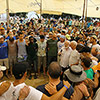
Hundreds of people from Israel and around the world gather every evening in our Sukkah to celebrate together under one roof. Over 10,000 people will celebrate in the “World’s Largest Sukkah” throughout this holiday.
Thousands of miles may stand between our hearts as everyone is stuck in their own worldview, but once a year we come together and a thatch of peace covers all our differences, revealing the beauty and splendor of the connections between us.
Happy Holiday!
Lesson Preparation
| [media 1] | [media 2] |
Lesson on the Topic “Sukkot”
| [media 3] | [media 4] |
Lesson on the Topic “Preparation to the Europe Convention”
| [media 5] | [media 6] |
Lesson Preparation
| [media 1] | [media 2] |
Lesson on the Topic “Sukkot”
| [media 3] | [media 4] |
Lesson on the Topic “Preparation to the Europe Convention”
| [media 5] | [media 6] |
Listen to an Audio Version of the Blog
Download:MP3 Audio
From My Facebook Page Michael Laitman 10/13/19
On Sukkot, we are commanded to dwell in temporary dwelling.
Temporary dwelling means that it is built from things we consider unimportant.
The things our ego cannot appreciate are the things that build our inner thatch. The inner thatch covers and protects us from our own ego.

The Times of Israel published my new article “Sukkot 2019: How to Reconstruct Our Jewish Home”
Synagogues across the globe are shutting down their doors for good. Demographic changes, financial problems, assimilation, and lack of interest in Jewish life among younger people, as well as the feeling of insecurity due to anti-Semitic attacks, are among the major factors that contribute to this phenomena. But there is a deeper cause to the declining membership and its consequences for communities: the lack of cohesion and sense of a common home among the Jewish people as a whole. The festival of Sukkot, during which we celebrate unity and hospitality with those closest to us is an invitation to reshape our destiny and reflect on building a common sukkah where all Jews can be united as one and with them the entire world.
The Jewish festivities this year face a new reality. Once vibrant Jewish communities around the world have seen their membership significantly reduced. For instance, the community in Nice, once the fourth largest in France with around 20,000 members, has decreased to a mere 3,000. Similar situations can be found in Jewish congregations in Boston, New York and the Midwest, all due to dwindling membership.
“Jews exhibit lower levels of religious commitment than the U.S. general public” among whom, only 26% said religion is “very important,” in comparison to 56% of non-Jews, according to American research organizations. The studies also show a gap between Jewish attendance at synagogue services compared with other denominations: “Jews report attending religious services at much lower rates than do other religious groups. 6-in-10 Christians (62%) say they attend religious services at least once or twice a month (compared with 29% of Jews),” revealed the survey.
I am not surprised. After WWII, the sense of belonging and the need for communal association thrived among Jews, but nowadays there is basically nothing to hold a community together. In a generation where everything is disposable and anything can be acquired, independence has become more highly valued than ever before and calculations for community trail accordingly. One may ask, “Why should we be part of a community and identify as being Jewish? What do I get out of it?” “Nothing, and perhaps the opposite,” would be the probable response. In fact, Jewish life essentially has little or no meaning if we do not ask life’s most significant questions, such as “Why do I exist?” and “What does it mean to be Jewish?”
The word “Jew”—“Yehudi” in Hebrew—stems from the word “unity”—“Yichud.” Our purpose as Jews is to reach a state of unity among each other and to share it with the nations of the world, i.e. to be “a light unto the nations.” However, in order to attain such a lofty goal, we need to first rise above our egoistic nature, that is, to transform our attributes of self-concern and self-indulgence into concern and care for others.
How does this relate to the Sukkot holiday? This festival is precisely a call to exit our comfortable egoistic “home,” meaning our self-love, and to build a new structure, a sukkah, the symbol of the new world that we can create if we acquire the quality of bestowal, the quality of love for others.
Sukkot symbolizes the beautiful process of inner change where we take the “waste of barn and winery,” items that, according to the wisdom of Kabbalah, represent the quality of love for others that are now mingled and immersed within our egoistic thoughts of self-concern, and raise such attributes like a roof, high above our heads. We construct a cover for the ego and, day by day, during the week of Sukkot, perform additional clarifications about the qualities that contribute to altruism and ask for our correction. Then, symbolically, the light that sifts through through the thatch roof transforms our previous egoistic qualities into a new state where we recognize love and connection with others as life’s most important values.
The true meaning of Sukkot is to build a new reality of mutual understanding and support—a sukkah of peace, so that the entire Jewish people and the whole world can gather beneath that big thatch of covering and be united as one. When this comes to pass, the temporary home of the sukkah will be transformed into a temple, a common place in our hearts, and not merely a physical structure.
I wish you all a joyful and peaceful holiday!
The true meaning of the holiday of Sukkot is to build a “Sukkah of Peace” so that the entire world will gather beneath this big thatch covering, where we will be united as one.
 Happy New Year!
The period from the beginning of the year (Rosh Hashanah) to the Day of Atonement (Yom Kippur) is called “terrible days.” Yet, in fact, it all depends on our perception. Even the most mournful days such as Tisha B’Av, which symbolizes the historical tragic events that happened to the Jewish people in the past, will in the future become the best days.
Therefore, everything depends on a person’s perception. If one lives in the past, as many people do because they know nothing about the future, then these are terrible days for him or her. However, the wisdom of Kabbalah, which is completely oriented toward the future, tells about these days as the most beautiful and good ones. The new year (Rosh Hashanah) is the beginning of good changes.
The period of repentance that precedes the beginning of the new year is necessary to recognize our evil nature, which we must correct. The most suitable time for correction is approaching, thanks to which we come to good.
Rosh Hashanah is followed by the Day of Atonement (Yom Kippur) when a person judges himself, clarifying how he can reach the degree of the Creator, the state of the upper force, the best state possible. He checks what he must correct in order to reach this corrected and elevated state.
As a result, the holiday of Sukkot comes. After all the clarifications and requests for correction, we begin to build a soul. The Sukkah symbolizes the common soul of Adam HaRishon we all are parts of. If we gather together under the roof of the Sukkah, under one cover, covering all crimes with love, then we reveal the joy of the Torah (Simchat Torah). We are so united together that the upper light, called the Torah, fills us and brings us to correction.
These days are called “terrible,” but their menace comes from their greatness. As it is written about the Creator that He is “great, mighty, and awesome,” but this is not from a threat but from worshiping His greatness.
Before Rosh Hashanah it is customary to wish each other a happy new year and a good entry in the nook of life. However, of utmost importance is the understanding that if we unite, covering all crimes with love, this year will indeed be good for us. We should reach such a connection not just once a year before the holiday, but every day, day by day becoming spiritually closer to each other until we feel such a heartfelt connection as if we were one man with one heart.
Then we will feel the upper force, the common nature that fills our common heart. This is what really will be a good new year.
From KabTV’s “The World. Jewish holidays” 9/26/19
Related Material:
Rosh HaShanah Is The Birthday Of Adam
15 Rosh Hashana Insights
What Does Rosh Hashana Symbolize?
 Baal HaSulam, “The Freedom”: Therefore, the collective is obliged to meticulously guard all the views of the few, so they will not perish from the world. This is because they must know for certain, in complete confidence, that the truer and more developed views are never in the hands of the collective in authority, but rather in the hands of the weakest, that is, in the hands of the indistinguishable minority.
Question: Why should everyone express their opinion when we sit in circles?
Answer: Until everyone fully realizes themselves in the connection between us, we cannot reach similarity with the Creator and build a group where the Creator will be revealed.
The group is a tool. We must calibrate it. As we turn the knob on a radio, tuning it to a certain wave, we must in the same way turn all the members of the group so they would connect with one another, and in their unity, the mutual, common integral force will manifest. This will be the Creator. Therefore, everyone’s participation is very important. Each one individually is very important as well.
[252983]
From KabTV’s “Fundamentals of Kabbalah” 12/25/18
Related Material:
Workshop: Hear Everyone
Accumulative Clarification
Collective Wisdom
 Daily Audio Version-MP3
 Get the Weekly eNewsletter
 Follow on Twitter

