Entries in the 'kabbalist' Category

Why Does a Kabbalist Wear a Skullcap?

Why Does a Kabbalist Wear a Skullcap?A question I received: You insist that a person studying Kabbalah shouldn’t make any external changes in his regular life, and that he should be concerned just with the inner work. In addition, you speak exclusively to the secular audience. So why does everyone in Bnei Baruch in Israel, where all your lessons are broadcast from, wear skullcaps? After all, for a secular person this is a dramatic change in outer appearance.
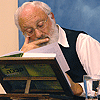
My Answer: As long as society hasn’t reached a complete understanding of what is Kabbalah and what is religion, we must be acceptable to the entire society. And the society, even a secular one, thinks that a Kabbalist has to look religious and wear a skullcap. In addition, this is a tradition, part of the Israeli nation’s culture, its custom, and this is why we observe it in Israel. Of course, it completely doesn’t matter what I wear around my animate body, but to people who are still uncorrected, such an external aspect also makes a difference.

Who Can I Talk to About Kabbalah?

Who Can I Talk to About Kabbalah?Two questions I received about sharing Kabbalah with others

Question: In response to a question, you said “Don’t talk about Kabbalah to anyone except the people you study with.” But then how should we push people to Kabbalah? I feel that if I don’t remind certain people about this topic or give them hints, then they’ll never even find out that such a thing exists, at least not in this reincarnation.

My Answer: You can give them a “hint” but no more than that, and don’t push. You should be especially careful with the people you have constant contact with. It’s better if others will talk to them about Kabbalah. Keep your relationships with them regular, on the level of this world.

Question: Can a student without spiritual attainment rely on his direct intellectual understanding of Baal HaSulam’s works? I’ve been listening to the Bnei Baruch lessons and reading Talmud Eser Sefirot almost every day for over a year now. Every time I feel that I understand something I read, I have a strong desire to share it with other students. Can I write about the things I understand and give it to others to read? Or can I only give it to people who have spiritual attainment?

My Answer: You can, but don’t overload others. Do it only for making contacts. After all, by doing so you won’t be studying the main material, the Kabbalist’s thoughts, but your own thoughts.

Love Thy Neighbor as Thyself

Love Thy Neighbor as ThyselfTwo questions I received on bestowing upon one’s neighbor

Question: I’ ve been studying with you, and I just don’t have the words to express my gratitude. It’s as if you take each of us by the hand and lead us to realize where we are. With your help, I’ve merited attaining a small but unmistakable glow, and working together with you.

I’d like to ask you the following: Suppose that I receive for the sake of bestowal, and the more I enjoy, the more I bestow. Or in other words, the more Light I reveal with the intention, the more I bestow. If I want to pass the Light on to my neighbor, and the Light has to go through me, through the Guf of my Partzuf, to my neighbor, so that more Light will be revealed in him than in me, then in order for this to happen, do I have to reveal more Light in the Guf of my Partzuf, or can it also happen without me revealing it, since I don’t want anything for myself except correction?

My Answer: Everything will happen automatically if you will think (and accordingly act) about everyone’s connection together into one Partzuf, and you desire and act for it to be filled, like the Creator. In this case, this Partzuf becomes filled with Light. And then you’ll perceive not only the Light of fulfillment, but also the pleasure of those whom you have fulfilled. The latter is a different kind of Light. It’s like a mother who perceives her children’s fulfillment, rather than what she fulfills them with. However, the Light that you pass to them also fulfills you, as it is written: “Every person who asks for his neighbor, receives first.”

Question: Suppose that a person has started perceiving the influence of the Upper Light and how to bring his neighbor to the same perception using the simplest words and notions – is this possible? If yes, then wouldn’t he be stealing his neighbor’s individual attainment? After all, he’s making the task easier for him, since the main thing is to start perceiving?

My Answer: It is written in the Torah: “Go and earn from one another” – all of us together need to adapt the harmony of the common mechanism of Adam, the common soul. By oneself, a person can never attain even a single spiritual state. It’s because, in essence, all of them are an even greater connection between the souls, the restoration of our breaking of the single soul of Adam into billions of pieces or souls. And everything has been prepared for you by the Kabbalists and by your friends. You’ve arrived when everything has already been prepared for you. Maybe you don’t feel it, but the entire world has been prepared for you by all the previous generations, and then you appeared in it as a baby. It is written: “Love thy neighbor as thyself,” and this is how you should act, in order to help others in the same way that you want to be helped. However, you shouldn’t do this coercively, but the way you would treat a child – show them the sources, introduce them to the foundations, and then leave it to them to understand themselves, their path, and Kabbalah.

Related Material:
Laitman.com Post: Let There Be Light
Laitman.com Post: Practical Advice by Rabash
Laitman.com Post: On Love
Laitman.com Post: Love of Friends, Love of the Creator

How to Use Kabbalistic Source Texts

All Kabbalistic Sources Discuss SpiritualityTwo questions I received on Kabbalistic texts
Question: I understand that Kabbalah is focused on changing life. But I can’t find instructions on how to integrate all the other fundamental texts, such as Humash, Mishnah, Talmud, Halachot, and others. How do you use them? Do we even need them? And how do we put it all into perspective?

My Answer: Once you learn Kabbalah, then when you will read other sources you will begin to understand that they all speak about spirituality or the Creator alone. That is to say, they are also Kabbalah, only written in a different style! For example, right now I posted an abbreviated translation of the Torah weekly chapter. Why? Because in this book, the greatest Kabbalist of all times, Moses, describes the ascent of man’s soul along the 125 steps of the ladder of similarity to the Creator. We must now realize this ascent – all of us together and each one of us individually – uniting more and more on every level, so that at the end of the ascent, we will become the single soul of Adam. No other source explains about this path so precisely and in so much detail!

The Zohar is a commentary on the Torah. Our next step is to gradually start studying The Book of Zohar through this blog, and then we will begin to see what was really passed down to us in the Torah. Then, after the Torah (Humash), we will also be able to learn Mishnah, Talmud, and Halachot in this manner. All of these books only speak about the correction of man, his soul, or the egoistic desire – Yetzer Ra – that was created by the Creator. And after that, the Torah (Tavlin) was given, only for its correction. Those who don’t feel egoism within themselves don’t study the Torah. They read an “empty” text instead of the text that Moshe gave them. You will be able to correctly “integrate” all of these books only after you properly attune yourself to using holy books (holiness is something that brings you to the property of holiness – love and bestowal).

Question: When I studied Kabbalah in college, a book titled Sefer HaBahir was mentioned many times, but you don’t mention this book on your website or at your lessons. Did this book ever exist?

My Answer: Yes, the book Sefer HaBahir exists. However, we mainly study the works of Baal HaSulam, who was the last Kabbalist and therefore is the most suitable for the correction of our souls. In addition to his works, we also study the works of Rabash, Ramchal, and Tanach.

Related Material:
Kabbalah Today Article: How to Study Kabbalah
Kabbalah Sources
5 Things You Should Know About The Zohar

Be Happy about the Descents!

Be Happy about the Descents!Questions I received on descents in the spiritual path
Question: “There isn’t a righteous man who hasn’t sinned.” What happens between the levels, when one is in a descent and everything one had attained – the Light and the Creator – falls into the Klipot? How can one live with this difficult feeling?

My Answer: As Baal HaSulam writes in the book Pri Hacham (Letters), one needs to be happy about a descent, because it is the revelation of your uncorrected properties.
And if the evil is being revealed in you, this means that you already have the strength, the understanding, and the ability to correct such properties and rise above them to the next degree. Therefore, there’s no reason to feel down even during the greatest descent! The greatest punishment is for you to become disconnected from the Creator in your thoughts and sensations.

Question: On the spiritual path, how can I overcome the state when I feel lack of energy? You know what your purpose in the world is, and you try to connect what’s happening to the Creator, but you still don’t have energy to do anything, you can’t cope with the corporeal world and you simply can’t do anything at all, like you’re trying to disappear and not feel anything…

My Answer: There are many states like this and they are very diverse. It’s in our power to accelerate the speed at which we go through them, but it is impossible to cancel them, and you shouldn’t ever think that they are unnecessary. They are all inside you and have to manifest, and you must justify their manifestation and rise above them. How? You should realize that everything you perceive comes from the Creator, because “there is none else besides Him.” And everything is done for your own good, because “The Creator is good and does good.” The best way to practically, correctly and quickly incorporate this within you is to participate in the group and disseminate.

Question: I have different problems, and I don’t know whether they are psychological or a consequence of studying Kabbalah. What would you advise me to do?

My Answer: If people have psychological problems (mental illnesses), then usually they aren’t allowed to study Kabbalah, or they may study under a doctor’s supervision and a special attitude from us. But if you are mentally healthy, then the only thing that can help you is to increase your studies. It’s because every ascent is preceded by a descent, and you shouldn’t miss the descent, but ascend through it, with an effort, elevating the greatness of the goal and the certainty that the Light of studying will elevate you.

Related Material:
Laitman.com Post: Problems in the Beginning
Laitman.com Post: It’s Impossible for a Kabbalist to be Dull and Somber
Laitman.com Post: Why Does a Person Get Beaten?
Shamati Article #1: There Is None Else Beside Him
Shamati Article #50: Two States
Shamati Article #196: A Grip for the Externals
eBook: Shamati (I Heard)
Purchase the Book: Shamati (I Heard)

Kabbalah Today Publication – 15th Issue

Kabbalah Today Publication - 15th IssueThe 15th issue of the Kabbalah Today publication is now available.

* View eVersion
* Download PDF Version
* Download Word Version

Editor’s Note
Shedding Spiritual Light on Modern Crises

Read Article >>>

Mankind’s Growing Hunger
The current food crisis has been declared a ‘silent tsunami’ in recent headlines. Kabbalah explains the root of the problem, and shows us how to avert this growing threat.
Read Article >>>

The Gatekeeper
Who is the guard standing at the entrance to the spiritual world who decides who shall enter and who shall not? A journey following Kafka, Baal Hasulam, two parables, and one gate.
Read Article >>>

Education, Relationships, Angels and the 72 Names of God
Kabbalist Michael Laitman answers questions on his weekly live TV show, “Ask the Kabbalist” and on his personal blog – www.laitman.com
Read Article >>>

Global Warming: So What?
With the abundant information available to the mass public today, everyone knows about global warming and climate change. But as it turns out, knowing and caring do not always go hand in hand.
Read Article >>>

From Racial Rifts to Spiritual Harmony
Why were we all created different? So far, this seems to have brought us nothing but schisms. Kabbalah explains how to put the pieces together.
Read Article >>>

The Story of Cogwheels
This is a story about all of us – about children and parents, about where we came from, how we got here, and how we will return Home – to a place called “The Single Soul.”
Read Article >>>

Opening Our Eyes
All of reality is a single, unchanging thought of bestowal and giving. Kabbalists refer to this thought by the name, “The Thought of Creation.”
Read Article >>>

Conscious Acceleration Toward Life’s Purpose

Conscious Acceleration Toward the Purpose of CreationA question I received: I have been reading and watching different Kabbalistic materials over the course of this past year. Sometimes I’m very interested in Kabbalah, and other times I get too busy doing daily things and searching for pleasure. Over this period of time I gradually started feeling that something is happening inside of me. I became sadder and less satisfied. But some time ago, my life and my previous sensations have completed the changes they were going through. I have experienced a loss, and suddenly my heart started hurting so bad that I didn’t know where to hide from this pain. I realized that there is nothing else in this world that could satisfy me. For the first time in my life I started to desire studying Kabbalah with passion. I started watching the beginners’ course over the internet. The first lesson was like heaven to me. I don’t know why I was feeling so incredibly well while watching it. My heart still hurts every time I don’t watch lessons.

My Answer: There is one path for everybody, and nobody can choose another path. There’s an opportunity to take the path toward the goal of creation consciously, while others go against their will, and with a much slower speed. A person following the conscious path also experiences plenty of sadness and stress, but everything depends on the environment. One needs to close one’s eyes and give himself fully to the environment. Everyday there are more unhappy and devastated people in the world. Just imagine that you’re going to the same place that they are, and that the only difference is that they are walking, while you’re flying past them in parallel on an escalator. The fast changes in your mood, thoughts, and inner life happen because of the increase in your speed relative to others.

Related Material:
Chapter 6 from the Book Basic Concepts in Kabbalah: The Essence and Purpose of Kabbalah
Article: Attainment of Unity of the Universe
Article: Kabbalah as a Root of All Sciences
Article: Matter and Form in the Science of Kabbalah

You Have to Know How to Ask

You Have to Know How to AskThree questions I received on requesting from the Creator

Question: Does one pray to G-d or to the Creator? You have said that it’s written that the Creator hears no prayer other than to be able to bestow, because He is the quality of bestowal and this is the only thing you can ask of Him. And what about the “kibbutsnikim” in the Negev?

My Answer: Back then the desires of the “kibbutsnikim” and the Creator were the same. But in general, the Creator hears everything and everyone, but He reacts only to that which leads to the goal, to Him, to adhesion with Him. And He definitely hears and reacts to one’s requests for correction, for equivalence with Him. The Creator is a system of forces surrounding us. The Creator (Elokim) = Nature (HaTeva). We need to understand that He does not change His goal and action – at every single moment, everything is directed at reacting to our actions, in order to influence each and every person in such a way that they will be directed precisely toward the goal. This is how the Creator – this system of forces – reacts to our desires, thoughts, and actions. This is why Kabbalah says that He does not change. In other words, He does not change His influence on us, which directs us precisely to the goal.

Question: About the “kibbutsnikim” who asked for rain: How is it possible that they received something just by asking for it? I’ve asked for things a thousand times, and the most I received was a reason to regret the fact that I asked.

My Answer: Their requests did not contradict the Creator’s plans to have people settle in these lands. They were (egoistically) united with each other as one whole. They asked for the necessity and gave it everything they had. And it worked temporarily. But when they lost the desire to be united, they became opposite to the system of governing forces, and the Upper Forces evoked their disintegration.

Question: As I understand, a prayer is a person’s deepest and most real desire. So why is there is a custom to pray at certain times rather than when one feels like it? After all, one receives a response only to a real prayer. And what does prayer give a person, in principle?

My Answer: Religion does not deal with correcting the soul – changing one’s intention from “for the sake of oneself” to “for the sake of others and the Creator” in all of one’s actions, but rather it only trains one to make physical actions – the commandments of our world. Therefore, in religion to pray is to read at specific times something that was written for you by other people (by the sages of the Great Assembly, 2,000 years ago). One does not receive a response to such actions, and we see that religious people do not become corrected, but vice versa – as time goes by, their moral descent is becoming more and more apparent. However, such mechanical actions hold people within certain boundaries, and as such, during the period of the Creator’s concealment (from 0 until the 20th century), the religions had the role of providing life’s boundaries. This was established by Kabbalists, to last until our time, when “the point in the heart” surfaces in people and they begin the path of individual spiritual development.

Related Material:
Kabbalah Today Article: A Prayer
Article: The Difference Between Kabbalah and Religion
Chapter 7.1 from the Book The Path of Kabbalah: Prayer
Baal HaSulam Article: There Is None Else Beside Him

Where’s My Place in Kabbalah?

Where\'s My Place in KabbalahThree questions I received on fitting ourselves into the the spiritual puzzle
Question: I am a bisexual man, and I always play the men’s role in my relationships with men. But in general, since I became interested in Kabbalah, I’ve lost almost all interest in both men and women. Can I study in a group?

My Answer: Please write to us describing how you view men in general when you are next to them for an extended period of time, when you study together, work together, travel together, drink together and hug each other, sing and dance together with men. What do you feel when men look at you and hug you? Once you respond, we will examine your situation further.

Question: I’ve never felt as bad as I do now. I want to change for the better, but the state I’ve been in for three days already is unbearable and horrible, ranging from the question “What’s all this for? Why do I live?” to “I don’t want to go on living.” I have Kabbalistic books, music, and lessons, and without them I wouldn’t be able to continue. But I don’t want my life to be based on the feeling that I’m being lowered into an abyss of my own dirt, and I’m trying to break out of it!

My Answer: There is nothing besides a person and the Creator – so turn to Him. Your appeal to the Creator will be more effective if you make actions of studying in a group and disseminating.

Question: Every soul is a piece of the general puzzle. Men collect their pieces together to form a Kli. When one person loses the connection and falls out of the general system, then there’s a “hole in the boat,” there’s no Light. This seems clear enough. But how does the female soul fit into this puzzle? I feel like I just don’t belong.

My Answer: This female feeling of being defective (not according to Freud, but according to Kabbalah) will accompany you (as well as all the men who are correcting their Malchut) throughout the entire path until the end of correction. You receive the Light from above through the global men’s group, the same way every man does. And just like the men, you insert your piece of the puzzle, your soul, into the common soul of Adam! You are the same as the men in every way, except for the fact that they attract the Light. The men (the male parts of the common soul) unwillingly accept your desires, and they go out to hunt and to work, in order to attract the Upper Light for everyone.

Kabbalah – For When Life Is Like Putting Out One Fire After Another

Kabbalah - For When Life Is Like Putting Out One Fire After AnotherA question I received: My whole life is like putting out one fire after the next! Bad things just keep happening to me, and I feel like all I’m doing in my life is trying to live through them and keep surviving. Why is this happening to me? And what should I do with these situations? I want to point out that I’m not really interested in the question “What’s the meaning of my life?,” that I’m more interested in the question, “Why is this happening to me?”

My Answer: They are the same question. It’s as Baal HaSulam writes, in item 2 of the “Introduction to Talmud Eser Sefirot“: “What’s the meaning of this suffering?” and “Who needs it?” Studying Kabbalah will help you understand everything. Why precisely Kabbalah? It’s because Kabbalah is the only wisdom that explains the one source of everything in existence. At the moment, you are experiencing this source in its negative, but you can change the way it treats you.

Again, the Creator is the one and only source of everything happening to you, because He governs everything in existence. By studying Kabbalah, you can discover the reason why He treats you the way He does at every single moment. Your question about the meaning and source of suffering is a Kabbalistic one: it marks the beginning of one’s discernment of oneself as a human being, i.e. as one who begins their relationship with the Creator.

Related Material:
Kabbalah Today Article: A New Direction
What Is the Meaning of Life? – Rav Michael Laitman, PhD Talks about the Wisdom of Kabbalah
Article: Who Am I?
Lesson: Introduction to Talmud Eser Sefirot (12-10-2007)